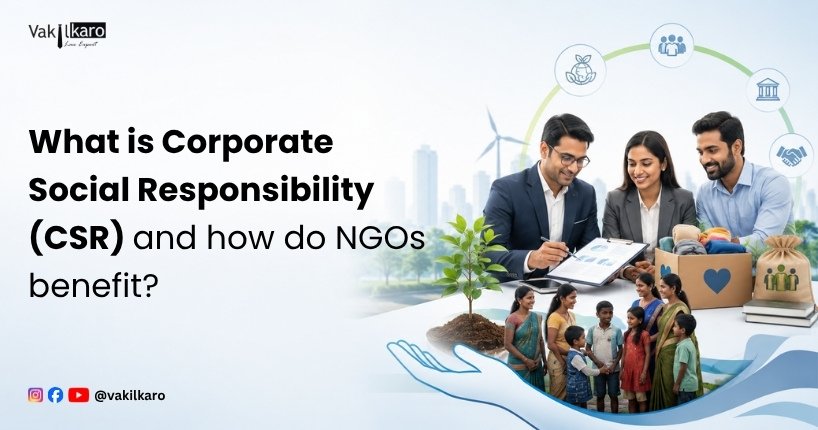
Corporate Social Responsibility (CSR) reflects a company’s commitment to ethical practices and inclusive growth. In India, CSR is a legal requirement under the Companies Act, 2013, mandating eligible companies to invest a portion of profits in social and environmental initiatives. NGOs play a vital role in executing these programs, acting as a bridge between corporates and communities. To qualify for CSR funding, NGOs must obtain key certifications like Section 8 company registration, NGO registration, and 12A and 80G registrations. These not only boost credibility but also unlock funding opportunities and tax benefits essential for sustainability and impactful service delivery.
Key Takeaways
- The Role of CSR in Strengthening NGOs and Enabling Social Impact Corporate Social Responsibility (CSR) has emerged as a powerful tool for driving ethical business practices and promoting inclusive growth.
- Introduction Corporate Social Responsibility (CSR) has evolved into a vital cornerstone of modern business practices, symbolizing a company’s dedication to ethical conduct, sustainability, and community welfare.
- Understanding Corporate Social Responsibility (CSR) CSR refers to a company's responsibility to conduct its business in an ethical manner, considering its social, economic, and environmental impact.
- By aligning their objectives with corporate missions and adopting best practices in governance, impact reporting, and stakeholder engagement, NGOs can transform CSR from a financial transaction into a powerful catalyst for sustainable social change.
- Why Choose Vakilkaro for CSR and Other Legal Services Vakilkaro stands out as a trusted partner for NGOs and businesses alike seeking expert assistance in navigating the complexities of Corporate Social Responsibility (CSR) compliance and other legal services.
The Role of CSR in Strengthening NGOs and Enabling Social Impact
Corporate Social Responsibility (CSR) has emerged as a powerful tool for driving ethical business practices and promoting inclusive growth. In India, CSR is not merely a voluntary contribution but a statutory obligation for companies that meet certain financial thresholds, as per the Companies Act, 2013. These companies are required to dedicate at least 2% of their average net profits from the preceding three financial years to CSR initiatives. This legal mandate has created vast opportunities for collaboration between corporate entities and Non-Governmental Organizations (NGOs).
NGOs play an essential role in the successful implementation of CSR initiatives. With their grassroots presence, community engagement, and deep knowledge of social issues, NGOs serve as effective channels through which companies can fulfill their CSR commitments. However, to become eligible and credible partners for CSR collaborations, NGOs must meet specific legal and compliance requirements.
Key among these is obtaining proper registrations such as Section 8 company registration, NGO registration, and tax-related approvals under Sections 12A and 80G of the Income Tax Act. A Section 8 company is a special form of nonprofit organization registered under the Companies Act that reinvests its profits to achieve charitable objectives. This legal structure is often preferred by corporate donors due to its transparency and accountability.
Moreover, 12A registration exempts the NGO’s income from taxation, while 80G registration allows donors to claim tax deductions on their contributions. These registrations not only establish the organization’s legitimacy but also make it more attractive to CSR-focused donors.
By securing these certifications and aligning their operations with compliance requirements, NGOs can unlock access to long-term CSR funding. This enables them to scale their programs, build organizational capacity, and contribute meaningfully to social development across sectors like education, healthcare, sustainability, and empowerment.
Corporate Social Responsibility (CSR) has evolved into a vital cornerstone of modern business practices, symbolizing a company’s dedication to ethical conduct, sustainability, and community welfare. In today’s business environment, CSR is not just a moral obligation but also a strategic priority that enhances a company's brand image, stakeholder trust, and long-term viability. In India, CSR holds even greater significance due to its legal mandate under the Companies Act, 2013. According to Section 135 of the Act, companies that meet specified financial thresholds—such as a net worth of ₹500 crore or more, or turnover of ₹1,000 crore or more, or net profit of ₹5 crore or more—are legally bound to spend at least 2% of their average net profits from the preceding three years on CSR activities. This legislation has institutionalized CSR as a core part of corporate governance in India.
The spectrum of CSR activities is broad, encompassing areas such as education, healthcare, environmental conservation, livelihood enhancement, gender equality, and rural development. However, executing these initiatives effectively on the ground requires expertise, community presence, and long-term engagement—capabilities that most corporate entities may lack. This is where Non-Governmental Organizations (NGOs) play a crucial role. With their specialized knowledge, grassroots networks, and focus on social outcomes, NGOs serve as essential partners in translating corporate CSR commitments into meaningful, measurable impact.
To become eligible and credible collaborators for CSR projects, NGOs must comply with various regulatory norms and obtain specific registrations. Key among these are Section 8 company registration under the Companies Act, NGO registration under relevant state or central laws, and tax exemptions under Sections 12A and 80G of the Income Tax Act, 1961. These certifications not only improve the NGO’s credibility and transparency but also make them more attractive to corporate donors by offering tax benefits and legal assurance. In essence, proper registration and compliance form the foundation for building strong, trust-based CSR partnerships that drive sustainable social development.
Understanding Corporate Social Responsibility (CSR)
CSR refers to a company's responsibility to conduct its business in an ethical manner, considering its social, economic, and environmental impact. In India, Section 135 of the Companies Act, 2013, mandates that companies meeting certain financial thresholds must spend at least 2% of their average net profits from the preceding three years on CSR activities. These activities encompass a wide range of initiatives, including poverty alleviation, education, gender equality, environmental sustainability, and more.
The Role of NGOs in CSR Implementation
NGOs are instrumental in executing CSR projects due to their grassroots presence, expertise in social issues, and ability to mobilize communities. They act as implementing agencies, translating corporate funds into tangible developmental outcomes. However, to collaborate effectively with corporations, NGOs must adhere to specific legal and regulatory frameworks.
Section 8 Company Registration
A Section 8 company is a legal entity formed under Section 8 of the Companies Act, 2013, with the primary objective of promoting non-profit activities such as commerce, art, science, sports, education, research, social welfare, religion, charity, and environmental protection. Unlike other companies, a Section 8 company reinvests its profits into achieving its objectives rather than distributing them among members.
Benefits of Section 8 Company Registration:
- Legal Recognition: Provides a formal structure, enhancing credibility with donors and partners.
- Tax Exemptions: Eligible for tax benefits under Sections 12A and 80G of the Income Tax Act.
- Limited Liability: Members have limited liability, protecting personal assets.
- Perpetual Succession: Continues to exist regardless of changes in membership.
NGO Registration
NGO registration can be accomplished through various structures: trusts, societies, or Section 8 companies. Each structure has its own legal framework and benefits. Proper registration is crucial for legal recognition, operational legitimacy, and eligibility for various grants and funding opportunities.
12A and 80G Registrations
To avail tax exemptions and provide tax benefits to donors, NGOs must obtain 12A and 80G registrations under the Income Tax Act, 1961.
- 12A Registration: Grants NGOs exemption from paying income tax on their surplus income.
- 80G Registration: Allows donors to claim tax deductions on their donations, making the NGO more attractive to potential contributors.
Process of Obtaining 12A and 80G Registrations:
- Prepare Documentation: Gather trust deed, registration certificate, PAN card, financial statements, and activity reports.
- File Application: Submit Form 10A for 12A registration and Form 10G for 80G registration to the Income Tax Department.
- Verification: The department reviews the application and may conduct inspections.
- Approval: Upon satisfaction, the department grants the registrations.
Importance of 12A and 80G Registrations in CSR Funding
For NGOs aiming to secure CSR funding, 12A and 80G registrations are often prerequisites. These certifications assure corporate donors of the NGO's compliance with tax regulations and enhance the credibility of the organization. Additionally, they provide tax incentives to donors, encouraging more substantial contributions.
Mandatory CSR Registration Number (Form CSR-1)
As of April 1, 2021, NGOs seeking CSR funding must register with the Ministry of Corporate Affairs by filing Form CSR-1. This registration provides a unique CSR Registration Number, enabling transparency and accountability in CSR activities.
Eligibility Criteria for CSR-1 Registration:
- Must be a Section 8 company, registered public trust, or registered society.
- Must have valid 12A and 80G registrations.
- Should have an established track record of at least three years in undertaking similar activities.
Benefits of CSR Funding for NGOs
- Financial Support: Provides substantial funds for project implementation and expansion.
- Capacity Building: Enhances organizational capabilities through exposure to corporate practices.
- Networking Opportunities: Facilitates connections with other organizations and stakeholders.
- Sustainability: Ensures long-term project viability through continuous funding.
Challenges in Accessing CSR Funds
Despite the benefits, NGOs may face challenges such as stringent eligibility criteria, complex application processes, and the need for transparency and accountability. Building strong governance structures and demonstrating impact are crucial to overcoming these hurdles.
Strategic Outlook: Strengthening NGO-Corporate Synergies
To truly harness the power of CSR, NGOs must not only focus on registrations like Section 8 company registration, NGO registration, and 12A and 80G registration but also invest in building strategic partnerships. Corporates look for transparency, measurable impact, and scalable models. Therefore, NGOs should prioritize:
- Impact Measurement: Regularly track and showcase the outcomes of their initiatives through reports, testimonials, and data visualizations.
- Transparency and Compliance: Maintain clear financial records, conduct audits, and share annual reports publicly to boost donor confidence.
- Professionalism: Operate with structured governance, skilled staff, and streamlined project management practices to appeal to corporate CSR teams.
- Storytelling and Branding: Use digital platforms to share compelling stories of change, which help attract both CSR partners and individual donors.
Future of CSR and NGO Collaborations in India
The CSR ecosystem in India is evolving rapidly, with an increasing number of corporates seeking meaningful and long-term partnerships with NGOs. Emerging sectors like climate change, digital literacy, mental health, and sustainable development are gaining attention. For NGOs, this presents an opportunity to diversify their impact areas and funding sources.
Furthermore, the integration of technology into CSR—such as data analytics, digital dashboards, and automated compliance tools—is enhancing transparency and effectiveness. NGOs that adapt to these trends will be better positioned to build enduring CSR relationships.
Final Thoughts
In conclusion, Corporate Social Responsibility is not just a funding mechanism but a collaborative force that drives inclusive growth. NGOs, with their grassroots reach and domain expertise, are ideal partners for corporates aiming to fulfill their CSR obligations. However, to fully benefit from this ecosystem, NGOs must ensure they have secured the necessary certifications—Section 8 company registration, NGO registration, and 12A and 80G registration.
These registrations serve as a foundation for trust, compliance, and long-term collaboration. By aligning their objectives with corporate missions and adopting best practices in governance, impact reporting, and stakeholder engagement, NGOs can transform CSR from a financial transaction into a powerful catalyst for sustainable social change.
Why Choose Vakilkaro for CSR and Other Legal Services
Vakilkaro stands out as a trusted partner for NGOs and businesses alike seeking expert assistance in navigating the complexities of Corporate Social Responsibility (CSR) compliance and other legal services. With a team of seasoned professionals, Vakilkaro offers end-to-end support for CSR-related legal requirements, including Section 8 company registration, NGO registration, and obtaining crucial tax exemptions such as 12A and 80G registrations. These certifications are essential for NGOs to be eligible for CSR funding, and Vakilkaro ensures a seamless, error-free process with full regulatory compliance.
What makes Vakilkaro a preferred choice is its commitment to personalized service, fast processing, and affordable pricing. The firm provides tailored guidance based on each client’s specific goals and organizational structure, reducing the chances of delays or rejections. From document preparation to liaison with government departments, Vakilkaro takes care of the entire process—saving you time, resources, and stress.
Beyond CSR, Vakilkaro offers a wide range of legal, tax, and compliance services including:
- Company registration (Private Limited, LLP, One-Person Company)
- Trademark registration and IP protection
- GST registration and compliance
- Drafting contracts, MOUs, and legal documentation
- Income tax filings and advisory
- Accounting and bookkeeping services
- Business licenses and regulatory approvals
- RBI licenses for financial institutions
- Legal representation and dispute resolution
With a strong track record, professional expertise, and digital-first approach, Vakilkaro ensures that both startups and established entities can focus on growth while their legal needs are expertly managed. Whether you’re launching an NGO or scaling a business, Vakilkaro is your one-stop destination for reliable and comprehensive legal support.
Official External Resources
Use these primary/official sources to verify rules, forms, fees, timelines and regulatory updates before publication.
Frequently asked questions
What is Corporate Social Responsibility (CSR) and how do NGOs benefit?+
The Role of CSR in Strengthening NGOs and Enabling Social Impact Corporate Social Responsibility (CSR) has emerged as a powerful tool for driving ethical business practices and promoting inclusive growth. Introduction Corporate Social Responsibility (CSR) has evolved into a vital cornerstone of modern business practices, symbolizing a company’s dedication to ethical conduct, sustainability, and community welfare.
