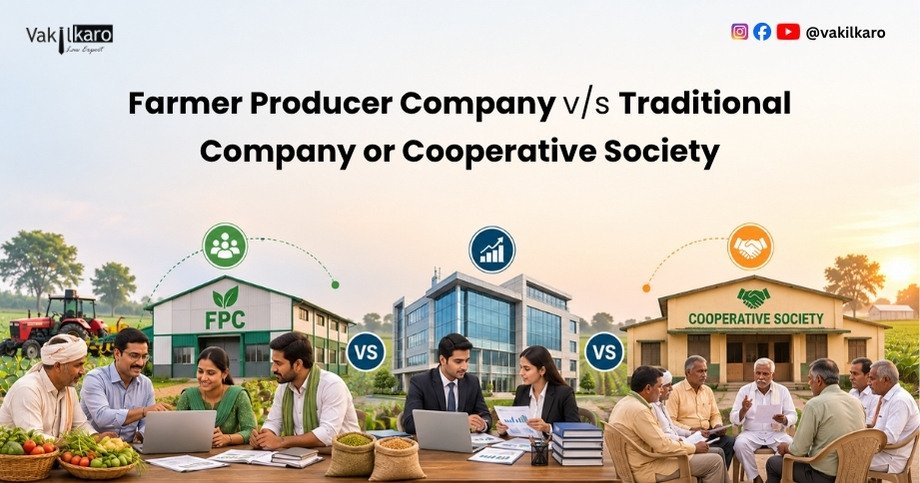
A Farmer Producer Company (FPC) blends the structure of a Private Limited Company with the principles of a Cooperative Society, empowering farmers to collectively manage production, marketing, and distribution activities. Registered under the Companies Act, 2013, an FPC offers limited liability, a separate legal entity, and access to government schemes. Unlike private companies driven purely by profits, FPCs prioritize farmer welfare. Unlike cooperatives, FPCs feature professional governance and patronage-based profit sharing. Through Farmer Producer Company Registration, farmers gain stronger market presence and financial benefits, ensuring sustainability and growth in India’s agricultural economy.
Key Takeaways
- A Farmer Producer Company (FPC) blends the structure of a Private Limited Company with the principles of a Cooperative Society, empowering farmers to collectively manage production, marketing, and distribution activities.
- Understanding the Difference Between a Farmer Producer Company, Traditional Company, and Cooperative Society The concept of a Farmer Producer Company (FPC) was introduced to bridge the gap between a traditional Private Limited Company and a Cooperative Society.
- This blog will comprehensively explore the difference between a Farmer Producer Company, a traditional private limited company, and a cooperative society.
- Farmer Producer Company vs Cooperative Society: Why FPCs Are Better Easier access to credit facilities Faster decision-making processes Limited government interference Better profitability Flexible management Farmer Producer Company vs Cooperative Society shows FPCs as the future for modern agricultural businesses.
- It bridges the gap between the traditional cooperative society and the efficiency-driven private limited company, ensuring the collective welfare of farmers while adhering to corporate governance standards.
Understanding the Difference Between a Farmer Producer Company, Traditional Company, and Cooperative Society
The concept of a Farmer Producer Company (FPC) was introduced to bridge the gap between a traditional Private Limited Company and a Cooperative Society. An FPC is a legally recognized entity formed under the Companies Act, 2013, specifically designed to address the challenges faced by small and marginal farmers. It offers the advantages of a separate legal entity, limited liability, and professional management, similar to any Private Limited Company. However, its primary goal is not just profit-making but promoting the collective welfare of its farmer-members.
Unlike traditional private companies, where ownership and profits are primarily focused on shareholders who invest capital, an FPC ensures that farmers — who contribute produce rather than money — remain the principal stakeholders. Profits in an FPC are distributed based on patronage (the level of participation in the company's activities), not merely on shareholding percentages.
In comparison to cooperative societies, FPCs offer a more structured and professional model. While cooperatives operate on democratic principles where each member has one vote regardless of their contribution, FPCs allow decision-making based on ownership and patronage. Governance in FPCs is typically more aligned with modern corporate practices, providing better transparency, efficiency, and accountability.
The Farmer Producer Company Registration process is conducted through the Ministry of Corporate Affairs (MCA), similar to company registration, but with eligibility criteria specifically for producers. Farmers seeking collective strength and better market access should consider an FPC structure.
Thus, by combining the benefits of both private companies and cooperatives, a Farmer Producer Company empowers farmers, promotes agricultural development, and offers a sustainable, market-driven business model. Registering a Farmer Producer Company is a strategic move for those aiming to maximize both community welfare and individual prosperity in India’s evolving agricultural landscape.
In India’s dynamic agricultural economy, the need for farmer empowerment has led to innovative business models like the Farmer Producer Company (FPC)). Farmers historically relied on traditional cooperative societies or struggled individually in fragmented markets. However, with the introduction of Farmer Producer Companies under the Companies Act, 2013, a new era began, offering farmers the best of both corporate professionalism and cooperative spirit.
This blog will comprehensively explore the difference between a Farmer Producer Company, a traditional private limited company, and a cooperative society. We'll also walk you through the Farmer Producer Company Registration Process, FPC Registration in India, and the benefits of setting up an FPC.
What is a Farmer Producer Company (FPC)?
A Farmer Producer Company (FPC) is a hybrid corporate entity designed specifically for farmers. It combines the benefits of a private limited company with the principles of a cooperative society. Registered under Sections 378A to 378ZU of the Companies Act, 2013, an FPC allows farmers to collectively manage production, marketing, and processing of agricultural produce.
FPCs promote collective strength by organizing farmers under one corporate umbrella, improving their bargaining power, market access, and profitability.
Traditional Private Limited Company vs. Farmer Producer Company
Cooperative Society vs. Farmer Producer Company
Farmer Producer Company under Companies Act, 2013
The Companies Act, 2013 specifically provides a separate chapter for Farmer Producer Companies to ensure a structured, legally recognized, and professionally managed entity. Unlike traditional cooperatives that are heavily regulated, FPCs have more autonomy, flexibility in management, and access to capital markets and government schemes.
Benefits of Farmer Producer Company
- Limited Liability Protection for members
- Separate Legal Entity status, independent of its members
- Access to government grants and schemes for agricultural growth
- Improved market access through collective marketing
- Eligibility for loans and subsidies
- Better bargaining power for selling produce
- Tax benefits on agricultural income
- Professional corporate governance
Clearly, FPCs offer a strong advantage compared to standalone farmers or even cooperative societies.
Eligibility for Farmer Producer Company Registration
Before you Register a Farmer Producer Company, ensure:
- Minimum 10 individual farmers or 2 producer institutions
- All members must be engaged in agricultural activities
- No involvement of non-producers as shareholders
Eligibility for Farmer Producer Company is strictly monitored to protect the integrity of the farmer-centric model.
How to Start a Farmer Producer Company?
If you're wondering How to Start a Farmer Producer Company, here’s a simple flow:
- Collect minimum 10 farmers
- Draft Memorandum of Association (MOA) and Articles of Association (AOA)
- Obtain DSC (Digital Signature Certificate) and DIN (Director Identification Number) for directors
- File SPICe+ form for Farmer Producer Company Incorporation
- Get COI (Certificate of Incorporation) and Company Identification Number (CIN)
Farmer Producer Company Registration Process
The Farmer Producer Company Registration Process involves:
- Obtain DSC and DIN
- Name reservation under MCA portal
- Draft MOA and AOA
- Submit incorporation documents via SPICe+ Form
- Pay Farmer Producer Company Registration Fees
- Get Certificate of Incorporation
- Open Corporate Bank Account
- Apply for PAN, TAN, and if necessary, GST registration
FPC Company Registration Steps are simplified with professional help like Vakilkaro, offering Farmer Producer Company Registration Online services.
Documents Required for Farmer Producer Company Registration
- PAN Card of all directors
- Aadhaar/Passport/Voter ID
- Passport-size photographs
- Proof of Registered Office (electricity bill/rent agreement/NOC)
- Signed MOA and AOA drafts
- Bank proof
Having these Documents required for Farmer Producer Company Registration ready will speed up your setup process.
Farmer Producer Company Registration Fees
Farmer Producer Company Registration Fees depend on:
- State of incorporation
- Authorized share capital
- Stamp duty
Typically, it ranges from ₹10,000 to ₹25,000 (excluding professional service charges).
Farmer Producer Company and Tax Benefits
A key attraction of an FPC:
- Agricultural income exempt from income tax under Section 10(1)
- Certain profits eligible for deductions under Section 80P
- Reduced GST compliance for certain agricultural activities
Thus, Farmer Producer Company and Tax Benefits significantly enhance farmers' financial strength.
Farmer Producer Company Business Model
The Farmer Producer Company Business Model focuses on:
- Aggregating agricultural produce
- Collective bargaining
- Direct marketing to buyers
- Processing and value addition
- Export activities
This model ensures farmers reap maximum benefits across the supply chain.
Farmer Producer Company Compliance Requirements
Once incorporated, an FPC must:
- Hold regular Board Meetings and Annual General Meetings (AGMs)
- Maintain Financial Statements and conduct Statutory Audits
- Submit Annual Filings like AOC-4 and MGT-7 to ROC
- File Income Tax Returns (ITR) and GST Returns (if applicable)
Farmer Producer Company Compliance Requirements ensure legal standing and financial health.
How to Register a Farmer Producer Company in India
Here’s a quick view of How to register a Farmer Producer Company in India:
- Check eligibility
- Collect documents
- Apply online through MCA SPICe+ portal
- Get PAN, TAN, COI
- Comply with post-incorporation formalities
Farmer Producer Company Registration under Companies Act enables full legal recognition under Indian law.
Farmer Producer Company vs Cooperative Society: Why FPCs Are Better
- Easier access to credit facilities
- Faster decision-making processes
- Limited government interference
- Better profitability
- Flexible management
Farmer Producer Company vs Cooperative Society shows FPCs as the future for modern agricultural businesses.
Role of Farmer Producer Company in Agricultural Development
FPCs contribute to:
- Enhancing farmers' incomes
- Building rural infrastructure
- Reducing middlemen exploitation
- Facilitating modern technology adoption
- Creating rural employment
The Role of Farmer Producer Company in Agricultural Development is immense and growing steadily.
Government Schemes for Farmer Producer Companies
Several initiatives supporting FPCs include:
- SFAC's FPO Promotion Scheme (₹15 lakh grant)
- NABARD FPO Program for capacity building
- 10,000 FPO Formation Scheme under Ministry of Agriculture
- Credit Guarantee Fund for FPOs
These Government Schemes for Farmer Producer Companies help in financial and operational support.
Farmer Producer Company Registration with Vakilkaro
At Vakilkaro, we provide:
- End-to-end Farmer Producer Company Registration
- Assistance in legal documentation
- ROC filing and compliance management
- Tax and GST registration
- Business advisory for FPC growth
Choosing Vakilkaro ensures a seamless, professional incorporation experience tailored for rural entrepreneurs.
How Much Time Does it Take to Register a Farmer Producer Company?
On average, How much time does it take to register a Farmer Producer Company?
- 15-25 working days from application to Certificate of Incorporation (COI), if documents are complete.
Conclusion
The Farmer Producer Company structure offers India’s farmers a modern, corporate platform to strengthen their financial and social position. It bridges the gap between the traditional cooperative society and the efficiency-driven private limited company, ensuring the collective welfare of farmers while adhering to corporate governance standards.
Whether you're a farmer collective, agricultural entrepreneur, or NGO planning to Register a Farmer Producer Company, understanding the unique benefits, registration process, and compliance structure will empower you to succeed.
Partner with Vakilkaro today to ensure a smooth, compliant, and affordable Farmer Producer Company Registration process — and start contributing to India's next agricultural revolution!
Official External Resources
Use these primary/official sources to verify rules, forms, fees, timelines and regulatory updates before publication.
Frequently asked questions
Farmer Producer Company vs Traditional Company or Cooperative Society+
Understanding the Difference Between a Farmer Producer Company, Traditional Company, and Cooperative Society The concept of a Farmer Producer Company (FPC) was introduced to bridge the gap between a traditional Private Limited Company and a Cooperative Society. This blog will comprehensively explore the difference between a Farmer Producer Company, a traditional private limited company, and a cooperative society.
