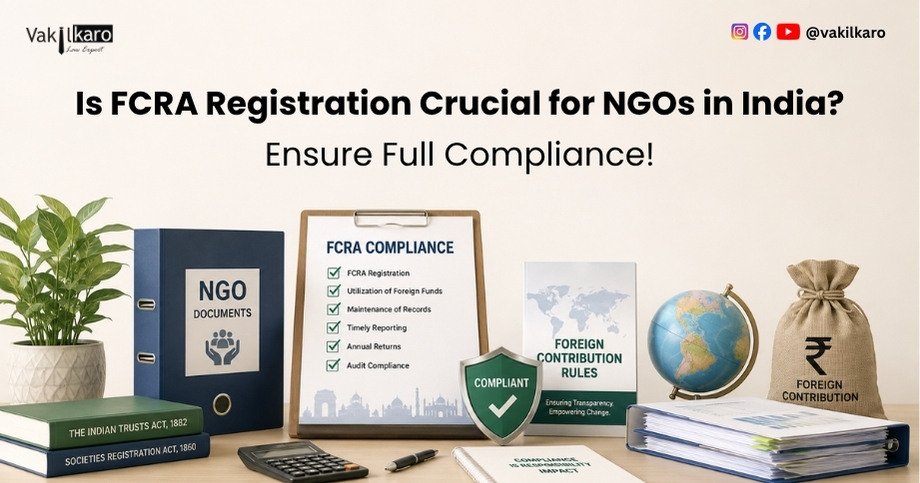
Setting up an NGO in India enables you to address vital social, environmental, and developmental challenges. NGOs can register as Trusts, Societies, or Section 8 companies, each with distinct governance and compliance requirements. To operate legally and access funding, NGOs often seek 12A and 80G registrations for tax exemptions on income and donations. Foreign Contribution Regulation Act (FCRA) registration, however, is only mandatory if the NGO plans to receive foreign donations. You can begin operations without FCRA approval, focusing on domestic funds, but must secure FCRA registration before accepting any foreign contributions to comply with legal regulations and avoid penalties.
Key Takeaways
- FCRA registration, on the other hand, should be pursued only when foreign funding becomes part of your strategy—ensuring full compliance and uninterrupted operations.
- We’ll begin by outlining the various legal structures available for NGOs—including Section 8 company registration, trusts, and societies—and explain how these foundational choices affect your subsequent compliance obligations.
- Approval and Compliance: After the application is processed, if everything is in order, the MHA will grant FCRA registration.
- Conclusion While obtaining FCRA registration may not be an immediate necessity for all NGOs, it becomes crucial once the organization intends to receive foreign donations.
- In addition to FCRA registration, Indian NGOs should also consider 12A and 80G registrations under the Income Tax Act, 1961.
Understanding NGO Structures, Tax Exemptions, and FCRA Requirements in India
Establishing a non-governmental organization (NGO) in India allows you to tackle pressing social, environmental, and developmental issues. The first step is choosing a legal form—Trust, Society, or Section 8 company. Each structure has its own NGO registration process and governance norms. Trusts and Societies are governed by their respective state laws, while Section 8 company registration under the Companies Act, 2013, offers a more formal corporate framework, with stricter compliance and greater transparency.
Once your NGO is registered, obtaining 12 A and 80G registration under the Income Tax Act, 1961, is crucial for financial sustainability. 12 A registration exempts your organization from income tax on its surplus, ensuring that all funds are channeled into charitable activities. Meanwhile, 80G registration incentivizes donors by allowing them to claim tax deductions on their contributions. Together, these certifications enhance credibility, attract both individual and corporate donors, and open doors to government grants and CSR funding.
However, not all NGOs need to secure FCRA registration immediately. The Foreign Contribution (Regulation) Act, 2010 mandates FCRA approval only if your NGO intends to receive foreign donations. This means you can begin operations—raising domestic funds and implementing projects—without FCRA clearance. Focusing initially on local fundraising can streamline your compliance requirements and reduce administrative burdens.
Before accepting any foreign contributions, though, it is imperative to apply for and obtain FCRA registration. The application process, managed by the Ministry of Home Affairs, involves submitting your NGO’s registration certificate (whether Trust Deed, Society MoA/AoA, or Section 8 incorporation documents), PAN, bank details, and activity reports. FCRA approval can take several months, so planning ahead is essential to avoid legal complications or penalties.
In summary, while NGO registration and Section 8 company registration lay the groundwork for your organization’s legitimacy, 12 A and 80G registration are non-negotiable for tax efficiency and donor confidence. FCRA registration, on the other hand, should be pursued only when foreign funding becomes part of your strategy—ensuring full compliance and uninterrupted operations.
Establishing a Non-Governmental Organization (NGO) in India is more than a mere administrative exercise—it is a commitment to driving meaningful change across society. NGOs serve as catalysts for development, tackling issues that range from poverty alleviation and women’s empowerment to environmental conservation, healthcare access, and educational outreach. By filling gaps left by government services and mobilizing community resources, NGOs play an indispensable role in building a more equitable and sustainable future.
However, the path from a well‐intentioned vision to a fully operational NGO is paved with a variety of legal and regulatory steps. These requirements exist to ensure that your organization is recognized by the state, operates transparently, and safeguards public and donor trust. Proper registration not only legitimizes your NGO but also unlocks critical funding channels—both domestic and, if applicable, international.
A fundamental question that often arises among new founders is whether to seek FCRA registration right away. Governed by the Foreign Contribution (Regulation) Act, 2010, FCRA registration is mandatory for any Indian NGO that plans to receive grants or donations from abroad. Securing FCRA approval is a key component of your compliance framework, but it also involves a detailed application process and ongoing reporting requirements. As a result, many organizations wonder: “Do we need to apply for FCRA registration from day one, or can we delay it until we actually start receiving foreign funds?”
In this blog, we’ll unpack this question thoroughly. We’ll begin by outlining the various legal structures available for NGOs—including Section 8 company registration, trusts, and societies—and explain how these foundational choices affect your subsequent compliance obligations. We’ll then dive into the specifics of FCRA registration: why it exists, who it applies to, and how the application process works. Finally, we’ll explore how 12A and 80G registrations under the Income Tax Act, 1961, complement FCRA approval, allowing your NGO to benefit from tax exemptions and to offer tax deductions to donors. By the end of this discussion, you’ll have a clear roadmap for determining when and how to integrate FCRA, 12A, and 80G registrations into your NGO’s legal strategy—ensuring that you can focus on your mission, secure in the knowledge that your organization is fully compliant and poised for growth.
Understanding FCRA Registration
Before delving into whether FCRA registration is mandatory from the beginning, it's important to understand what FCRA registration is and its purpose.
The Foreign Contribution (Regulation) Act (FCRA), 2010 was introduced by the Government of India to regulate the receipt of foreign donations by Indian NGOs. This law ensures that foreign funds are not used for activities that may harm the national interest or destabilize the country. NGOs or organizations receiving foreign contributions must register under FCRA and comply with the norms set forth by the Ministry of Home Affairs (MHA), which oversees the process.
FCRA registration is important because it allows NGOs to receive foreign funds legally. Without it, an NGO cannot accept any foreign contribution, even if it is a legitimate donation intended for charitable purposes. The registration process involves a stringent application procedure, and the Ministry of Home Affairs reviews applications carefully before granting approval. NGOs that are registered under FCRA must follow certain compliance norms, including annual reporting on the utilization of foreign funds.
Is FCRA Registration Compulsory from the Start?
FCRA registration is not compulsory for all NGOs right from the moment of their establishment. However, this depends on the nature of the organization's activities and its intention to receive foreign funds.
- FCRA Registration for NGOs Receiving Foreign Donations: The primary purpose of FCRA registration is to regulate and monitor the flow of foreign donations to NGOs. If your NGO does not intend to receive foreign contributions in the beginning, you can initially function without FCRA registration. This means that an NGO can start its operations and focus on raising domestic funds, carrying out social or charitable activities, and fulfilling its mission. Once the NGO starts receiving foreign donations, FCRA registration will become mandatory.
- FCRA Registration and Section 8 Company Registration: Note that FCRA registration is not automatically tied to the form in which an NGO is established. NGOs in India can be registered as Section 8 companies under the Companies Act, 2013, as trusts under the Indian Trusts Act, 1882, or as societies under the Societies Registration Act,1860. While Section 8 company registration ensures that your organization operates on a not-for-profit basis, it does not require FCRA registration unless the organization intends to receive foreign donations.
- When Should You Apply for FCRA Registration?: While FCRA registration is not compulsory from the beginning, it becomes a requirement once an NGO plans to receive foreign donations. It is crucial to apply for FCRA registration before accepting any foreign funds. The Ministry of Home Affairs has strict guidelines for NGOs receiving foreign contributions. An NGO that fails to apply for FCRA registration and still receives foreign funds could face legal action and may have to return the funds.
- Link Between FCRA and 12A/80G Registration: FCRA registration is a separate process from 12A and 80G registration. These two registrations are essential for any NGO operating in India. 12A registration provides tax exemptions on the income generated by the NGO, ensuring that the funds received are not taxed, provided they are used for charitable purposes. Similarly, 80G registration is crucial for NGOs that wish to encourage donations by offering tax deductions to their donors.
In short, Section 8 company registration is a legal structure for your NGO and has no direct bearing on whether FCRA registration is needed. An NGO with Section 8 company registration that does not receive foreign contributions can operate without FCRA registration, but once foreign funds are introduced, FCRA registration is required.
The application process for FCRA registration can take time and may require several months to be processed and approved by the MHA. Hence, NGOs should apply for FCRA registration well in advance if they anticipate receiving foreign donations in the future.
While 12A and 80G registration are not directly linked to FCRA registration, having these certifications can make it easier for your NGO to attract both domestic and foreign funding. The 12A and 80G registration can enhance the credibility of your NGO and can make donors more inclined to contribute, knowing that their donations are exempt from taxes. FCRA registration adds another layer of legitimacy, specifically for foreign donors.
Steps to Apply for FCRA Registration
If your NGO plans to receive foreign donations, here is a step-by-step process for applying for FCRA registration:
- Complete NGO Registration: Whether you register as a Section 8 company, trust, or society, your NGO must first be legally registered with the appropriate authorities. This step is crucial for obtaining the necessary certifications and operating as a legitimate organization.
- Obtain PAN and Bank Account: Your NGO must have a Permanent Account Number (PAN) and a designated bank account in the name of the organization. FCRA funds can only be received through an account that has been opened specifically for the NGO, and the bank must be one listed in the FCRA-approved list of banks.
- File for FCRA Registration: To apply for FCRA registration, you must fill out the online application form available on the Ministry of Home Affairs website. The application requires several documents, such as:
- NGO registration certificate
- PAN card of the organization
- Memorandum of Association (MoA) and Articles of Association (AoA) or Trust Deed/Society by-laws
- Financial statements of the organization (if available)
- A detailed description of the activities and the need for foreign contributions
- Submit the Application: After preparing all the required documents, submit the FCRA registration application online. Once submitted, the Ministry of Home Affairs will review the application and may request additional information or documents. This process can take several months, so it's essential to plan accordingly.
- Approval and Compliance: After the application is processed, if everything is in order, the MHA will grant FCRA registration. Once granted, your NGO must comply with the regulations set out by the MHA, including regular reporting on the utilization of foreign funds.
Benefits of FCRA Registration
- Legality: FCRA registration ensures that your NGO receives foreign contributions legally, following the guidelines set by the government of India.
- Financial Support: FCRA registration opens the door to a wide range of financial resources from international donors, development agencies, and foreign governments.
- Enhanced Credibility: Obtaining FCRA registration helps build the credibility of your NGO. It assures donors that their contributions will be utilized for the stated purpose and in compliance with Indian laws.
- Avoiding Legal Issues: Without FCRA registration, receiving foreign funds is illegal, and this could lead to penalties, fines, or even closure of the organization.
Conclusion
While obtaining FCRA registration may not be an immediate necessity for all NGOs, it becomes crucial once the organization intends to receive foreign donations. Initially, NGOs can operate and focus on raising funds from domestic sources, implementing their programs, and fulfilling their mission without the added complexity of FCRA registration. However, once the organization aims to broaden its funding base to include international donors, securing FCRA approval is an essential legal requirement. Accepting foreign contributions without this registration can result in legal complications, fines, and potentially jeopardize the NGO's credibility and operations.
In addition to FCRA registration, Indian NGOs should also consider 12A and 80G registrations under the Income Tax Act, 1961. These registrations offer valuable tax exemptions to the NGO and its donors. 12A registration ensures that the organization’s income is exempt from tax as long as the funds are used for charitable purposes, enhancing the organization’s financial sustainability. 80G registration, on the other hand, allows donors to claim deductions on their taxable income for contributions made to the NGO, which significantly boosts donor engagement and increases the flow of funds. Both registrations help streamline the funding process, foster transparency, and build trust with existing and potential supporters.
Ultimately, obtaining Section 8 company registration or other forms of NGO registration is the first step toward setting up a legally compliant and sustainable non-profit organization in India. These registrations, when combined with FCRA, 12A, and 80G certifications, lay the groundwork for an NGO to operate smoothly and effectively while maintaining full legal compliance. Together, they create a robust framework that enables NGOs to carry out their work confidently and legally.
For NGOs planning to receive foreign donations, a comprehensive understanding of FCRA registration and its relationship with 12A and 80G registrations is critical. The application process can be complex, and errors or delays in registration can hinder an NGO's ability to access vital funds. Therefore, seeking professional advice and consulting with legal experts who specialize in NGO registration and FCRA compliance is highly recommended. These experts can guide NGOs through the intricate legal processes, ensuring that all registration requirements are met accurately and efficiently, and helping to avoid potential pitfalls that could disrupt their operations.
Why Choose Vakilkaro for NGO Registration and Legal Services?
Vakilkaro is your trusted partner for setting up and managing an NGO in India. Our team specializes in NGO registration, Section 8 company registration, FCRA registration, and securing 12A and 80G certifications. We provide expert legal support, ensuring that your NGO is set up legally, compliant with regulations, and ready to receive funding. Our services are efficient, affordable, and tailored to your needs, helping you navigate complex legal processes smoothly. With Vakilkaro, you can focus on your NGO’s mission while we handle all the legal aspects. Let us guide you every step of the way.
Official External Resources
Use these primary/official sources to verify rules, forms, fees, timelines and regulatory updates before publication.
Frequently asked questions
Is FCRA Registration Crucial for NGOs in India? Ensure Full Compliance!+
FCRA registration, on the other hand, should be pursued only when foreign funding becomes part of your strategy—ensuring full compliance and uninterrupted operations. We’ll begin by outlining the various legal structures available for NGOs—including Section 8 company registration, trusts, and societies—and explain how these foundational choices affect your subsequent compliance obligations.
