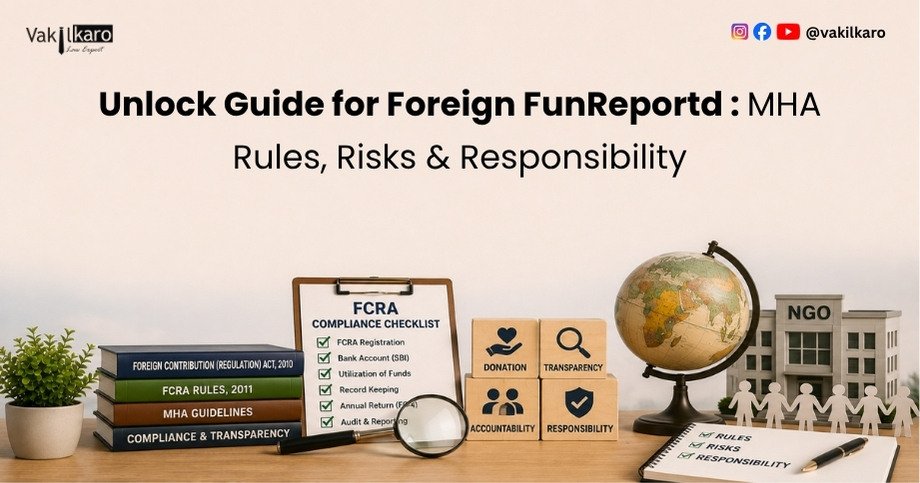
Foreign contributions enable NGOs to support social programs, but FCRA 2010 requires annual reporting to the Ministry of Home Affairs. Any trust, society, or Section 8 company must submit Form FC-4 through an FCRA-designated bank account, PAN, Darpan ID. 12A, 80G certifications boost credibility. This guide walks you through login, form completion, document attachments, digital signatures, and submission for compliance and international funding access.
Key Takeaways
- Reporting Foreign Contributions to the MHA: A Step-by-Step Overview Navigating the Foreign Contribution (Regulation) Act (FCRA), 2010, is essential for any NGO in India that depends on overseas funding.
- Failure to adhere to these rules can lead to penalties, suspension of FCRA registration, or even permanent debarment from foreign funding.
- Understanding FCRA and the Role of MHA The Foreign Contribution (Regulation) Act (FCRA), 2010 was enacted to regulate how foreign funds are received, utilized, and managed by organizations operating in India.
- Step-by-Step Guide to Reporting Foreign Contributions under FCRA Filing foreign contribution reports with the Ministry of Home Affairs (MHA) is a crucial part of maintaining FCRA compliance for any NGO, whether it holds Section 8 company registration, trust, or society registration.
- The Bigger Picture: Legal Hygiene & Sustainability Reporting foreign contributions accurately is not just about following rules — it’s about building a sustainable and impactful NGO.
Reporting Foreign Contributions to the MHA: A Step-by-Step Overview
Navigating the Foreign Contribution (Regulation) Act (FCRA), 2010, is essential for any NGO in India that depends on overseas funding. Whether you’re registered as a trust, society, or under Section 8 company registration, compliance with FCRA norms—particularly annual filing of Form FC-4—is non-negotiable. This process starts by receiving all foreign contributions into a dedicated FCRA bank account, typically held at the SBI’s New Delhi branch. You’ll also need a valid PAN and Darpan ID, obtained via the NITI Aayog portal, before logging into the official FCRA portal to submit returns.
Reporting begins with selecting the relevant financial year and completing Form FC-4. The form collects detailed data on total foreign inflows, donor identities (including country of origin), project purposes, and balances of unspent foreign funds. Attaching accurate audited financial statements, a Chartered Accountant’s certificate, activity reports, and bank statements ensures your submission is complete. Once every field is verified, the chief functionary uses a Class II/III Digital Signature Certificate (DSC) to sign and submit the return online.
Deadlines are critical: all FCRA returns must be filed by December 31 for the previous April–March cycle. Even if no foreign contributions were received, a nil return is mandatory. Missing this window—or providing incorrect donor details, incomplete documents, or the wrong digital signature—can invite penalties or suspension of your FCRA license.
While FCRA compliance is central, securing 12A and 80G registrations under the Income Tax Act further strengthens your NGO’s credibility. Section 12A ensures that your organization’s income is tax-exempt, and 80G enables donors to claim tax deductions, enhancing donor confidence and helping maintain consistent inflows. Together with robust record-keeping, regular updates of any changes in governance or bank accounts, and timely renewal of your FCRA registration every five years, these measures build a transparent, accountable, and sustainable foundation for international partnerships.
Foreign contributions play a pivotal role in empowering Non-Governmental Organizations (NGOs) across India to pursue ambitious social, environmental, and humanitarian goals. From delivering rural healthcare camps to running educational programs in under-resourced communities, these international funds often bridge critical resource gaps. Yet, given the scale and sensitivity of such contributions, the Indian government enacted the Foreign Contribution (Regulation) Act, 2010 (FCRA) to impose a robust oversight framework. Compliance with FCRA norms is not merely best practice—it is a statutory requirement for any body with NGO registration, including trusts, societies, or those incorporated through Section 8 company registration.
Under FCRA, all foreign donations must be channeled through a dedicated bank account and reported annually to the Ministry of Home Affairs (MHA). Accurate reporting safeguards against misuse, reinforces public trust, and ensures that NGOs can retain their eligibility to receive international grants. Failure to adhere to these rules can lead to penalties, suspension of FCRA registration, or even permanent debarment from foreign funding.
This blog post will walk you through each stage of the FCRA reporting process—starting with preparatory steps such as setting up your FCRA bank account, obtaining your PAN and Darpan ID, and confirming your entity’s legal status under NGO registration or Section 8 company registration. You’ll learn how 12A and 80G registrations, while separate from FCRA, reinforce your organization’s overall compliance posture by ensuring income tax exemptions and donor incentives. Alongside practical guidance on completing and submitting Form FC-4, we’ll highlight common pitfalls to avoid—like missing the December 31 deadline or attaching incomplete audited statements—and share tips for maintaining transparent records year-round.
By the end of this guide, you will understand not only how to meet your legal obligations under FCRA but also how these reporting practices strengthen your NGO’s credibility, enabling sustainable partnerships and continued impact. Whether you’re a newly registered trust or a well-established Section 8 company, mastering FCRA reporting is a cornerstone of responsible governance.
Understanding FCRA and the Role of MHA
The Foreign Contribution (Regulation) Act (FCRA), 2010 was enacted to regulate how foreign funds are received, utilized, and managed by organizations operating in India. The aim of the FCRA is to ensure that foreign contributions are used for purposes that align with the nation’s social, economic, and political welfare while preventing misuse of funds for activities that could harm India’s national interest or security. This legislation provides a framework for transparency, accountability, and oversight over the financial transactions involving international donations to NGOs and other entities.
The Ministry of Home Affairs (MHA) is the nodal government agency responsible for monitoring and overseeing the implementation of FCRA regulations. The MHA ensures that NGOs and other entities receiving foreign donations comply with the established guidelines, file regular reports, and remain transparent in how they spend the contributions. The Ministry plays a crucial role in protecting the integrity of the country’s domestic policies and security by scrutinizing how foreign funds are utilized. It also acts as the authority that issues and renews FCRA registrations and grants prior permissions.
Under the FCRA, NGOs in India must comply with certain requirements to receive foreign contributions. These NGOs must either have:
- FCRA Permanent Registration: This is granted to established organizations that have been operating for at least three years and have a proven track record of significant activity. This type of registration allows NGOs to receive foreign contributions on an ongoing basis and is typically the preferred option for larger, well-established organizations. However, only those who meet specific operational and financial criteria, such as the requirement of spending a minimum amount on core activities, are eligible for permanent registration.
- FCRA Prior Permission: This is an option for newly registered NGOs that do not yet meet the three-year operational requirement. It allows these NGOs to receive a one-time foreign contribution for a specific donor-approved project. This permission is temporary and grants flexibility to new organizations that are just starting and may not yet have the required track record to apply for permanent registration. The NGO must submit a detailed project proposal and provide a commitment letter from the donor indicating the amount and purpose of the foreign contribution.
Whether the NGO is registered as a trust, society, or a Section 8 company, it must fulfill the MHA’s compliance requirements to maintain FCRA status. These include regular filing of returns, submitting financial statements, and providing details about the utilization of foreign funds. NGOs with Section 8 company registration, NGO registration, and those that have obtained 12A and 80G registrations have additional benefits, such as tax exemptions and the ability to receive tax-deductible donations. However, they must still comply with FCRA’s specific regulations if they intend to receive foreign contributions.
In essence, FCRA ensures that foreign funding is not misused and that NGOs continue to serve the public good while adhering to the legal requirements. By fulfilling MHA’s criteria, NGOs can maintain their eligibility to receive both domestic and foreign support while ensuring their operations remain transparent and legally compliant.
Pre-Reporting Essentials for FCRA Compliance
Before you begin reporting foreign contributions to the Ministry of Home Affairs (MHA), there are several foundational steps every NGO must have in place to ensure smooth compliance:
Valid Legal Registration
Your organization must be legally constituted as a trust, society, or Section 8 company under the Companies Act, 2013. While all forms of NGO registration are acceptable, Section 8 company registration is often favored for its robust governance framework and statutory backing. This legal status not only legitimizes your operations but also signals to domestic and international donors that your organization adheres to a recognized corporate structure.
Dedicated FCRA Bank Account
All foreign contributions must flow through a designated FCRA bank account, which is typically opened at the State Bank of India’s New Delhi Main Branch. This separate account ensures transparent tracking of foreign inflows and prevents commingling with domestic funds. Maintaining up-to-date bank statements and reconciliations for this FCRA account is critical when preparing your annual returns (Form FC-4).
FCRA Registration or Prior Permission
Under the FCRA, no NGO may legally receive or utilize foreign funds without either a permanent registration or prior permission. Permanent registration is granted after three years of operation with a proven track record, while prior permission allows newly registered NGOs to accept foreign funds for a specific project and donor. Attempting to receive foreign contributions without one of these approvals can lead to severe penalties, including suspension of your FCRA privileges.
PAN & Darpan ID
A valid PAN (Permanent Account Number) is mandatory for all financial transactions, including FCRA reporting. Additionally, since 2020, NGOs must register on the NITI Aayog’s NGO Darpan portal to obtain a unique Darpan ID. This digital identifier streamlines FCRA applications and renewals, linking your organization’s identity across multiple government databases.
12A and 80G Registration
While 12A (income tax exemption) and 80G (donor tax-deduction) registrations are not prerequisites for FCRA filings, they greatly enhance your NGO’s financial credibility. A 12A exemption ensures your organization’s surplus income is not taxed, and 80G certification incentivizes donors by offering tax relief. Together, these registrations bolster your reputation for transparency and can indirectly strengthen your FCRA compliance profile by demonstrating rigorous financial governance.
Step-by-Step Guide to Reporting Foreign Contributions under FCRA
Filing foreign contribution reports with the Ministry of Home Affairs (MHA) is a crucial part of maintaining FCRA compliance for any NGO, whether it holds Section 8 company registration, trust, or society registration. Here's a detailed, step-by-step guide to help you navigate this reporting process efficiently:
Step 1: Login to the FCRA Online Portal
Begin by visiting the official FCRA portal at https://fcraonline.nic.in. Use your unique user ID and password—these credentials would have been created during your FCRA registration or prior permission application. Ensure your login details are secure and updated to avoid any access issues.
Step 2: Access and Open Form FC-4
Form FC-4 is the official form used for annual returns under the FCRA.
- Once logged in, navigate to the “Annual Returns” section.
- Select the appropriate financial year for which you are filing.
- Click on Form FC-4 to initiate the filing process.
Step 3: Provide Detailed Financial Information
Fill out the form with comprehensive data on:
- Total foreign contributions received during the reporting year.
- Complete donor information, including names, addresses, countries, and type (individual or organization).
- Specific uses of the foreign funds, including the social or developmental activities they supported.
- Detailed reports of projects funded and outcomes achieved.
- The closing balance of unutilized foreign contributions carried over from the previous year.
Step 4: Upload Required Supporting Documents
Attach the following essential documents to your FC-4 submission:
- Audited financial statements (Income & Expenditure Account, Balance Sheet, and Receipt & Payment Account).
- Certificate from a Chartered Accountant (CA) verifying financial accuracy.
- NGO’s activity report highlighting how the funds were utilized.
- Complete bank statements of the designated FCRA account.
Step 5: Apply Digital Signature and Submit
After verifying all entries:
- Use a Class II or Class III Digital Signature Certificate (DSC) belonging to your organization’s chief functionary.
- Digitally sign and submit the form securely through the portal.
Step 6: Save Acknowledgement Receipt
Once submitted, you’ll receive an acknowledgment number. This is your official proof of filing and should be securely stored both digitally and physically. It confirms your NGO’s compliance with annual FCRA reporting requirements.
By following these steps carefully, your NGO ensures continued eligibility to receive foreign contributions and maintains its reputation for transparency and accountability. Whether you're operating under a Section 8 company registration or other forms of NGO registration, proper and timely reporting under the FCRA is a legal and ethical necessity.
Timelines for Filing FC-4: Key Deadlines and Consequences
Timely and accurate reporting of foreign contributions is one of the most important responsibilities for any organization registered under the Foreign Contribution (Regulation) Act (FCRA), 2010. This obligation applies to all NGOs, whether they operate as a Section 8 company, trust, or society, and regardless of whether they received foreign funds during the year or not. Here's a detailed look at the reporting deadlines and the implications of missing them.
Annual Filing Deadline
Every FCRA-registered NGO is required to submit Form FC-4, the annual return form, to the Ministry of Home Affairs (MHA). This form must be filed by December 31st of each year for the preceding financial year, which runs from April 1st to March 31st.
For instance, for the financial year 2023–24 (April 1, 2023 to March 31, 2024), the FC-4 must be filed by December 31, 2024.
NIL Return Requirement
Even if the organization has not received any foreign contributions during the financial year, it is still mandatory to file an FC-4 as a NIL return. This demonstrates ongoing compliance and assures the authorities that the organization is adhering to FCRA norms, even in the absence of funds.
Consequences of Missing the Deadline
Failing to file FC-4 on time—or submitting incomplete or inaccurate information—can have serious repercussions:
- Late Filing Penalties: Monetary fines may be imposed.
- Suspension of FCRA License: The MHA can temporarily suspend the organization’s ability to receive foreign funds.
- Cancellation of FCRA Registration: In severe or repeated cases, the government may cancel the NGO’s FCRA registration entirely.
This is why NGOs with Section 8 company registration, as well as those with 12A and 80G registration, should treat FCRA reporting with the same seriousness as other compliance obligations. Staying on top of timelines not only avoids legal trouble but also preserves the NGO’s credibility and donor confidence.
Importance of Section 8 Company Registration in Compliance
Section 8 company registration, governed by the Companies Act, 2013, offers structured governance, internal controls, and compliance protocols that are often more robust than other forms of NGO registration. This makes maintaining FCRA compliance easier through:
- Clear record-keeping.
- Regular board meetings and documentation.
- Better financial audit trails.
These characteristics help in smooth FCRA reporting and present a positive image during scrutiny or renewal processes.
Role of 12A and 80G Registration
While 12A and 80G registration are not directly linked to FCRA reporting, they are essential for overall financial hygiene of an NGO. Here’s how:
- 12A Registration: Ensures income of the NGO is exempt from tax, which aligns with the documentation and reporting integrity required by MHA.
- 80G Registration: Encourages donations by allowing donors to claim tax deductions. A well-funded NGO is better positioned to maintain its FCRA compliance.
Having these registrations reflects a commitment to transparency, financial accountability, and donor trust — all important when reporting to the MHA.
Common Mistakes to Avoid in FCRA Reporting
- Missing the Filing Deadline: Delayed returns can cause suspension.
- Incorrect Donor Details: Always verify names, addresses, and donor country.
- Incomplete Documentation: Ensure CA-certified statements are complete.
- Wrong Digital Signature Usage: Use the correct DSC linked to the chief functionary.
- Unreported Fund Utilization: Clearly account for all disbursed foreign funds.
Maintaining Ongoing Compliance
- Keep separate books of accounts for foreign and domestic contributions.
- Update the FCRA portal with any change in name, address, board members, bank account, etc.
- Maintain a physical and digital file of all documents.
- Renew FCRA registration every five years.
- File Form FC-1, FC-2, FC-3 when required.
The Bigger Picture: Legal Hygiene & Sustainability
Reporting foreign contributions accurately is not just about following rules — it’s about building a sustainable and impactful NGO. Whether you have Section 8 company registration, or any other form of NGO registration, aligning with FCRA norms, having valid 12A and 80G registration, and submitting reports on time enables:
- Greater trust from foreign donors.
- Long-term project sustainability.
- Eligibility for international grants and partnerships.
Conclusion
FCRA compliance, especially in reporting foreign contributions to the MHA, is a non-negotiable aspect of running an NGO in India. It requires attention to detail, discipline in financial reporting, and a commitment to transparency. With timely filing of Form FC-4, complete documentation, and continuous compliance, your NGO can continue to access valuable international funding that powers social change.
Whether you are a trust, society, or a Section 8 company with registration in place, and backed by 12A and 80G registration, the path to responsible foreign contribution utilization starts with accurate reporting. Make it a practice, not an afterthought.
Need expert help? Vakilkaro offers end-to-end support for NGO registration, 12A and 80G certification, Section 8 company incorporation, and FCRA compliance to help you stay focused on your mission while we handle the legalities.
Official External Resources
Use these primary/official sources to verify rules, forms, fees, timelines and regulatory updates before publication.
Frequently asked questions
Unlock Guide for Foreign FunReportd: MHA Rules, Risks & Responsibility+
Failure to adhere to these rules can lead to penalties, suspension of FCRA registration, or even permanent debarment from foreign funding. Understanding FCRA and the Role of MHA The Foreign Contribution (Regulation) Act (FCRA), 2010 was enacted to regulate how foreign funds are received, utilized, and managed by organizations operating in India.
