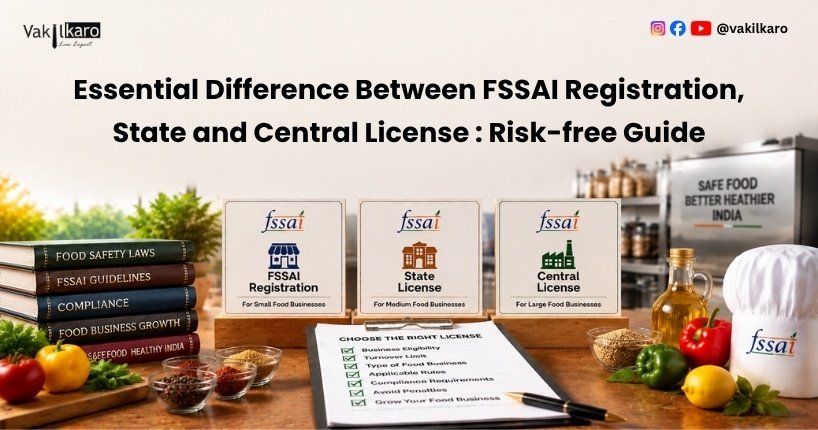
If you run any food business in India, you must get approval from FSSAI. Many entrepreneurs struggle to understand the difference between FSSAI Registration, State License, and Central License. Each category depends on your annual turnover, scale, and business type. This guide explains their eligibility, compliance rules, and application steps. Whether you operate a home kitchen, restaurant, or export business, having the right FSSAI certificate is legally essential and builds trust with customers. Vakilkaro makes it simple to apply online, prepare documents, and stay compliant. Avoid penalties and confusion—secure your food license online with expert support today.
Key Takeaways
- Many entrepreneurs struggle to understand the difference between FSSAI Registration, State License, and Central License.
- FSSAI Registration, State License & Central License Explained If you run a food-related business in India, whether a home-based kitchen, restaurant, processing unit, or an online platform selling packaged foods, it is legally mandatory to secure approval from the Food Safety and Standards Authority of India (FSSAI).
- FSSAI offers three categories: Basic Registration, State License, and Central License.
- Should you go for Basic FSSAI Registration, or do you need a State License or a Central License?
- Conclusion Understanding the differences between FSSAI Registration State License, and Central License is absolutely essential for anyone involved in the food industry.
FSSAI Registration, State License & Central License Explained
If you run a food-related business in India, whether a home-based kitchen, restaurant, processing unit, or an online platform selling packaged foods, it is legally mandatory to secure approval from the Food Safety and Standards Authority of India (FSSAI). However, many business owners are unsure about which type of license they need.
FSSAI offers three categories: Basic Registration, State License, and Central License. Each depends on the scale of your operations, your annual turnover, and the nature of your activities. Basic FSSAI Registration applies to small businesses with turnover up to ₹12 lakhs, like petty traders, hawkers, and homemade food sellers. For this, you can complete the FSSAI registration online easily.
If your business turnover falls between ₹12 lakhs and ₹20 crores and operates within one state, you’ll need a State License. Larger companies exceeding ₹20 crores in turnover, those involved in interstate commerce, imports, or exports, must obtain a Central License. Even if your revenue is below ₹20 crores but you export or supply government institutions, you must apply for the Central License.
The application process for any category involves submitting detailed documents, including identity proof, a business plan, and a food safety management plan, via the official FoSCoS platform. Once approved, you’ll receive your FSSAI certificate and 14-digit registration number, which must be displayed at your business premises.
Having the correct FSSAI license isn’t just about legal compliance—it builds customer trust, helps access new markets, and ensures smooth business operations. If you’re unsure which license fits your business, Vakilkaro can help you choose the right option, prepare accurate documents, and complete the food license apply online process quickly. With their expert support, you can avoid penalties and focus on growing your brand confidently.
If you operate a food business in India—whether it’s a small catering service, a cloud kitchen, a bustling restaurant, a food manufacturing unit, or an e-commerce platform selling packaged products—you are legally required to obtain approval from the Food Safety and Standards Authority of India (FSSAI).
Having a valid FSSAI license or registration is not just a legal formality. It demonstrates your commitment to food safety, builds trust with customers, and helps you access markets like supermarkets, modern trade, and online platforms. In fact, displaying your FSSAI certificate prominently can significantly enhance your reputation and give your business a competitive edge.
However, many entrepreneurs and small business owners feel overwhelmed by the different categories of approvals available. Should you go for Basic FSSAI Registration, or do you need a State License or a Central License? What turnover thresholds apply? How do you decide which category is correct for your business model? And what happens if you choose the wrong type or forget to renew on time?
These are common questions that can lead to confusion, delays, and even penalties if not handled properly. That’s why it’s essential to understand the differences between each approval type, their eligibility criteria, the required documents, and the compliance obligations that follow once you receive your FSSAI number.
This guide answers all your questions in detail. You’ll learn how each license works, what documents you need, and how to complete your food licence registration without hassle.
To make this process easier, Vakilkaro offers complete assistance, from determining the correct category for your business to preparing and filing your application accurately. With Vakilkaro’s support, you can apply for FSSAI license quickly and confidently, avoid costly mistakes, and focus on growing your food business while staying fully compliant.
What is FSSAI?
The Food Safety and Standards Authority of India (FSSAI) is the apex regulatory body under the Ministry of Health & Family Welfare. Established under the Food Safety and Standards Act, 2006, FSSAI is responsible for:
- Setting food safety standards
- Regulating the manufacture, storage, distribution, sale, and import of food
- Granting FSSAI registration and licenses
- Monitoring and enforcing compliance
- Issuing the FSSAI certificate
Any individual or business involved in any stage of the food chain must get registered or licensed, depending on their turnover and nature of operations.
Why Do You Need an FSSAI License or Registration?
Operating without a valid FSSAI license is a punishable offense. The penalties are steep, including fines and imprisonment. Besides, having an FSSAI number on your packaging and invoices assures consumers about the safety and quality of your food products.
An FSSAI food license helps you:
- Build credibility and trust with customers
- Legally sell and distribute your food products
- Participate in online marketplaces
- Access bank loans or funding more easily
- Avoid legal penalties and business disruptions
Whether you’re a home-based food seller or a large manufacturer, you need either FSSAI registration, a State License, or a Central License.
The Three Categories Explained
Let’s look at each approval in detail.
1️. Basic FSSAI Registration
Who Needs It?
Small food businesses and petty food manufacturers whose turnover does not exceed ₹12 lakhs per year. This includes:
- Small retailers
- Hawkers and petty traders
- Cottage industries
- Small-scale homemade food businesses
- Tiny storage units
Key Features:
- Registration Form: Form A
- Validity: 1–5 years (renewable)
- Fees: Nominal, very affordable
- Compliance: Basic hygiene and safety requirements
This is the simplest category, often referred to as FSSAI Registration.
How to Get It:
Small operators can complete FSSAI registration online through the official FoSCoS FSSAI platform. You need:
- Address proof
- Photo ID
- A declaration of compliance
Once approved, you receive an FSSAI certificate with a 14-digit registration number that must be displayed at your place of business.
2️. State FSSAI License
Who Needs It?
Medium-sized food businesses with turnover between ₹12 lakhs and ₹20 crores per year, including:
- Mid-sized manufacturers
- Storage units
- Transporters
- Wholesalers
- Medium-scale restaurants
Key Features:
- Application Form: Form B
- Validity: 1–5 years (renewable)
- Fees: Higher than Basic Registration
- Compliance: Adherence to state-level regulations
If you operate only within a single state and fall into this turnover category, you must apply for FSSAI license under the State Authority.
3️. Central FSSAI License
Who Needs It?
Large food businesses with turnover exceeding ₹20 crores, and businesses engaged in:
- Import and export of food products
- Food supply to government agencies
- Large manufacturers and processors
- Operations in multiple states
Key Features:
- Application Form: Form B
- Validity: 1–5 years (renewable)
- Fees: Highest among all categories
- Compliance: Stringent monitoring and standards
Even if your turnover is below ₹20 crores but you import or export food, you need a Central License.
Differences Between Registration, State License, and Central License
Feature Basic Registration State License Central License
Turnover Up to ₹12 lakhs ₹12 lakhs to ₹20 crores Above ₹20 crores or interstate/exports
Jurisdiction Local Within one state Across multiple states/national level
Application Form Form A Form B Form B
Fees Lowest Medium Highest
Regulatory Body Local Authorities State FSSAI Central FSSAI
Compliance Basic hygiene Detailed records, periodic inspections Strict monitoring, audits
Step-by-Step Process to Apply for FSSAI Registration or License
Whether you need a Basic Registration, State License, or Central License, the application process is streamlined through FoSCoS FSSAI, the Food Safety Compliance System.
Step 1: Create Login Credentials
Visit the official FoSCoS website and sign up using your email and mobile number.
Step 2: Fill the Application
Choose the right category—Registration, State, or Central—and complete Form A or Form B.
Step 3: Upload Documents
Depending on the type, you’ll need:
- Identity and address proof
- Photographs of the applicant
- Business constitution certificate
- Food safety management plan
- Import/export documents (for Central License)
Step 4: Pay Fees
You can food licence apply online by paying the applicable fees through net banking or card.
Step 5: Inspection and Approval
Authorities may inspect your premises before granting the license. Once approved, you’ll receive your FSSAI certificate.
Documents Required
For FSSAI Registration:
- ID proof
- Passport photo
- Business details
For State License:
- Blueprint/layout of premises
- List of equipment
- Proprietor/Partner details
- Food safety management plan
For Central License:
- Import/export code
- Proof of turnover
- Details of food categories handled
Benefits of Having the Right License
- Legal Protection: Operating without the correct license can result in heavy penalties and imprisonment.
- Customer Confidence: The FSSAI logo on your packaging assures quality.
- Market Access: You can sell through e-commerce platforms, supermarkets, and export channels.
- Improved Funding: Banks and investors prefer compliant businesses.
How to Renew Your License
FSSAI licenses and registrations are typically issued with a validity period ranging from 1 to 5 years, depending on what you selected during your initial application. It’s crucial to track your license expiry date carefully because continuing to operate after your license has lapsed is treated as a legal violation and can result in heavy penalties or even suspension of your food business operations.
To avoid any disruption, you must initiate the renewal process at least 30 days before your license expires. FSSAI does not accept renewal applications submitted after the expiration date without imposing late fees. The longer you delay beyond the expiry date, the higher the fines, and in some cases, you may be required to reapply entirely as a fresh applicant.
Renewal is now simple thanks to the FSSAI license apply online process via the official FoSCoS portal. Here’s how to do it:
- Log in to your account on the FoSCoS FSSAI website.
- Select the option to “Apply for Renewal” next to your existing license details.
- Review and update any business information, such as address changes, new products, or changes in turnover.
- Upload any updated documents or declarations required for renewal.
- Pay the applicable renewal fee online using net banking, credit card, or debit card.
- Submit your application and save the acknowledgement receipt for your records.
Once submitted, authorities may conduct a fresh inspection if your business activities have changed. After successful verification, your renewed FSSAI certificate will be issued and remain valid for the new term you selected.
If you’d like help avoiding delays, Vakilkaro can handle the entire renewal process for you—ensuring all documents are correct, fees are paid on time, and your business stays compliant without interruption.
Common Mistakes to Avoid
- Choosing the wrong license category
- Incomplete documentation
- Delaying renewal
- Not updating business details
FSSAI Compliance After Licensing
After you receive your FSSAI food license, compliance doesn’t end:
- Display the license at your premises
- Maintain records of production and distribution
- File annual returns (especially for manufacturers)
- Update FSSAI on changes to business structure
FAQs
Q: Can I start a business with only FSSAI Registration?
Yes, if your turnover is below ₹12 lakhs.
Q: How long does it take to get the license?
7–60 days, depending on the category.
Q: What is FoSCoS FSSAI?
It’s the online system for FSSAI license registration and compliance.
Q: Can I switch from State to Central License?
Yes, if your turnover crosses ₹20 crores or you start exporting.
Why Choose Vakilkaro for FSSAI Licensing?
Navigating FSSAI regulations and paperwork can be complicated, but you don’t have to do it alone. Vakilkaro simplifies the entire process:
- Helping you choose the right license
- Preparing documents accurately
- Submitting applications
- Tracking status updates
- Guiding compliance
Whether you want to fssai apply online, food license apply online, or upgrade your existing approval, Vakilkaro offers end-to-end support to save you time and avoid errors.
Conclusion
Understanding the differences between FSSAI Registration State License, and Central License is absolutely essential for anyone involved in the food industry. Each license type has its own eligibility criteria, required documents, and specific compliance rules you must follow to operate legally. Choosing the right license isn’t just about ticking a box—it’s about ensuring your business meets the standards set by the Food Safety and Standards Authority of India and demonstrates your commitment to delivering safe, high-quality food to your customers.
Regardless of whether you are a small home-based food entrepreneur, a mid-sized manufacturer, or a large-scale importer, obtaining the correct FSSAI approval is non-negotiable. A valid FSSAI license not only keeps you legally compliant but also builds trust with consumers, opens doors to modern trade channels and online marketplaces, and strengthens your reputation in an increasingly competitive market.
Although FSSAI registration online has made the process more accessible than ever, completing your application accurately and tracking your compliance obligations can still be challenging, especially if you are unfamiliar with the system or managing multiple locations. Missing a detail or deadline can lead to delays, penalties, or legal issues that disrupt your business.
That’s why partnering with professionals like Vakilkaro can make all the difference. Vakilkaro’s experienced team can help you choose the correct license, gather and prepare all necessary documentation, submit your application seamlessly, and keep your records updated year after year. With their guidance, you can focus your energy on growing your business while knowing your compliance is handled properly.
Ready to secure your FSSAI certificate?
Reach out to Vakilkaro today to register your food business quickly, confidently, and professionally. Let them take the complexity out of compliance so you can move forward with total peace of mind.
Official External Resources
Use these primary/official sources to verify rules, forms, fees, timelines and regulatory updates before publication.
Frequently asked questions
Essential Difference Between FSSAI Registration, State and Central License: Risk-free Guide+
Many entrepreneurs struggle to understand the difference between FSSAI Registration, State License, and Central License. FSSAI Registration, State License & Central License Explained If you run a food-related business in India, whether a home-based kitchen, restaurant, processing unit, or an online platform selling packaged foods, it is legally mandatory to secure approval from the Food Safety and Standards Authority of India (FSSAI).
