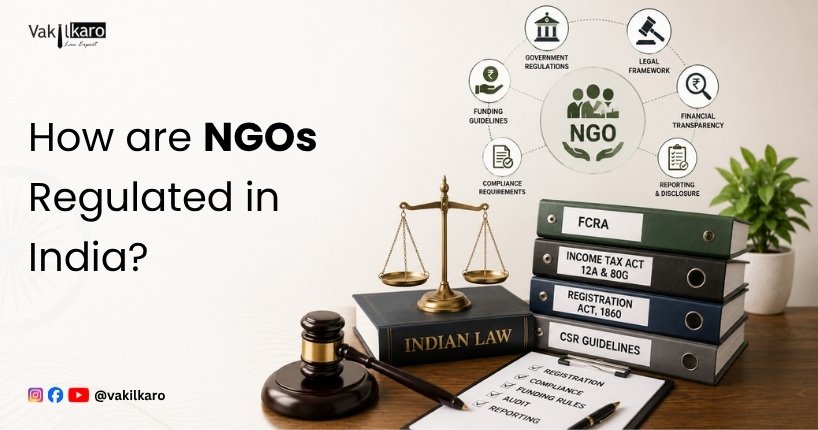
India has a vast network of NGOs addressing social, economic, and environmental challenges. They operate as trusts, societies, or Section 8 companies, each requiring proper NGO registration. Section 8 companies, governed by the Companies Act, 2013, offer legal credibility and tax benefits through 12A and 80G registration. Compliance with laws like FCRA and the Income Tax Act ensures transparency and accountability. Despite challenges like complex registration and funding limitations, digital reforms are simplifying processes. Proper governance, donor engagement, and legal compliance are crucial for NGOs to sustain their mission and maximize their societal impact.
Key Takeaways
- Despite their noble objectives and widespread impact, NGOs must function within a regulated framework to ensure transparency, accountability, and legitimacy.
- This blog delves into the legal and regulatory framework governing NGOs in India, highlighting key aspects such as NGO registration, Section 8 company registration and 12A and 80G registration.
- Income Tax Act, 1961 NGOs are eligible for tax exemptions under Sections 11 and 12 of the Income Tax Act, provided they obtain 12A registration.
- The Role of Professional Advisors Given the complexity involved, NGOs often hire consultants or legal experts for: Drafting trust deeds or MoA for Section 8 company registration Filing 12A and 80G registration applications Managing annual compliances Assisting in audits and assessments Professional help ensures that the NGO stays compliant while focusing on its core mission.
- One-Stop Legal Solution for Businesses & NGOs Apart from NGO registration, Vakilkaro provides comprehensive business and legal services, including: 📌 Company registration (Private Limited, LLP, OPC) 📌 GST registration & compliance 📌 Trademark registration & intellectual property protection 📌 Tax advisory & corporate legal services 6.
Regulating NGOs in India: Structure, Compliance, and Challenges
India has a diverse network of NGOs working to address social, economic, and environmental issues. These organizations function in different legal forms, including trusts, societies, and Section 8 companies, each requiring proper NGO registration While trusts are governed by the Indian Trusts Act, 1882, and societies operate under the Societies Registration Act, 1860, Section 8 company registration falls under the Companies Act, 2013, offering greater legal credibility and structured governance.
For NGOs to operate efficiently and gain public trust, they must comply with various legal frameworks, including the Income Tax Act and the Foreign Contribution (Regulation) Act (FCRA). Tax exemptions are available through 12A registration, which exempts an NGO’s income from taxation, and 80G registration, which enables donors to claim tax benefits. Proper 12A and 80G registration not only boosts financial sustainability but also encourages donor contributions. Additionally, Section 8 companies must meet corporate compliance standards, such as filing annual returns and undergoing audits.
Despite their crucial role in society, NGOs face numerous challenges. Lengthy registration processes, complex compliance requirements, and evolving legal frameworks make it difficult for smaller organizations to sustain themselves. The absence of 80G registration can limit funding opportunities, especially from corporate donors and CSR initiatives. However, recent government reforms, such as digital portals for NGO registration and streamlined approval processes for 12A and 80G registration, have aimed to simplify compliance.
To ensure long-term success, NGOs should adopt best practices, including transparent financial reporting, strong governance, and active donor engagement. Staying updated with regulatory changes and seeking professional guidance for legal formalities can help NGOs maximize their impact. By adhering to compliance requirements and maintaining accountability, NGOs can continue to drive positive change in India’s social sector.
India is home to a vast and diverse network of Non-Governmental Organizations (NGOs) that play an essential role in addressing various social, economic, and environmental challenges. These organizations work towards uplifting marginalized communities, providing essential services, and advocating for policy changes. From small grassroots initiatives in remote villages to large-scale institutions operating across the country, NGOs contribute significantly to fields such as education, healthcare, poverty alleviation, women empowerment, environmental conservation, and disaster relief efforts.
Despite their noble objectives and widespread impact, NGOs must function within a regulated framework to ensure transparency, accountability, and legitimacy. Since NGOs often receive donations from individuals, corporations, and international organizations, it is crucial to monitor their financial operations and governance practices. Proper regulation prevents misuse of funds, fraudulent activities, and financial mismanagement, ensuring that these organizations remain dedicated to their social mission.
To operate legally in India, NGOs must undergo NGO registration under one of three legal structures—Trusts, Societies, or Section 8 Companies. Each of these structures comes with its own compliance requirements, advantages, and governing laws. Among them, Section 8 company registration, governed by the Companies Act, 2013 offers a well-defined corporate structure, ensuring credibility and efficiency in operations.
Additionally, NGOs can seek tax exemptions under the Income Tax Act to encourage donations and secure financial sustainability. 12A registration grants NGOs exemption from income tax, while 80G registration provides tax benefits to donors, making it easier to attract funding.
This blog delves into the legal and regulatory framework governing NGOs in India, highlighting key aspects such as NGO registration, Section 8 company registration and 12A and 80G registration. Understanding these regulations is crucial for any organization looking to create a meaningful and lasting impact in society.
Understanding NGOs in India
A Non-Governmental Organization (NGO) is a non-profit entity that operates independently of government control and is dedicated to furthering social, charitable, educational, or developmental causes. NGOs play a crucial role in bridging the gap between the government and citizens, addressing issues related to poverty, education, healthcare, gender equality, environmental conservation, and disaster relief. They rely primarily on donations, grants, and fundraising efforts to sustain their operations.
In India, NGOs can be registered under different legal structures, each governed by specific laws that define their scope, compliance obligations, and operational framework. The three primary forms of NGO registration in India are:
Trusts
Trusts are one of the oldest forms of NGOs in India, commonly used for charitable, religious, and philanthropic activities. They are governed by the Indian Trusts Act, 1882 A Trust Deed is the founding document that outlines the purpose, objectives, and operational guidelines of the organization. Trusts are usually managed by trustees and do not require periodic elections to change leadership.
Key Features:
- Simple and easy to register
- Suitable for religious and charitable organizations
- Managed by trustees, ensuring stability in governance
- Limited government interference but requires compliance with tax regulations
Societies
Societies are voluntary associations of individuals formed to promote charitable, literary, scientific, or social welfare activities. They are governed by the Societies Registration Act, 1860 and require a minimum of seven members to be registered. Unlike trusts, societies are democratically managed, with members electing a governing body periodically.
Key Features:
- Best suited for educational institutions, cultural organizations, and scientific research groups
- Requires a Memorandum of Association (MoA) and Articles of Association (AoA) for registration
- Subject to annual reporting and audits to ensure transparency
- Allows for democratic decision-making and leadership rotation
Section 8 Companies
Section 8 companies are non-profit organizations registered under the Companies Act, 2013, and are designed for promoting charitable objectives such as education, healthcare, environmental protection, and social welfare. These companies are not allowed to distribute profits among members; instead, any earnings must be reinvested in the organization’s mission.
Key Features:
- Provides legal credibility and professional management
- Allows for structured governance similar to for-profit companies
- Requires approval from the Ministry of Corporate Affairs (MCA)
- Offers tax benefits and exemptions, including eligibility for 12A and 80G registration
Choosing the Right Structure
Each legal form of NGO has its own advantages, governance structure, and compliance requirements. While trusts are best suited for long-term charitable initiatives with stable leadership, societies offer democratic governance for dynamic organizations. Section 8 companies are ideal for professionally run organizations that require corporate-style governance and accountability.
Despite their differences, all these NGO structures share a common goal—promoting social welfare and public service without the intention of profit distribution. The choice of structure depends on the nature of activities, scale of operations, and long-term vision of the organization.
NGO Registration in India
Establishing an NGO in India requires a legal foundation to ensure transparency, compliance, and smooth operations. The first step is NGO registration, which provides an organization with legal recognition and enables it to receive donations, government grants, and tax benefits.
Founders must determine the scope, structure, and compliance level of their organization before selecting the most suitable legal structure. In India, NGOs can be registered under three primary legal frameworks:
Trust Registration
Trusts are widely chosen for charitable and religious activities, including running educational institutions, healthcare centers, orphanages, and places of worship. Governed by the Indian Trusts Act, 1882, trusts are relatively simple to establish and manage.
Steps to Register a Trust:
- Drafting a Trust Deed – The Trust Deed is the core legal document that defines the purpose, structure, and operational guidelines of the trust. It must mention the trustees, beneficiaries, and management policies.
- Submission to the Sub-Registrar – The deed must be registered with the local Sub-Registrar’s office, along with the required documents, such as identity proof and address proof of trustees.
- Obtaining Registration Certificate – Once verified, the trust receives its official registration certificate, allowing it to function legally.
Key Features of Trusts:
✔ Easy to register and manage
✔ Suitable for long-term charitable or religious activities
✔ Does not require periodic elections, ensuring stable governance
Society Registration
Societies are suitable for organizations that engage in educational, cultural, scientific, and social welfare activities. Governed by the Societies Registration Act, 1860, societies operate under a democratic framework, requiring at least seven members to form an association.
Steps to Register a Society:
- Draft a Memorandum of Association (MoA) and Rules & Regulations – The MoA outlines the objectives, governance, and operational structure of the society.
- Apply to the Registrar of Societies – The application must be submitted to the Registrar of Societies in the respective state, along with identity proof of the founding members.
- Approval and Registration – Upon verification, the Registrar issues a certificate of registration, making the society legally valid.
Key Features of Societies:
✔ Best suited for educational and cultural institutions
✔ Requires a minimum of seven founding members
✔ Operates democratically with elected governing bodies
✔ Must conduct regular audits and maintain financial transparency
Section 8 Company Registration
A Section 8 Company is an NGO that operates like a corporate entity, ensuring professional management and high legal credibility. These companies are governed by the Companies Act, 2013, and must use their profits exclusively for charitable purposes.
Steps to Register a Section 8 Company:
- Obtain Digital Signatures (DSC) and Director Identification Number (DIN) – Required for all directors to sign digital documents.
- Apply for Name Approval – The proposed name must be unique and include terms like "Foundation," "Association," or "Organization."
- Draft the Memorandum of Association (MoA) and Articles of Association (AoA) – These documents outline the company's mission, governance, and operational policies.
- Submit Application to the Ministry of Corporate Affairs (MCA) – After approval, the Certificate of Incorporation is issued.
Key Benefits of Section 8 Company Registration:
✔ Strong legal recognition ensures credibility with donors and government bodies
✔ Limited liability for directors and members
✔ Eligible for tax exemptions under 12A and 80G registration
✔ High transparency and professional management
Choosing the Right Structure
The choice between a Trust, Society, or Section 8 Company depends on the organization’s goals, governance preferences, and compliance capacity. Trusts are ideal for long-term charitable and religious activities, Societies work best for educational and cultural initiatives, and Section 8 Companies offer structured governance and credibility for large-scale operations.
Registering as an NGO not only provides legal protection but also enhances the organization’s ability to receive funds, apply for government grants, and gain tax exemptions, making it a crucial first step toward sustainable social impact.
Legal Framework Governing NGOs
After NGO registration, the organization becomes subject to several laws and regulations. These include:
Income Tax Act, 1961
NGOs are eligible for tax exemptions under Sections 11 and 12 of the Income Tax Act, provided they obtain 12A registration. Donors can also avail tax benefits under Section 80G if the NGO has secured 80G registration.
Foreign Contribution (Regulation) Act, 2010 (FCRA)
NGOs receiving foreign donations must be registered under FCRA Registration. This act ensures that foreign contributions do not affect internal affairs and are used for legitimate charitable purposes.
Companies Act, 2013
Section 8 companies are regulated by the Ministry of Corporate Affairs and must comply with annual filings, audits, and board meetings.
Societies Registration Act and Indian Trusts Act
Societies and trusts must adhere to their respective governing laws and maintain proper records, file updates on changes in the governing body, and ensure the charitable application of funds.
Importance of 12A and 80G Registration
Once the NGO registration is complete, obtaining 12A and 80G registration becomes crucial for the sustainability and credibility of the NGO.
12A Registration
This registration exempts the income of the NGO from taxation. Without it, any income generated (even donations) may be subject to tax. 12A registration is a one-time process but must be renewed periodically as per current norms.
80G Registration
With 80G registration, donors receive tax deductions on their contributions. This encourages individuals and corporates to contribute to the NGO. To avail this benefit, the NGO must operate transparently, with audited accounts, PAN, and regular filings.
Both 12A and 80G registration applications are made online through the Income Tax Department's portal, and approval is subject to scrutiny of documents, objectives, and financials.
Compliance and Reporting Requirements
For Trusts and Societies:
- Maintain proper books of accounts
- Annual filing of returns (in some states)
- Conduct regular meetings and maintain minutes
- Comply with FCRA if applicable
For Section 8 Companies:
- File annual returns and financials with the Registrar of Companies (ROC)
- Hold Annual General Meetings (AGMs)
- Maintain board resolutions and meeting minutes
- Regular statutory audit
- File income tax returns, and renew 12A and 80G registration as per law
Challenges Faced by NGOs in India
While NGOs play a vital role in social welfare and development, they often face significant challenges that hinder their growth, sustainability, and impact. Despite having a structured regulatory framework, NGOs encounter multiple roadblocks, ranging from bureaucratic registration processes to financial constraints. Below are some of the major challenges NGOs face in India:
Complex Registration Processes
The process of registering an NGO, especially as a Section 8 company, can be lengthy, bureaucratic, and cumbersome. NGOs must comply with several legal and administrative requirements, including obtaining approvals from various regulatory authorities.
- Multiple Legal Frameworks: NGOs can be registered under three different laws—the Indian Trusts Act, 1882, the Societies Registration Act, 1860, and the Companies Act, 2013 (for Section 8 companies). Each has different requirements and levels of compliance.
- Lengthy Approval Times: The approval process for Section 8 company registration often takes weeks or months due to multiple verification steps.
- Heavy Documentation: Founders must submit several documents, including the Memorandum of Association (MoA) Articles of Association (AoA), identity proofs, and financial records, making the process complex.
NGOs often need legal assistance to navigate this complex landscape, increasing operational costs.
Changing Legal Landscape
The laws governing NGOs, particularly those related to tax exemptions and foreign funding, have undergone frequent changes, making it difficult for organizations to keep up.
- 12A and 80G Registration Reforms: The Income Tax Department has tightened rules regarding 12A and 80G registration, requiring NGOs to renew these certifications periodically instead of earlier one-time approvals. This increases paperwork and administrative costs.
- Foreign Contribution (Regulation) Act (FCRA) Amendments: NGOs receiving foreign donations must comply with strict FCRA rules, which have been amended multiple times. Recently, the government introduced stricter regulations on foreign funding, limiting how NGOs can use these funds and requiring greater transparency.
- Increased Scrutiny: NGOs must now provide detailed financial reports, donor disclosures, and governance structures, increasing their compliance burden.
Compliance Burden
Once an NGO is registered, it must adhere to various legal and financial compliance requirements. Different regulatory bodies, such as the Ministry of Corporate Affairs (MCA), Income Tax Department, and FCRA Division, have overlapping compliance requirements.
- Annual Filings: NGOs must file annual returns, tax filings, and financial statements, depending on their legal structure.
- Multiple Regulatory Bodies: Section 8 companies are regulated by the MCA, while trusts and societies fall under state regulations. NGOs must also comply with Income Tax laws, FCRA rules, and local government norms.
- Audit and Reporting Requirements: NGOs must maintain books of accounts, undergo audits, and submit utilization reports, which can be resource-intensive.
These requirements increase operational costs and demand dedicated staff for compliance, which small NGOs often struggle with.
Limited Funding and Financial Constraints
Funding remains one of the biggest challenges for NGOs in India. Many NGOs depend on donations, government grants, and corporate social responsibility (CSR) funding, but securing these funds is increasingly difficult.
- 80G Registration Requirement: Without 80G registration, NGOs cannot offer tax benefits to donors, making it harder to attract financial support. Institutional donors and corporates prefer to fund NGOs with 80G tax-exempt status.
- Decline in Foreign Funding: Due to FCRA restrictions, many NGOs have lost access to international grants and donations. The process of obtaining an FCRA license is stringent, leading to delays in funding approval.
- Competition for CSR Funds: Large NGOs with strong networks and brand visibility often attract corporate CSR funding, while smaller NGOs struggle due to a lack of resources and connections.
Recent Reforms and Digitalization
The government has made several reforms to simplify and digitize the regulatory process:
- Online portals for NGO registration and tax exemption filings
- Darpan Portal by NITI Aayog for NGOs seeking government grants
- Faceless Assessment for 12A and 80G approvals
- Time-bound issuance of FCRA licenses and renewals
These steps are intended to enhance transparency while ensuring that only genuine organizations benefit from tax and funding privileges.
The Role of Professional Advisors
Given the complexity involved, NGOs often hire consultants or legal experts for:
- Drafting trust deeds or MoA for Section 8 company registration
- Filing 12A and 80G registration applications
- Managing annual compliances
- Assisting in audits and assessments
Professional help ensures that the NGO stays compliant while focusing on its core mission.
Best Practices for NGO Governance
- Clear Mission Statement: Define objectives in the founding documents.
- Robust Accounting System: Use reliable accounting software for transparency.
- Regular Reporting: File tax returns and ROC compliances on time.
- Board Oversight: Hold meetings and keep proper documentation.
- Donor Engagement: Keep donors informed and provide tax certificates under 80G.
Conclusion
NGOs are the backbone of India's civil society and play a pivotal role in addressing societal gaps. However, to operate effectively and sustainably, they must navigate a robust regulatory landscape. Understanding the legal provisions around NGO registration, Section 8 company registration, and 12A and 80G registration is vital for any organization intending to work in the non-profit sector.
With evolving norms, increased digitalization, and greater scrutiny, NGOs must prioritize compliance as much as they prioritize their social mission. Whether you're starting a new NGO or running an existing one, staying informed and organized is the key to making a lasting impact.
Why Choose Vakilkaro for NGO Registration and Legal Services?
When it comes to legal services, especially NGO registration, Section 8 company registration, and 12A & 80G registration, choosing the right expert can make a huge difference. Vakilkaro is a trusted name in legal advisory, known for its expertise, efficiency, and client-centric approach. Here’s why Vakilkaro stands out for NGO-related services and other legal requirements:
Expertise in NGO Registration & Compliance
Vakilkaro specializes in seamless NGO registration, helping organizations register as Trusts, Societies, or Section 8 Companies. Their legal professionals handle:
✅ Drafting Trust Deeds, Memorandums (MoA), and Articles of Association (AoA)
✅ Filing applications with the MCA, Registrar of Societies, and Sub-Registrar offices
✅ End-to-end compliance, ensuring error-free documentation
12A & 80G Registration Assistance
NGOs require 12A registration to enjoy tax exemption and 80G registration to attract donors with tax benefits. Vakilkaro simplifies this process by:
✔️ Preparing and submitting applications with the Income Tax Department
✔️ Ensuring compliance with evolving tax laws
✔️ Providing post-approval compliance support
Hassle-Free Legal & Regulatory Compliance
Navigating the complex legal landscape of NGOs can be overwhelming. Vakilkaro ensures:
🔹 Annual compliance for NGOs, Section 8 Companies, and Trusts
🔹 FCRA registration for NGOs receiving foreign donations
🔹 GST registration tax filings, and financial audits
Affordable & Transparent Pricing
Vakilkaro offers cost-effective legal solutions with no hidden charges. Their affordable pricing and flexible packages make legal services accessible to all NGOs and businesses.
One-Stop Legal Solution for Businesses & NGOs
Apart from NGO registration, Vakilkaro provides comprehensive business and legal services, including:
📌 Company registration (Private Limited, LLP, OPC)
📌 GST registration & compliance
📌 Trademark registration & intellectual property protection
📌 Tax advisory & corporate legal services
Quick & Reliable Service with Expert Guidance
Vakilkaro is known for fast processing, accurate documentation, and expert legal guidance. Their team ensures that legal procedures are smooth, stress-free, and fully compliant.
Conclusion
Whether you need NGO registration, Section 8 company registration, or compliance with 12A & 80G requirements, Vakilkaro is your trusted legal partner. With its expert team, affordable services, and commitment to excellence, Vakilkaro ensures hassle-free legal solutions for NGOs, businesses, and individuals.
📞 Contact Vakilkaro today to get started with your NGO or legal service needs! 🚀
Official External Resources
Use these primary/official sources to verify rules, forms, fees, timelines and regulatory updates before publication.
Frequently asked questions
How are NGOs Regulated in India?+
Despite their noble objectives and widespread impact, NGOs must function within a regulated framework to ensure transparency, accountability, and legitimacy. Income Tax Act, 1961 NGOs are eligible for tax exemptions under Sections 11 and 12 of the Income Tax Act, provided they obtain 12A registration.
