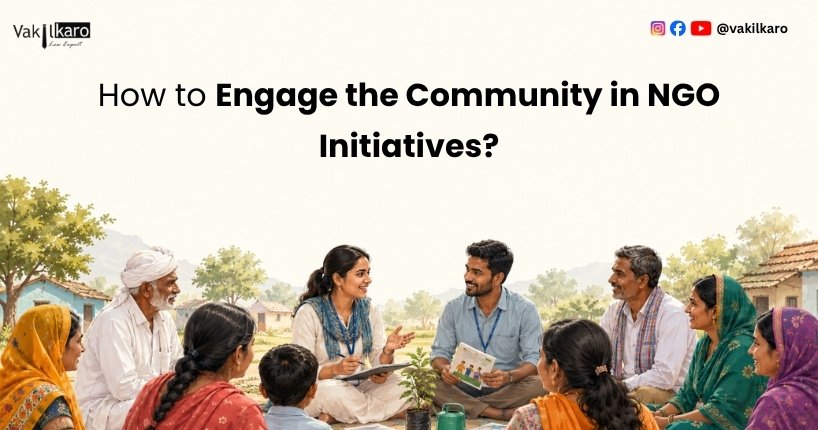
Community engagement is the foundation of a successful NGO. In India, meaningful involvement ensures programs are relevant, sustainable, and community-driven. Whether your NGO has Section 8 company registration, is pursuing NGO registration, or holds 12A and 80G registration, involving the community enhances impact and compliance. From needs assessments to volunteer programs, local partnerships, and transparent reporting, engagement builds trust, accountability, and lasting change. It also helps fulfill statutory requirements and attract donor support. VakilKaro supports NGOs through complete legal assistance in Section 8 company registration, NGO registration, and 12A and 80G registration to strengthen both compliance and community impact.
Key Takeaways
- Whether your NGO has Section 8 company registration, is pursuing NGO registration, or holds 12A and 80G registration, involving the community enhances impact and compliance.
- VakilKaro supports NGOs through complete legal assistance in Section 8 company registration, NGO registration, and 12A and 80G registration to strengthen both compliance and community impact.
- Whether your NGO operates as a trust, society, or has obtained Section 8 company registration, active community involvement is vital to achieving long-term impact.
- Understanding the Importance of Community Engagement Community engagement is a cornerstone of successful NGO operations, ensuring that initiatives are not only well-intentioned but also genuinely effective.
- Whether your organization has NGO registration, operates as a Section 8 company, or holds 12A and 80G registration, effective community involvement strengthens credibility, boosts impact, and ensures compliance.
The Role of Community Engagement in Strengthening NGO Impact
Community engagement is the heartbeat of a successful Non-Governmental Organization (NGO). In a diverse country like India, where needs vary across regions and demographics, the role of NGOs becomes even more significant. However, no organization can create meaningful or sustainable change in isolation. Engaging the community effectively not only increases the reach and relevance of initiatives but also fosters a deep sense of ownership among beneficiaries. Whether your NGO operates as a trust, society, or has obtained Section 8 company registration, active community involvement is vital to achieving long-term impact.
Understanding the community's needs through listening sessions, surveys, and focus group discussions is the first step. A well-conducted needs assessment helps tailor programs to address real challenges and can be instrumental for NGOs with 12A and 80G registration seeking CSR funding. Including local voices in the planning phase, forming advisory boards, and using culturally appropriate communication are strategies that build trust and ensure initiatives are accepted and sustained.
Leveraging local networks like schools, self-help groups, and religious institutions also enhances outreach. Employing local manpower as mobilizers or coordinators ensures contextual understanding and builds rapport. Organizing community events, encouraging volunteerism, and sharing success stories foster a strong sense of collaboration and transparency.
Maintaining open feedback channels and educating communities about their rights adds to their empowerment. For NGOs with Section 8 company registration or those maintaining compliance under 12A and 80G registration, documenting such engagement activities also satisfies regulatory requirements.
At Vakilkaro, we understand the importance of legal and administrative compliance in supporting impactful grassroots work. We assist NGOs with Section 8 company registration, NGO registration, and 12A and 80G registration to ensure they are legally sound and well-positioned to engage communities meaningfully and sustainably. With the right legal framework, NGOs can focus more on creating lasting social change.
Community engagement forms the foundation of any impactful Non-Governmental Organization (NGO). It is not just an operational tactic but the very essence that breathes life into any social initiative. In a country like India, where cultural, economic, and geographical diversity creates varying needs across regions, NGOs serve as vital connectors between underserved populations and essential services. Whether addressing education, healthcare, poverty alleviation, or women’s empowerment, NGOs play a pivotal role in bridging critical gaps. But to truly make a lasting difference, NGOs must do more than just deliver services—they must work with the people, not just for them.
Sustainable development cannot be imposed from the outside. It must emerge from within communities through trust, dialogue, and participation. Community engagement ensures that the voices of beneficiaries are heard and integrated into the planning, implementation, and evaluation of programs. This fosters a sense of ownership and accountability among the people, significantly increasing the effectiveness and long-term viability of initiatives. When communities feel empowered and involved, they become partners in change rather than passive recipients.
Whether your organization is a registered trust, society, or has completed Section 8 company registration, community participation is a legal and strategic priority. NGOs that have obtained or are seeking NGO registration and 12A and 80G registration must also demonstrate community involvement to meet donor expectations and comply with regulatory requirements. These legal recognitions often come with reporting obligations, where showcasing meaningful community engagement can add credibility and attract sustained funding.
In today’s dynamic social environment, the ability to engage communities effectively is what sets successful NGOs apart. It enhances impact, builds lasting relationships, and contributes to the resilience and growth of the organization. Understanding how to do this strategically is therefore essential for any NGO aiming to achieve its mission and scale its impact.
Understanding the Importance of Community Engagement
Community engagement is a cornerstone of successful NGO operations, ensuring that initiatives are not only well-intentioned but also genuinely effective. When NGOs involve the community from the outset, they are better positioned to design programs that reflect the real needs, values, and cultural nuances of the people they serve. This alignment between organizational goals and community expectations increases the relevance and acceptance of interventions, reducing resistance and enhancing participation.
Trust is another crucial byproduct of community engagement. When local people feel heard and valued, they are more likely to support and collaborate with the NGO. This trust paves the way for smoother implementation of projects, better communication, and stronger partnerships at the grassroots level. It also fosters transparency, as the community holds the organization accountable, ensuring that resources are used efficiently and outcomes are achieved.
For NGOs that have completed Section 8 company registration, engaging with communities is not just good practice—it’s a legal expectation. The Companies Act emphasizes governance, transparency, and stakeholder involvement, making community engagement a vital compliance element. By aligning with these governance standards, Section 8 companies demonstrate their commitment to ethical operations and inclusive development.
Moreover, effective community engagement helps NGOs attract and retain support from donors, especially those providing funds under Corporate Social Responsibility (CSR) initiatives. Organizations with 12A and 80G registration benefit immensely, as their ability to involve communities can be showcased in reports and funding proposals, fulfilling donor expectations for measurable, community-driven impact.
In essence, NGOs that prioritize community engagement are more likely to:
- Deliver results that truly matter to beneficiaries
- Gain access to local knowledge, volunteers, and infrastructure
- Inspire local leadership and long-term change
- Build credibility with donors and regulatory bodies through demonstrated impact
Therefore, community engagement is not just a strategy—it is a commitment to inclusive, sustainable, and responsible development.
Start with Listening and Needs Assessment
The foundation of any successful NGO initiative lies in its deep understanding of the community it aims to serve. This begins with active listening and a thorough needs assessment. Rather than assuming what the community requires, NGOs must take the time to engage directly with local people, listening to their stories, challenges, aspirations, and ideas. This respectful and inclusive approach ensures that interventions are not only relevant but also embraced by the community.
Conducting a needs assessment involves a combination of tools and techniques such as one-on-one interviews, community surveys, participatory rural appraisals, and focus group discussions. These methods help gather both quantitative data and qualitative insights. Through this process, NGOs can identify key issues, understand the social dynamics, uncover hidden vulnerabilities, and map out available community resources that can be leveraged.
For NGOs that have undergone NGO registration or Section 8 company registration, these assessments play a vital role in strategic planning and program design. They ensure that every project is rooted in reality and designed with sensitivity to local conditions, culture, and capabilities.
Moreover, NGOs registered under the 12A and 80G frameworks can significantly benefit from a well-documented needs assessment. When included in grant applications, donor reports, or CSR project proposals, these assessments serve as powerful evidence of grassroots engagement and situational awareness. They demonstrate that the organization does not operate in isolation but collaborates with the community to co-create solutions.
Ultimately, starting with listening builds trust, encourages transparency, and empowers the community to take part in shaping their development journey. It shows that the NGO values the voices of the people it serves, laying the groundwork for long-term partnerships and more impactful programs. This approach also enhances the NGO’s credibility, improves fundraising prospects, and aligns with compliance requirements for both 12A and 80G registration.
Involve the Community in Planning
Effective community engagement doesn’t end with listening—it must extend into the planning and decision-making processes. Involving the community in planning not only enhances the quality of programs but also builds a sense of shared responsibility and ownership. When people feel that they’ve contributed to shaping a project, they are more likely to support it, participate actively, and help sustain it over time.
NGOs should begin by identifying and inviting key stakeholders such as community leaders, local influencers, educators, youth representatives, women’s groups, and other relevant voices to the planning table. These individuals often have a deep understanding of local needs, social norms, and possible constraints. Their perspectives can help uncover potential challenges and design culturally sensitive and practical interventions that align with the community’s values and priorities.
For organizations operating as Section 8 companies, involving stakeholders in planning is more than a good governance practice—it also aligns with the statutory requirements of the Companies Act. The law emphasizes transparency, accountability, and stakeholder participation in decision-making, especially for companies involved in non-profit activities. Collaborative planning helps fulfill these mandates while strengthening relationships with beneficiaries and supporters.
To facilitate meaningful participation, NGOs can establish community advisory boards or local working groups. These bodies can serve as sounding boards for ideas, help co-design activities, and offer ongoing feedback throughout the project lifecycle. Their involvement ensures that the initiative remains dynamic, relevant, and adaptable to changing community needs.
Additionally, participatory planning increases the chances of attracting donor interest. For NGOs with 12A and 80G registration, showcasing stakeholder involvement in planning adds value to proposals and reports, reinforcing the NGO’s commitment to inclusiveness and democratic governance. Overall, community participation in planning is a powerful tool for achieving sustainable and impactful development outcomes.
Leverage Local Networks and Institutions
One of the most effective strategies for community engagement is leveraging existing local networks and institutions. These entities—such as schools, self-help groups (SHGs), religious organizations, and panchayats—hold significant influence within communities and are often seen as trustworthy and legitimate by local residents. By forming partnerships with them, NGOs can amplify their outreach, build credibility faster, and mobilize resources more efficiently.
Schools, for instance, serve as not just educational spaces but also community hubs. Partnering with schools allows NGOs to implement awareness campaigns, skill development workshops, or health interventions that directly reach children, parents, and teachers. Similarly, self-help groups, particularly those involving women, are powerful platforms for spreading information, encouraging savings, and implementing micro-enterprise projects. These groups are usually well-organized and highly motivated, making them ideal allies for grassroots development.
Religious institutions also play a pivotal role in Indian society. They command respect, facilitate large gatherings, and can be instrumental in driving behavior change campaigns related to health, hygiene, education, or social reform. Involving faith leaders in your initiatives can improve acceptance and participation, particularly in sensitive or stigmatized areas.
Panchayats, being the lowest level of local governance, are vital partners for NGOs. They understand local dynamics, hold administrative power, and can provide logistical support or even allocate funds. For NGOs with formal NGO registration, such collaborations also demonstrate legitimacy and can help with faster implementation of government-linked schemes or programs.
Leveraging these networks also makes economic sense. Instead of building outreach systems from scratch, NGOs can tap into existing infrastructures, saving both time and money. For those with Section 8 company registration or 12A and 80G registration, showcasing these alliances in project reports or funding applications also signals efficient use of resources and strengthens the case for continued support from donors or CSR partners.
Employ Local Resources and Manpower
One of the most impactful ways to deepen community engagement is by employing local resources and manpower in your NGO’s programs. Hiring individuals from within the community not only increases the acceptability of your initiatives but also ensures that they are contextually relevant and culturally sensitive. Local personnel are naturally attuned to the social dynamics, language, and challenges of the area, making them more effective in communicating with beneficiaries and implementing programs.
Community members can be trained to serve in various roles such as mobilizers, peer educators, translators, field supervisors, or project coordinators. Their involvement builds trust and rapport, which significantly boosts participation rates in programs. For instance, a health awareness drive led by a local youth group is likely to receive better reception than one led by outsiders unfamiliar with local customs.
Moreover, employing local manpower aligns with the broader development goals of skill-building and employment generation. This is particularly relevant for NGOs seeking or already possessing 12A and 80G registration, as many CSR initiatives prioritize community-based employment and capacity-building efforts. By integrating local people into your organizational structure or program teams, you can demonstrate to donors and corporate partners that their funds are directly contributing to sustainable community development.
This approach also helps create a pipeline of local leaders who can take ownership of initiatives in the long run, reducing the NGO's dependence on external support. It fosters a sense of pride and responsibility among residents, encouraging them to sustain the projects even after the NGO exits. Furthermore, showcasing this community-driven model in donor reports and grant applications adds credibility and strengthens the case for ongoing or future funding.
Ultimately, utilizing local resources and manpower transforms beneficiaries into active participants, making development a collaborative and inclusive process rather than a top-down intervention.
Use Culturally Appropriate Communication
Communicate in the local language and use familiar symbols, stories, and customs to connect with your audience. Visual aids, street plays, puppet shows, and folk songs can be more effective than brochures or PowerPoint presentations.
This type of engagement helps NGOs registered as Section 8 companies demonstrate inclusive practices and strengthen their case for continued donor and government support.
Encourage Volunteerism
Volunteer engagement is a powerful tool to involve the community. Develop structured volunteer programs that allow locals to contribute time, skills, or other resources.
Volunteerism fosters a sense of contribution and belonging, and for NGOs with 12A and 80G registration, volunteer hours and community participation can be reported as part of impact assessment.
Organize Community Events and Workshops
Hold awareness campaigns, health camps, training workshops, or community meetings regularly. These events promote your cause, build familiarity, and provide a platform for dialogue.
NGOs with Section 8 company registration are often required to document such activities as part of annual reporting. Proper documentation enhances visibility and audit-readiness.
Foster Transparency and Accountability
Community members are more likely to stay engaged when they trust your organization. Share project goals, budgets, timelines, and outcomes transparently. Display posters, hold meetings, and publish simple reports.
Transparency also helps maintain compliance with obligations tied to NGO registration, Section 8 company registration, and especially for maintaining tax exemptions under 12A and 80G registration.
Create Feedback Mechanisms
Establish multiple channels through which the community can express their views—suggestion boxes, community meetings, mobile surveys, or social media platforms. Take feedback seriously and act upon it to improve programs.
Feedback mechanisms support adaptive learning, and Section 8 companies can use them to align with corporate governance principles under the Companies Act.
Promote Beneficiary Success Stories
Highlight community champions and success stories from your initiatives. Share these narratives through newsletters, websites, and social media. This not only builds morale within the community but also inspires more people to get involved.
For NGOs with 12A and 80G registration, these stories can be included in reports submitted to donors or government agencies, showcasing effective use of funds.
Educate the Community on Their Rights
Awareness is power. Conduct sessions on social rights, health, education, environment, and government schemes. An informed community is more empowered to participate in and demand better services.
NGOs with formal NGO registration often undertake such programs as part of their core mandate. These sessions can be part of impact metrics used in CSR project evaluations.
Encourage Youth Participation
The youth are dynamic and open to change. Engage them through school-based programs, youth clubs, internships, and innovation challenges. Let them lead campaigns, surveys, or awareness drives.
Young volunteers and participants become long-term supporters and ambassadors of your work. For NGOs with Section 8 company registration, youth engagement initiatives also fulfill part of their social responsibility goals.
Measure and Celebrate Impact
Keep track of participation rates, satisfaction levels, and tangible outcomes of community involvement. Organize events to celebrate milestones and acknowledge contributors.
This celebration reinforces community interest and strengthens relationships. Also, documented outcomes support mandatory reporting for NGOs with 12A and 80G registration.
Build Long-Term Relationships
Community engagement is not a one-off activity. Maintain regular communication, revisit beneficiaries, and keep them updated about future plans.
Sustained engagement builds resilience and promotes a collaborative model where community members transition from beneficiaries to co-creators.
Understand the Role of MCA in Strengthening NGO Governance
For NGOs operating under the legal structure of a Section 8 company, the Ministry of Corporate Affairs (MCA) plays a pivotal regulatory role. The MCA governs corporate and nonprofit entities in India, ensuring they maintain transparency, legal compliance, and ethical governance. Section 8 companies, registered under the Companies Act, 2013, are required to adhere to MCA guidelines, which include maintaining proper records, filing annual returns, and ensuring community-oriented objectives are met. By aligning with MCA regulations, NGOs can demonstrate a commitment to accountability and good governance—qualities that not only build community trust but also appeal to CSR donors and institutional funders. Engaging the community, documenting outcomes, and maintaining transparency are all practices that align with MCA's vision of responsible and impactful nonprofit operations.
Conclusion
Engaging the community is central to an NGO's mission and sustainability. Whether your organization has NGO registration, operates as a Section 8 company, or holds 12A and 80G registration, effective community involvement strengthens credibility, boosts impact, and ensures compliance.
It is not enough to design well-intentioned projects; NGOs must also cultivate trust, enable participation, and create platforms for shared growth. At VakilKaro, we understand that robust legal and administrative foundations empower your field efforts. We provide complete support in NGO registration, Section 8 company registration, 12A and 80G registration, and ongoing compliance, allowing you to focus on what matters most: serving communities with integrity and impact.
If your NGO is looking to deepen its community engagement and expand its legal standing, VakilKaro is your trusted partner every step of the way.
Official External Resources
Use these primary/official sources to verify rules, forms, fees, timelines and regulatory updates before publication.
Frequently asked questions
How to Engage the Community in NGO Initiatives?+
Whether your NGO has Section 8 company registration, is pursuing NGO registration, or holds 12A and 80G registration, involving the community enhances impact and compliance. VakilKaro supports NGOs through complete legal assistance in Section 8 company registration, NGO registration, and 12A and 80G registration to strengthen both compliance and community impact.
