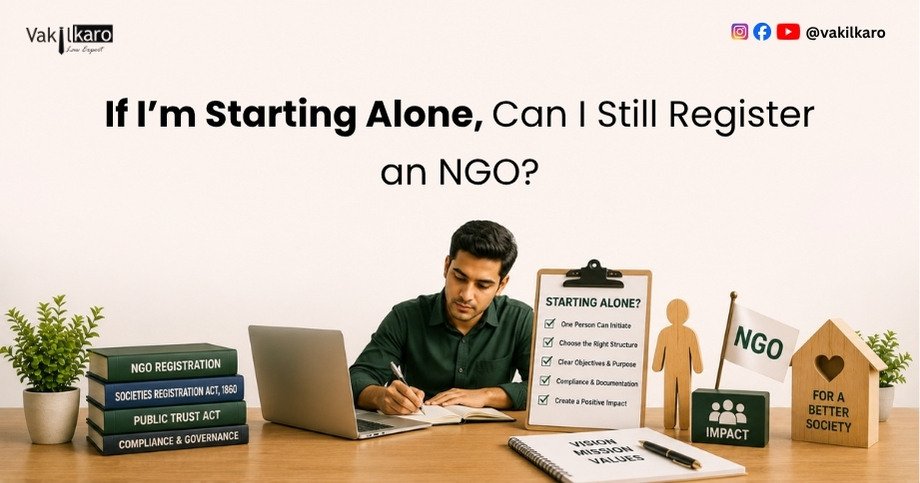
Starting an NGO alone in India depends on the registration type. For a Trust, you can register with one founder but need at least two trustees. Societies require a minimum of seven members, while Section 8 Companies need at least two directors and two shareholders. Regardless of the structure, securing 12A and 80G registration is essential to avail tax exemptions and attract donations. While it’s possible to begin solo, you'll need to involve others for official registration. Vakilkaro offers expert guidance on NGO registration, Section 8 Company formation, and securing 12A and 80G for funding and tax benefits.
Key Takeaways
- Starting an NGO alone in India depends on the registration type.
- When starting a Non-Governmental Organization (NGO) in India, one of the first questions an aspiring founder might have is whether they can establish the organization alone or if a minimum number of members is required.
- In conclusion, while you can start planning and drafting your NGO alone, you will need additional members to register the organization officially.
- Steps to Start an NGO (Even If You're Starting Alone) Choose Your Legal Structure: Decide whether a Trust, Society, or Section 8 Company suits your vision.
- In conclusion, while you can start the planning alone, you will need at least one or more individuals to register your NGO, depending on the legal structure you choose.
Can I Register an NGO Alone in India?
When starting a Non-Governmental Organization (NGO) in India, one of the first questions an aspiring founder might have is whether they can establish the organization alone or if a minimum number of members is required. The answer to this depends largely on the type of registration you choose. In India, three primary registration structures exist for NGOs: Trusts, Societies, and Section 8 Companies, and each has its own requirements regarding the number of members or founders needed.
For Trust registration, you can initiate the process alone as the founder or settlor. However, a minimum of two trustees is required for the trust to be legally recognized, although this number may vary depending on state-specific regulations. Trusts are ideal for smaller, community-focused charitable activities, and once registered, you can apply for important tax exemptions and benefits like 12A and 80G registration.
Societies, on the other hand, cannot be registered by a single individual. According to the Societies Registration Act, 1860, a minimum of seven members is required for a society, and these members must be from the same state if the society is being registered locally. For national-level societies, members must be from different states. Societies generally operate with a managing committee and are suited for educational, cultural, and welfare activities.
For Section 8 Companies, which are registered under the Companies Act, 2013, a minimum of two directors and two shareholders are required. These directors and shareholders can be the same individuals, making it easier to form compared to societies. Section 8 Companies are preferred for larger, professionally managed NGOs due to their formal governance structure, making them ideal for attracting government grants and CSR funding.
In conclusion, while you can start planning and drafting your NGO alone, you will need additional members to register the organization officially. Regardless of the structure, securing 12A and 80G registration is vital to ensuring tax exemptions and appealing to potential donors.
Starting a Non-Governmental Organization (NGO) is a commendable initiative that aims to address various social issues and contribute positively to society. Whether it’s focused on education, health, the environment, or social justice, NGOs play an essential role in driving change. However, one of the most frequently asked questions by individuals looking to start their NGO is: "Can I start an NGO alone, or do I need a group of people?" This is an important question because the answer is highly dependent on the legal framework you choose for registering your NGO in India.
The legal requirements and processes for registering an NGO in India can vary significantly based on the structure you opt for. The most common types of NGO registration in India are Trust, Society, and Section 8 Company. Each of these structures has different rules when it comes to the number of people required for the registration process.
Understanding the member requirements for each of these types is crucial for those who wish to move forward with their NGO idea but don’t have a large team or group of people to start with. While some structures allow you to begin the process on your own, others have specific requirements for a minimum number of members or founders. Knowing the legal framework that best suits your mission and resources will save you time and effort in the long run.
In addition to the basic structure and member requirements, it’s essential to understand the significance of crucial registrations like the 12A and 80G certifications. These registrations are vital for ensuring your NGO enjoys tax exemptions and can attract donations, including corporate sponsorships and government grants. They increase the credibility of your organization and make it eligible for numerous funding opportunities.
This blog will delve into each of these registration types—Trust, Society, and Section 8 Company—explaining the requirements, advantages, and challenges of starting an NGO under each. By the end of this guide, you will have a clearer idea of how to start your NGO, even if you are working alone, and the steps you need to take to make your venture successful and sustainable.
Understanding the Basics of NGO Registration in India
When starting a Non-Governmental Organization (NGO) in India, one of the first steps is to choose the appropriate legal structure. The structure you choose will not only affect the day-to-day operations of your NGO but also its legal standing, governance model, and ability to attract funding. In India, three primary structures are commonly used for NGO registration: Trust Registration, Society Registration, and Section 8 Company Registration. Each has its own set of legal requirements, governance structures, and minimum member conditions. Understanding these differences is key to determining which structure best aligns with your vision, objectives, and available resources.
Trust Registration
A Trust is one of the simplest and most flexible structures for starting an NGO in India. Trusts can be registered under the Indian Trusts Act, 1882 (or relevant state-specific laws for public charitable trusts). The primary characteristic of a Trust is that it is managed by one or more trustees, with a founder or settlor who sets up the trust and defines its objectives. Trust registration typically requires a minimum of two trustees for public charitable trusts, though in some states, only a single trustee is needed for private trusts.
Advantages of Trust Registration:
- Simple and Quick Setup: Trusts are relatively easy to form and have fewer compliance requirements compared to other structures.
- Flexibility: Trustees have the freedom to manage the NGO’s operations with relatively few formalities.
- Ideal for Small to Medium-Scale NGOs: Trusts are commonly used for small-scale charitable initiatives such as educational, health, and community-focused projects.
Challenges of Trust Registration:
- Limited Governance Structure: Since the organization is controlled by trustees, it may lack the formal governance mechanisms desired by larger donors or government bodies.
- Less Formalized Compliance: The lack of a managing body or broader membership may limit transparency, which can be a hurdle in accessing government or CSR funding.
Society Registration
A Society is a more formal structure for organizing an NGO, governed by the Societies Registration Act, 1860. Unlike a Trust, a Society is managed by a governing body or managing committee, and membership is open to individuals who support the organization’s objectives. One of the defining characteristics of a Society is that it requires a minimum of seven members to register, and at least three of these members must reside in the same state (if registering at the state level). For a national-level society, members must be from different states.
Advantages of Society Registration:
- Democratic Governance: Societies provide more democratic governance, with decision-making typically involving the broader membership and committee members.
- Public Confidence and Credibility: The transparent and inclusive structure of a Society often appeals to larger funders, including government bodies and corporations looking for CSR partnerships.
- Ideal for Educational, Cultural, and Social Initiatives: Societies are suitable for organizations that require active participation from their members, such as educational or cultural institutions.
Challenges of Society Registration:
- Complex Setup Process: Due to the requirement for a minimum number of members, setting up a Society may take longer compared to Trust registration.
- Regular Governance Meetings: Societies must maintain a governing body and hold regular meetings, which could become burdensome for smaller NGOs or those with fewer resources.
Section 8 Company Registration
The Section 8 Company Registration is governed by the Companies Act, 2013, and is one of the most formal and structured ways to establish an NGO. Section 8 Companies are specifically set up for charitable purposes and must apply for registration with the Registrar of Companies (ROC). This type of NGO requires a minimum of two directors and two shareholders, though they can be the same people, making the process slightly more flexible than a Society in terms of the number of individuals required. A Section 8 Company must have a Board of Directors and adhere to strict governance and compliance requirements, such as annual filings, statutory audits, and board meetings.
Advantages of Section 8 Company Registration:
- High Credibility and Recognition: Being incorporated under the Companies Act offers higher legal standing and recognition, which is crucial for attracting large donors, government grants, and CSR funding.
- Strong Governance and Accountability: The formal governance structure of a Section 8 Company makes it more transparent and accountable, which is essential for maintaining donor trust.
- Eligibility for Foreign Contributions and CSR Funding: Section 8 Companies are more likely to be preferred by corporates and international organizations that require strict compliance and transparency.
Challenges of Section 8 Company Registration:
- Higher Compliance Requirements: This structure comes with significant regulatory obligations, including annual filing of financial statements, board meetings, and statutory audits. This can be resource-intensive for smaller NGOs.
- More Complex Setup: Registering as a Section 8 Company requires a bit more paperwork and a minimum number of individuals, which can delay the process compared to simpler structures like Trusts.
Choosing the Right Structure for Your NGO
The structure you choose for your NGO will directly impact its governance, operational efficiency, and access to funding. It is crucial to weigh the pros and cons of each structure in relation to your organization’s mission, scale, and funding goals.
- For Smaller Initiatives: If you are just starting out with a small-scale project and don’t have a large team, registering as a Trust might be the most straightforward choice. It requires fewer people and offers flexibility in management, but it may limit your ability to attract large-scale funding or comply with extensive regulations.
- For Medium-Scale, Member-Driven Initiatives: If you require more formal governance and plan to involve a larger group of people, a Society may be the ideal choice. It provides transparency, accountability, and the ability to involve community members in decision-making. However, it requires a minimum of seven members, which could be a challenge for solo founders.
- For Large-Scale, Professional NGOs: If your goal is to access substantial government grants, corporate social responsibility (CSR) funding, or international donations, Section 8 Company registration is the best option. Its formal governance structure and regulatory compliance make it an appealing choice for larger organizations with long-term sustainability in mind.
Can a Single Person Register a Trust?
Yes, it is possible to register a public charitable trust with a single person as the founder or settlor. However, for the board of trustees, a minimum of two trustees is generally required, although this can vary slightly based on state laws.
Key Features:
- Registered under the Indian Trusts Act, 1882 (or state-specific legislation)
- Minimum two trustees required (in most cases)
- Easy to set up and manage
- Ideal for small-scale charitable activities
While you can initiate the process alone, you will need at least one more individual to complete the registration legally. Once registered, you can proceed to apply for 12A and 80G registration, which are essential for tax exemptions and attracting donors.
Can a Single Person Register a Society?
No, a single person cannot register a society. Societies require a minimum of seven members from different states if registering as a national-level society. For state-level societies, at least seven individuals from the same state are needed.
Key Features:
- Registered under the Societies Registration Act, 1860
- Minimum seven founding members required
- Operates with a governing body or managing committee
- Suitable for educational, cultural, and charitable organizations
Because of the higher member requirement, societies are more collaborative and democratic in nature. Once established, societies are also eligible for 12A and 80G registration to facilitate tax exemptions and donor incentives.
Can a Single Person Register a Section 8 Company?
No, you cannot register a Section 8 Company as a single individual. You need a minimum of two directors and two shareholders. However, these can be the same individuals, which allows for a more streamlined formation process compared to societies.
Key Features:
- Registered under the Companies Act, 2013
- Minimum two directors and shareholders required
- High level of compliance and transparency
- Ideal for NGOs seeking government grants and CSR funding
Despite the initial setup requiring two people, a Section 8 Company offers numerous long-term advantages, including greater credibility, structured governance, and better access to funding. You can also apply for 12A and 80G registration once the company is incorporated.
What Are 12A and 80G Registrations and Why Are They Important?
Regardless of the type of NGO registration, applying for 12A and 80G registration is crucial:
- 12A Registration: Provides income tax exemption for the NGO's revenue, allowing funds to be reinvested into charitable activities.
- 80G Registration: Enables donors to claim tax deductions on the donations made, making your NGO more attractive to individual and corporate donors.
These registrations are provided by the Income Tax Department and require you to maintain proper records, annual filings, and audits.
Comparative Table: Member Requirements for NGO Registration Types
Why Section 8 Company Registration is Often Preferred?
Even though it requires at least two people, Section 8 Company registration is often the most preferred choice for aspiring social entrepreneurs due to:
- Legal credibility and recognition
- Access to government and CSR funding
- Professional governance and compliance structure
- Higher chances of FCRA and 12A & 80G approval
If you're planning to start an NGO with long-term impact, working with one more committed individual to register a Section 8 Company can significantly boost your chances of success.
Can I Start the Process Alone and Add Members Later?
Yes, in many cases, you can begin the groundwork alone—ideating the mission, drafting the objectives, and preparing documentation. However, you will need to involve additional members when it comes time to register the NGO officially, regardless of whether you choose a Trust, Society, or Section 8 Company.
Steps to Start an NGO (Even If You're Starting Alone)
- Choose Your Legal Structure: Decide whether a Trust, Society, or Section 8 Company suits your vision.
- Prepare Key Documents: Draft the Memorandum of Association (MOA), Articles of Association (AOA), and other required documents.
- Identify Co-Founders or Members: Depending on the structure, find the minimum number of people required.
- Register Your NGO: File the required paperwork with the appropriate authority.
- Apply for 12A and 80G Registration: To ensure tax exemptions and donor incentives.
Common Challenges and How to Overcome Them
- Finding Committed Members: Look for like-minded individuals through social media, volunteering networks, or community events.
- Navigating Legal Requirements: Work with legal experts or platforms like Vakilkaro for smooth registration and compliance.
- Securing Funding: Begin with small-scale fundraising while building credibility through proper governance and tax exemptions.
Conclusion: Can You Register an NGO Alone?
In conclusion, while you can start the planning alone, you will need at least one or more individuals to register your NGO, depending on the legal structure you choose. Among the options, Trusts require the fewest people, while Societies require the most. If you are serious about building a transparent, credible, and professionally run NGO, partnering with at least one other committed individual to register a Section 8 Company is the most strategic choice.
No matter the structure, don’t forget to obtain 12A and 80G registration to unlock key tax benefits and funding opportunities.
For complete guidance on NGO registration, Section 8 Company registration, and securing 12A and 80G registration, Vakilkaro provides expert assistance tailored to your needs. Let your journey of social impact begin with the right legal foundation!
Official External Resources
Use these primary/official sources to verify rules, forms, fees, timelines and regulatory updates before publication.
Frequently asked questions
If I’m Starting Alone, Can I Still Register an NGO?+
Starting an NGO alone in India depends on the registration type. When starting a Non-Governmental Organization (NGO) in India, one of the first questions an aspiring founder might have is whether they can establish the organization alone or if a minimum number of members is required.
