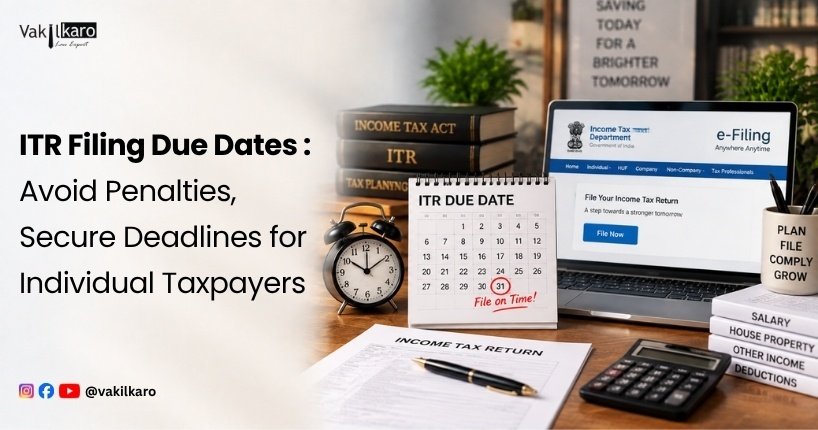
Filing your Income Tax Return (ITR) on time is vital to avoid penalties and claim refunds. For individuals, the due date is usually 31st July of the Assessment Year. Delays can lead to fines and interest charges. With the Income Tax e-filing portal registration, filing has become simpler and faster. Register easily, choose the correct ITR form, and e-verify your return. Early filing ensures quicker refunds and peace of mind. Whether salaried or self-employed, start your income tax e-filing new registration today. Need help? Vakilkaro guides you through every step of your tax compliance journey confidently.
Key Takeaways
- In India, the due date for most individual taxpayers to file their ITR is 31st July of the Assessment Year.
- In India, individual taxpayers must file their Income Tax Return (ITR) every year within specific deadlines set by the Income Tax Department.
- If you’ve ever wondered, “What is the due date for filing ITR for individual taxpayers?” you are not alone.
- Common Errors to Avoid Even after income tax e registration, taxpayers often make mistakes like: ❌ Selecting the wrong ITR form ❌ Mismatch in income details ❌ Forgetting to disclose exempt income ❌ Missing verification ❌ Entering incorrect bank details Double-check everything before submission on the income tax e filing new registration portal.
- Conclusion The due date for filing ITR for individual taxpayers in India is generally 31st July of the Assessment Year.
Why Filing Your ITR on Time Matters and How to Do It Right
Meeting your Income Tax Return (ITR) deadlines is not just a formality—it’s an essential part of financial responsibility. In India, the due date for most individual taxpayers to file their ITR is 31st July of the Assessment Year. For those whose accounts require an audit, the deadline extends to 31st October. Missing these dates can lead to penalties of up to ₹5,000, along with interest on any outstanding tax dues.
Thanks to the Income Tax Department’s e-filing registration portal, filing returns has become more accessible. New users must first complete income tax e-filing new registration. This process involves creating an account by verifying your PAN, mobile number, and email address. Once registered, you can log in anytime to download the appropriate ITR forms, pre-fill your data, declare deductions, and submit your return.
Timely filing has several benefits beyond avoiding penalties. You can carry forward losses to offset future income, ensure faster refunds if you have excess tax deducted, and maintain a clean compliance record—something that’s increasingly important when applying for loans or visas. Early filing also gives you more time to review your details carefully, reducing the chance of errors such as choosing the wrong form, mismatching income figures, or omitting important disclosures.
Before you start, gather essential documents like Form 16, bank statements, interest certificates, investment proofs, and your Aadhaar card. Double-check all entries before submitting and remember to e-verify your return within 30 days to complete the process.
If the process feels overwhelming, Vakilkaro’s experts can assist you at every step—from income tax e-filing new user registration to final submission and responding to notices. With the right support, you can file confidently and stay compliant with India’s tax laws.
Paying income tax is not merely a legal requirement—it is one of the most meaningful ways citizens actively contribute to the growth and development of the nation. Every rupee you pay supports infrastructure, public welfare programs, education, and essential services that keep India moving forward.
In India, individual taxpayers must file their Income Tax Return (ITR) every year within specific deadlines set by the Income Tax Department. Missing these deadlines can have serious consequences: you risk paying late fees and penalties, forfeiting eligible refunds, and inviting unnecessary scrutiny from tax authorities. Despite these risks, many taxpayers still find the process confusing, especially if they are new to e-filing or have multiple sources of income.
If you’ve ever wondered, “What is the due date for filing ITR for individual taxpayers?” you are not alone. Every year, lakhs of people rush to complete their returns as the deadline approaches. The good news is that with the convenience of income tax e-filing portal registration, filing your return has become simpler, faster, and more transparent than ever. You can now register online, pre-fill your details from linked accounts, and e-verify your return without standing in long queues or dealing with piles of paperwork.
This detailed guide will explain:
✅ The due dates for various categories of individual taxpayers
✅ What happens if you file late
✅ How to complete your income tax e-filing new registration step by step
✅ Tips to avoid last-minute errors and omissions
✅ Answers to the most common questions taxpayers have
If the process feels overwhelming, this is exactly where Vakilkaro can help. Vakilkaro’s team of tax experts provides end-to-end support—from guiding you through income tax e-filing new user registration to reviewing your documents and ensuring your return is filed accurately and on time. With Vakilkaro, you gain peace of mind and the confidence that your compliance is handled by professionals who understand the nuances of India’s tax system.
Whether you are filing your return for the first time or want to optimize your tax strategy, Vakilkaro makes the process hassle-free and clear, so you can focus on your life and business while staying compliant.
Understanding the ITR Filing Deadline
The Income Tax Department of India prescribes the due date for filing returns under Section 139(1) of the Income Tax Act, 1961.
For individual taxpayers not required to have their accounts audited (i.e., salaried employees, pensioners, freelancers without audit), the due date is:
➡️ 31st July of the Assessment Year
For example, for income earned during Financial Year (FY) 2024–25 (April 1, 2025 to March 31, 2025), the due date is 31st July 2025.
For individuals or businesses whose accounts are subject to audit, such as professionals or business owners exceeding turnover thresholds, the due date is:
➡️ 31st October of the Assessment Year
If you are required to file a report under Section 92E (international or specified domestic transactions), the deadline is:
➡️ 30th November of the Assessment Year
Important: These dates can be extended by government notification. Always verify the latest announcements on the income tax e filing portal registration or the official Income Tax Department website.
Why Meeting the Deadline Matters
Timely filing isn’t just about avoiding penalties—it unlocks important benefits:
✅ You can carry forward losses, such as capital losses, to offset future income.
✅ You can claim timely refunds if you have excess TDS deducted.
✅ You avoid interest under Section 234A, which can be 1% per month on unpaid taxes.
✅ You protect yourself from late fees under Section 234F, which can go up to ₹5,000.
✅ You maintain a clean compliance record in the income tax registration portal, helping with loans and visas.
Using the Income Tax E-Filing Registration Portal
Before you file, you must be registered on the e-filing website. Here’s a step-by-step guide to income tax e filing new user registration:
Step 1: Visit the Official Portal
Go to www.incometax.gov.in — this is the income tax e filing register portal.
Step 2: Click on “Register”
On the home page, click the “Register” button to start the income tax e filing new registration process.
Step 3: Choose Your User Type
Select “Individual” and click “Continue.”
Step 4: Enter Basic Details
✅ PAN
✅ Surname, First Name, Middle Name
✅ Date of Birth
✅ Residential Status
Step 5: Validate PAN
The system will validate your PAN with the Income Tax Department database.
Step 6: Provide Contact Information
✅ Email ID
✅ Mobile Number
✅ Address
You will receive an OTP on your mobile and email for verification.
Step 7: Set Password
Create a strong password for your income tax e filing portal registration account.
✅ Password must be 8–14 characters with a combination of uppercase, lowercase, number, and special character.
Step 8: Complete Registration
Submit the form, and your income tax e portal registration will be complete.
You can now log in anytime to e-file your ITR filing, check refund status, or download documents.
Filing Your ITR After Registration
Once your income tax e filing register account is active, you can:
✅ Download the appropriate ITR form (ITR-1, ITR-2, etc.)
✅ Fill out income, deduction, and tax details
✅ Use pre-filled data (Form 26AS, AIS, TIS) for accuracy
✅ Validate and verify your return
After filing, don’t forget to e-verify within 30 days using Aadhaar OTP, bank account EVC, or a signed ITR-V sent by post.
Late Filing Penalties
If you miss the due date of 31st July (or your applicable deadline), you can still file a belated return under Section 139(4) until 31st December of the Assessment Year.
However, you’ll face consequences:
✅ Late fee up to ₹5,000 under Section 234F
✅ Interest under Sections 234A/B/C
✅ Losses (other than house property) cannot be carried forward
✅ Refunds get delayed
To avoid these problems, use your income tax portal registration early and file well before the deadline.
Who Must File ITR?
Even if your income is below the taxable limit, you must file if:
✅ You deposited over ₹1 crore in a bank account
✅ You spent ₹2 lakh or more on foreign travel
✅ Your electricity bill exceeded ₹1 lakh
✅ You hold foreign assets or have signing authority abroad
✅ You want to claim a refund
Always check eligibility on the income tax registration portal to avoid non-compliance.
Documents Needed to File ITR
Before filing, gather:
✅ Form 16 (salaried employees)
✅ Form 26AS and Annual Information Statement
✅ Interest certificates (FDs, savings accounts)
✅ Investment proofs (Section 80C, 80D)
✅ Aadhaar and PAN
✅ Bank account details
With these ready, filing through your income tax e filing register account becomes seamless.
Common Errors to Avoid
Even after income tax e registration, taxpayers often make mistakes like:
❌ Selecting the wrong ITR form
❌ Mismatch in income details
❌ Forgetting to disclose exempt income
❌ Missing verification
❌ Entering incorrect bank details
Double-check everything before submission on the income tax e filing new registration portal.
How to Revise Your ITR
If you discover errors after filing, you can submit a Revised Return under Section 139(5) before 31st December of the Assessment Year.
✅ Log in to your income tax e filing register account
✅ Choose “File Revised Return”
✅ Correct the mistakes
✅ E-verify again
Benefits of Early Filing
Filing before the due date offers several advantages:
✅ Faster refunds
✅ Time to rectify errors
✅ Peace of mind
✅ Improved credit profile
Don’t wait until the last week of July. Use the income tax e-portal registration to file early.
Key Due Dates for FY 2025–26
✅ 31st July 2025: Individuals not requiring audit
✅ 31st October 2025: Individuals with business requiring audit
✅ 30th November 2025: Transfer pricing report under Section 92E
How Vakilkaro Can Help
The entire process—from income tax e-filing, new user registration to final submission—can be confusing, especially if you have multiple income sources. Vakilkaro offers:
✅ Guidance on choosing the right ITR form
✅ Help with income tax e-filing portal registration
✅ Review of your tax computation
✅ Assistance with e-verification
✅ Support in responding to notices
With Vakilkaro’s team, you can file accurately and confidently.
Conclusion
The due date for filing ITR for individual taxpayers in India is generally 31st July of the Assessment Year. However, this deadline can differ if your accounts need to be audited or if you have certain international transactions. No matter your category, failing to file on time can trigger avoidable headaches: late fees under Section 234F, interest on unpaid taxes, delays in receiving refunds, and even trouble when applying for loans or visas.
Fortunately, with the rise of the income tax e-filing registration portal, compliance no longer has to be stressful or complicated. From registering as a new user to uploading documents and verifying your return, each step is now fully digital, making it much faster and more transparent. Early preparation is the key—when you plan ahead and file before the deadline, you protect your finances, build a clean tax record, and avoid last-minute errors that can cost you time and money.
If you still haven’t completed your income tax e-filing new registration, this is the right moment to do it. Whether you are a salaried professional, a consultant, a small business owner, or a freelancer juggling multiple income streams, filing your return correctly and on time helps you stay compliant and confident.
This is exactly where Vakilkaro can make a difference. From start to finish, Vakilkaro’s tax professionals are ready to guide you—helping you set up your income tax e-filing register account, advising you on the right ITR form, checking your deductions and exemptions, and reviewing every detail before submission. Their support ensures you don’t overlook anything critical and that your return is accurate, complete, and filed well within the deadline.
Ready to file your ITR with clarity and total peace of mind? Vakilkaro is here to help you every step of the way—so you can focus on what matters most, knowing your compliance is in expert hands.
Official External Resources
Use these primary/official sources to verify rules, forms, fees, timelines and regulatory updates before publication.
Frequently asked questions
ITR Filing Due Dates: Avoid Penalties, Secure Deadlines for Individual Taxpayers+
If you’ve ever wondered, “What is the due date for filing ITR for individual taxpayers?” you are not alone. Common Errors to Avoid Even after income tax e registration, taxpayers often make mistakes like: ❌ Selecting the wrong ITR form ❌ Mismatch in income details ❌ Forgetting to disclose exempt income ❌ Missing verification ❌ Entering incorrect bank details Double-check everything before submission on the income tax e filing new registration portal.
