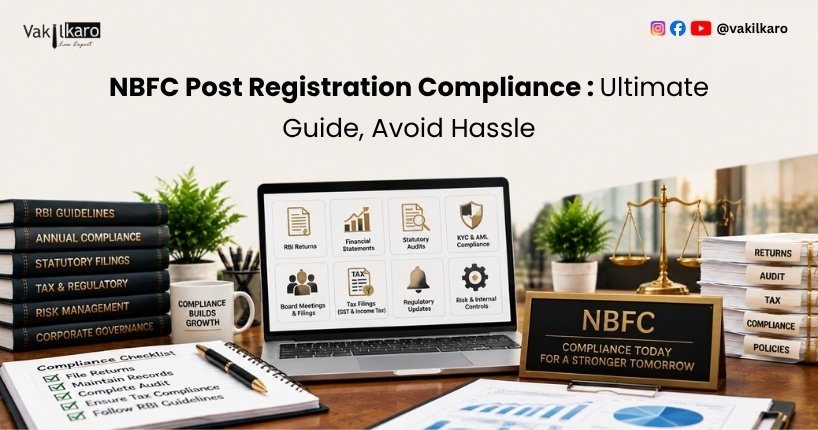
NBFCs are vital to India's financial landscape, and while securing an NBFC license from RBI is the first milestone, the real challenge begins post-registration. Complying with RBI's ongoing statutory, prudential, and operational norms is essential to retain your NBFC certificate and stay on the RBI registered loan company list. From filing returns and adhering to KYC/AML guidelines to maintaining transparency with CERSAI and CIC, these requirements ensure financial discipline. Whether it’s a new NBFC registration or a fintech giant like Zomato seeking an NBFC license, understanding and fulfilling post-registration obligations is key to long-term success and regulatory survival.
Key Takeaways
- While obtaining an NBFC license from the Reserve Bank of India (RBI) is a significant achievement, it marks just the beginning of a more critical journey—ensuring post-registration compliance.
- Post-Registration Compliance Requirements for NBFCs Once your company receives its NBFC certificate of registration, here are the key compliance responsibilities: 1.
- These are applicable post NBFC registration with RBI and non-compliance can result in regulatory action, including rbi cancels NBFC license.
- Consequences of Non-Compliance Failing to meet RBI norms post-registration can result in: Monetary penalties Public warnings Removal from NBFC registered company list RBI cancels NBFC license and initiates winding up proceedings Hence, timely adherence to all compliance procedures is non-negotiable.
- As a trusted legal and financial compliance advisory platform, Vakilkaro offers end-to-end solutions for NBFCs, from initial NBFC company registration and license acquisition to post-registration compliance management.
Why Post-Registration Compliance is Critical for NBFCs
Non-Banking Financial Company Registration (NBFCs) play a pivotal role in strengthening India’s financial system by offering credit and financial services in areas often underserved by traditional banks. While obtaining an NBFC license from the Reserve Bank of India (RBI) is a significant achievement, it marks just the beginning of a more critical journey—ensuring post-registration compliance.
After successful NBFC registration, companies are obligated to meet a series of regulatory, operational, and financial compliance standards. These include filing periodic returns with the RBI, such as NBS-1, NBS-2, NBS-3, and others, which cover asset classification, capital adequacy, and business performance. Timely submission of these reports helps the RBI monitor the financial health of NBFCs and ensures that they function within defined norms.
Furthermore, every NBFC must adhere to Prudential Norms, including maintaining a minimum Capital Adequacy Ratio (CAR) and following provisioning rules for non-performing assets. Companies must also register with CERSAI (Central Registry of Securitisation Asset Reconstruction and Security Interest) and Credit Information Companies (CICs) to reduce credit risk and enhance transparency in lending.
NBFCs are also required to follow strict Know Your Customer (KYC) and Anti-Money Laundering (AML) guidelines. Adopting a Fair Practices Code is another mandatory step, which lays down the standards for loan processing, interest rates, and customer interaction.
Additionally, NBFCs engaged in digital lending—such as emerging fintech players or tech giants like Zomato exploring NBFC licenses—must comply with RBI’s digital lending regulations to protect consumer data and ensure fair lending practices.
Neglecting these post-registration responsibilities can result in penalties, loss of RBI registration, or even license cancellation. Therefore, for any company aiming to thrive in the NBFC space, meeting compliance standards is not just a regulatory necessity—it’s a strategic imperative for sustainability and growth.
Non-Banking Financial Companies (NBFCs) have emerged as a vital pillar in India’s rapidly evolving financial landscape. Unlike traditional banks, NBFCs cater to niche segments by offering credit, investment, and financial services to individuals, small businesses, and underserved markets. As financial inclusion gains momentum across India, an increasing number of entrepreneurs, fintech startups, and corporations are exploring opportunities in this sector. However, stepping into this space demands more than just enthusiasm—it requires a deep understanding of the legal and regulatory framework that governs NBFC operations.
The first significant milestone for any aspiring NBFC is obtaining the necessary approvals, which includes completing the NBFC registration process and securing an NBFC license from the Reserve Bank of India (RBI). This process, although rigorous, is relatively straightforward when compared to the responsibilities that follow. Once the NBFC certificate is issued and the entity becomes part of the RBI registered loan company list, the focus must shift from setup to ongoing compliance.
Post-registration, NBFCs are required to strictly adhere to RBI's statutory, prudential, and operational regulations. These include filing regular returns, maintaining liquidity buffers, following Know Your Customer (KYC) and Anti-Money Laundering (AML) norms, and adhering to Fair Practices Codes. These compliance mandates are not mere formalities—they are critical for maintaining legitimacy, protecting consumers, and ensuring financial stability.
Failure to meet these compliance standards can lead to severe consequences, including monetary penalties, restrictions on business operations, or even cancellation of the NBFC license. Therefore, understanding these post-registration obligations is not optional—it’s essential.
In this comprehensive guide, we delve into the critical post-registration compliance requirements that every NBFC must follow to remain operational, credible, and successful in India’s competitive financial environment.
What Is an NBFC?
A Non-Banking Financial Company (NBFC) is a financial institution that is registered under the Companies Act, 2013 (or earlier versions), and is also registered with the Reserve Bank of India (RBI) to conduct financial business. While NBFCs function similarly to traditional banks in offering various financial services, they differ in a few key ways—most notably, they cannot accept demand deposits, which are funds that are payable on demand, like those held in a savings or current account.
NBFCs are legally recognized entities that play a complementary role to the traditional banking sector. They serve diverse financial needs by providing services such as loans and advances, asset financing, credit facilities, leasing, hire-purchase, microfinance, investment in securities, and infrastructure financing. Some NBFCs even specialize in specific sectors, including housing finance, vehicle loans, personal loans, and SME lending.
Despite not having a banking license in the conventional sense, NBFCs are regulated under the Reserve Bank of India Act, 1934, especially sections that pertain to financial prudence, liquidity, and governance. To protect public interest and maintain financial system stability, NBFCs must secure an NBFC license from RBI before starting operations and are required to appear on the RBI registered NBFC company list.
A key distinction lies in their operational flexibility. While banks offer a wide range of services under stricter regulatory oversight, NBFCs enjoy slightly more agility and are often quicker to adapt to evolving market needs—making them highly favored in the fintech and lending startup space.
In summary, an NBFC is a company registered under the Companies Act and licensed by the RBI to engage in non-banking financial activities. They are essential players in India’s financial ecosystem, bridging credit gaps and promoting financial inclusion across various segments of the economy.
Understanding NBFC Registration
Before diving into post-registration compliances, a brief overview of the NBFC registration process is necessary.
To register as an NBFC, companies must:
- Be incorporated under the Companies Act 2013 (incorporation of NBFC company).
- Have a minimum net owned fund of ₹2 crore.
- Submit the application for NBFC registration via the COSMOS portal on the RBI website.
- Provide the NBFC application form, supporting documents, and comply with RBI guidelines for NBFC registration.
Upon review, if everything is in order, the company is granted the NBFC license from RBI and becomes part of the RBI registered loan company list or list of NBFCs registered with RBI.
Post-Registration Compliance Requirements for NBFCs
Once your company receives its NBFC certificate of registration, here are the key compliance responsibilities:
Statutory Reporting Requirements
NBFCs must regularly file returns to the RBI. These include:
- NBS-1: Quarterly return on financial parameters.
- NBS-2: Quarterly return on Prudential Norms.
- NBS-3: Quarterly return on liquid assets.
- NBS-4: Annual return (only for NBFCs with public deposits).
- NBS-7: Monthly return on principal business and asset classification.
Missing deadlines could risk being excluded from the registered NBFC list RBI.
Compliance with Prudential Norms
NBFCs must follow:
- Capital Adequacy Ratio (CAR): Minimum 15%.
- Asset Classification and Provisioning norms.
- Credit Concentration Norms.
These are applicable post NBFC registration with RBI and non-compliance can result in regulatory action, including rbi cancels NBFC license.
Auditing and Inspection
Every NBFC must:
- Appoint a statutory auditor.
- Submit audited financials to RBI annually.
- Cooperate with RBI inspections as part of maintaining status as an RBI registered NBFC.
CERSAI and CIC Registration
After getting the NBFC license rbi, the entity must register with:
- CERSAI (Central Registry of Securitisation Asset Reconstruction and Security Interest)
- Credit Information Companies (CIC)
This helps reduce credit risk and promotes transparency.
KYC and Anti-Money Laundering Compliance
NBFCs must follow Know Your Customer (KYC) norms and Anti-Money Laundering (AML) guidelines laid down by RBI. This includes maintaining proper records and conducting regular audits.
Fair Practices Code
Once part of the RBI registered NBFC company, a company must adopt a Fair Practices Code and share it publicly. It outlines procedures for loan disbursement, interest rates, and customer grievance redressal.
Income Recognition and Asset Classification (IRAC) Norms
As a registered NBFC with RBI, companies are required to recognize income only when it is realized and to classify assets into standard, sub-standard, doubtful, or loss categories.
Registration with Other Authorities
Depending on the nature of services, NBFCs might require:
- SEBI registration (sebi registered NBFC) for portfolio management.
- MFI registration (NBFC MFI registration) for micro-finance services.
- Core investment company registration if they primarily invest in group companies.
Changes in Management or Shareholding
Any change in control, board of directors, or shareholding (exceeding 26%) must be approved by RBI in advance to maintain a valid NBFC license.
Digital Lending Guidelines
For NBFCs engaged in digital lending (including fintech players like Zomato NBFC license), adherence to RBI's digital lending guidelines is mandatory. This includes data privacy, loan transparency, and ethical recovery practices.
Importance of Staying on the RBI Registered Company List
Remaining on the RBI registered company list or RBI registered finance company list builds credibility with lenders, investors, and customers. Non-compliance could lead to your NBFC being listed as “NBFC registration cancelled by RBI,” damaging your reputation and ability to conduct business.
Cost of NBFC Compliance
Aside from the NBFC license cost and NBFC registration fees, ongoing compliance also incurs expenses. These include:
- Auditing fees
- Software for RBI returns
- KYC verification systems
- Legal consultation and annual filings
While the NBFC registration cost is a one-time fee, compliance costs are recurring and must be budgeted from the start.
Classification of NBFCs Based on Registration with RBI
NBFCs are categorized based on their activities. Some examples include:
- Investment and Credit Company (ICC)
- Infrastructure Finance Company (IFC)
- Microfinance Institution (MFI)
- Housing Finance Company (HFC)
- Core Investment Company (CIC)
Each category has unique post-registration obligations. The classification of NBFCs based on registration with RBI determines specific compliance rules, especially regarding capital adequacy and asset quality norms.
Other Requirements After Incorporation of NBFC
Following the incorporation of NBFC, companies must also:
- Display the NBFC certificate from RBI at the office.
- Mention NBFC registration number in official documents.
- Not use misleading names unless officially a banking license NBFC.
Companies like Zomato NBFC license explore such models to expand credit offerings via affiliated or white-labeled NBFCs.
Consequences of Non-Compliance
Failing to meet RBI norms post-registration can result in:
- Monetary penalties
- Public warnings
- Removal from NBFC registered company list
- RBI cancels NBFC license and initiates winding up proceedings
Hence, timely adherence to all compliance procedures is non-negotiable.
Frequently Asked Questions (FAQs)
What is the procedure for incorporation of NBFC?
The NBFC incorporation process involves company formation, capital infusion, and application to RBI with proper documents.
Is NBFC registration online?
Yes, NBFC registration online is possible through the COSMOS portal on the RBI website.
What documents are required for NBFC registration?
The documents required for NBFC registration include:
- MoA & AoA
- Directors’ profiles
- Board resolution
- Net worth certificate
- KYC of directors and shareholders
Is there a difference between NBFC and a finance company?
Technically, all RBI registered finance companies are NBFCs, but not all finance entities are regulated. Always check the NBFC registered under RBI status.
Conclusion
Obtaining an NBFC license from RBI is a major milestone for any financial enterprise. However, it is only the starting point of a much larger journey. The real challenge begins post-registration—navigating the complex maze of compliance requirements, maintaining good standing with the RBI registered NBFC list, and ensuring long-term sustainability in a tightly regulated environment.
Whether you're launching a new NBFC registration initiative or operating as a tech-driven giant like the Zomato NBFC license model, your growth and reputation hinge on consistent compliance. This includes timely regulatory filings, adherence to prudential norms, statutory audits, ethical lending practices, and compliance with KYC/AML guidelines. Ignoring these responsibilities could lead to fines, restrictions, or even cancellation of your NBFC certificate—jeopardizing your entire business.
This is where Vakilkaro becomes a strategic partner in your NBFC journey. As a trusted legal and financial compliance advisory platform, Vakilkaro offers end-to-end solutions for NBFCs, from initial NBFC company registration and license acquisition to post-registration compliance management. Their expert team handles everything from RBI filings and policy drafting to registration with authorities like CERSAI and CIC, allowing business owners to focus on growth without worrying about legal pitfalls.
Vakilkaro understands the regulatory nuances that come with operating in the financial sector and provides personalized support tailored to your business model—whether you're a microfinance NBFC, investment company, or fintech innovator. Their proactive compliance solutions ensure that your NBFC remains not only operational but also competitive in an ever-evolving financial landscape.
In conclusion, compliance is not just a regulatory necessity—it’s a strategic advantage. With Vakilkaro by your side, you can confidently meet RBI norms, avoid penalties, and focus on scaling your financial enterprise with complete peace of mind.
For entrepreneurs planning to enter the lending space, understanding NBFC registration requirements, the NBFC company registration process, and following through with post-registration obligations is crucial. Non-compliance is not an option—it’s a risk no serious NBFC should take.
Official External Resources
Use these primary/official sources to verify rules, forms, fees, timelines and regulatory updates before publication.
Frequently asked questions
NBFC Post Registration Compliance: Ultimate Guide, Avoid Hassle+
While obtaining an NBFC license from the Reserve Bank of India (RBI) is a significant achievement, it marks just the beginning of a more critical journey—ensuring post-registration compliance. Consequences of Non-Compliance Failing to meet RBI norms post-registration can result in: Monetary penalties Public warnings Removal from NBFC registered company list RBI cancels NBFC license and initiates winding up proceedings Hence, timely adherence to all compliance procedures is non-negotiable.
