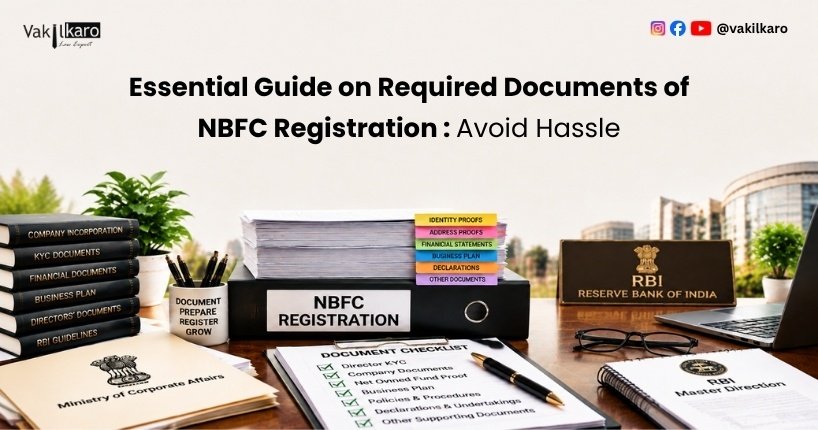
Non-Banking Financial Companies (NBFCs) are vital to India’s lending sector, offering credit, loans, and asset financing beyond traditional banks. Registering an NBFC requires thorough documentation, including incorporation certificates, NOF confirmation, a detailed business plan, and compliance policies. You must meet RBI’s criteria, maintain ₹2 crore in Net Owned Funds, and submit your application online and offline. This guide explains required documents, step-by-step registration, costs, and common pitfalls to avoid. By preparing carefully, you can secure your NBFC license, appear on the RBI registered loan company list, and confidently launch your finance business while complying with all regulations.
Key Takeaways
- This guide explains required documents, step-by-step registration, costs, and common pitfalls to avoid.
- How to Prepare for NBFC Registration in India Non-Banking Financial Company Registration (NBFCs) are essential to India’s financial landscape, providing credit, loans, and other services that extend beyond the scope of traditional banks.
- Vakilkaro specializes in end-to-end NBFC registration support—from drafting your Memorandum and Articles of Association to preparing financial documents, filing online and offline applications, and liaising with RBI officials.
- Below is a detailed checklist of documents you will need to prepare for your NBFC company registration process: 1️.
- Vakilkaro offers end-to-end support for NBFC registration, including drafting your Memorandum of Association and Articles of Association, preparing your financial statements and affidavits, filing applications, publishing required notices, and liaising directly with RBI officials on your behalf.
How to Prepare for NBFC Registration in India
Non-Banking Financial Company Registration (NBFCs) are essential to India’s financial landscape, providing credit, loans, and other services that extend beyond the scope of traditional banks. As more entrepreneurs look to enter this sector, it’s important to understand exactly what registering an NBFC entails.
The process begins with incorporating your company as either a Private Limited or Public Limited entity under the Companies Act. Your firm must maintain a minimum Net Owned Fund (NOF) of ₹2 crore—this is not just a formality but an essential financial threshold demonstrating your capacity to operate responsibly. Additionally, at least one director should have experience in financial services, ensuring knowledgeable oversight.
Before applying, you’ll need to assemble a comprehensive set of documents. This includes your Certificate of Incorporation, Memorandum and Articles of Association highlighting financial services as the primary objective, board resolutions authorizing the application, and audited financial statements. You’ll also need detailed director profiles, KYC documents, a robust business plan outlining your strategy for the next three years, and proof of your registered office address.
After preparing your documents, the application process unfolds in two parts: submitting forms online via the RBI’s COSMOS portal and sending hard copies to the appropriate Regional RBI Office. The Reserve Bank of India will then rigorously review your submission, verifying your compliance with fit and proper criteria, confirming your NOF, and evaluating your business model.
Once satisfied, the RBI will issue your NBFC Certificate of Registration, officially authorizing you to operate. It’s crucial to maintain compliance, submit regular returns, and adhere to all regulations to keep your license in good standing.
By understanding each step and preparing thoroughly, you can secure your NBFC license, feature on the RBI registered loan company list, and confidently build a respected lending business in India’s dynamic economy.
Non-Banking Financial Companies (NBFCs) play a pivotal role in India’s fast-evolving financial landscape by offering credit, loans, asset financing, and investment services beyond the reach of traditional banks. These companies have become indispensable in supporting small businesses, startups, and underserved borrowers, bridging critical gaps in access to finance. As the demand for alternative lending channels has grown, more entrepreneurs, fintech founders, and established businesses are actively considering NBFC registration to build fully compliant finance companies under the Reserve Bank of India’s (RBI) framework.
However, registering an NBFC is not a casual undertaking. The process is complex and highly regulated, requiring meticulous preparation of documents, strict adherence to RBI norms, and a clear understanding of licensing costs, fees, and long-term compliance obligations. Even a minor oversight—such as missing affidavits, unclear capital proof, or incomplete director information—can delay or derail your application altogether.
Whether you are planning to secure your NBFC license, exploring the NBFC registration process, or simply wish to verify a lender on the RBI registered loan company list, this guide is designed to walk you through every critical aspect step by step.
Below, you will find a detailed overview of:
- The mandatory documents needed for NBFC registration
- The exact process of applying for an NBFC license from RBI
- Estimated costs, fees, and timelines involved
- Compliance requirements you must maintain after receiving your NBFC certificate
- Common mistakes and pitfalls to avoid along the way
For many businesses, navigating these requirements can feel overwhelming. That’s where professional partners like Vakilkaro are invaluable. Vakilkaro specializes in end-to-end NBFC registration support—from drafting your Memorandum and Articles of Association to preparing financial documents, filing online and offline applications, and liaising with RBI officials. Their expertise significantly reduces the risk of rejection and saves time, so you can focus on building your lending business confidently.
By the end of this guide, you’ll be equipped with practical insights and resources to plan, prepare, and execute your NBFC company registration successfully, backed by expert help whenever you need it.
What is an NBFC?
Before we dive into the documents and licensing process, let’s clarify what an NBFC is.
An NBFC (Non-Banking Financial Company) is a company registered under the Companies Act, 2013 (or earlier versions) engaged in financial activities such as:
- Loans and advances
- Acquisition of shares, stocks, bonds, and debentures
- Leasing and hire-purchase
- Insurance business
- Chit funds
Unlike traditional banks, RBI registered NBFCs cannot accept demand deposits (such as savings accounts), but they can provide credit and other financial services that fuel business growth and consumer spending.
If you wish to check whether a company holds a valid license, you can refer to the RBI registered loan company list, which is publicly available on the Reserve Bank’s official website.
NBFC Registration Requirements
Before applying for your NBFC license, you must ensure you meet the NBFC registration requirements, including:
- Your company must be incorporated as a Private Limited Company or Public Limited Company under the Companies Act.
- The minimum Net Owned Fund (NOF) should be ₹2 crore (for standard NBFCs) or higher for specialized categories like NBFC-Factors or Microfinance Institutions.
- At least one director must have financial sector experience.
- The company must have a clear business plan, robust internal policies, and necessary infrastructure (office, technology systems).
Satisfying these NBFC license requirements is mandatory for your application to be accepted.
What Documents Are Required for NBFC Registration?
Below is a detailed checklist of documents you will need to prepare for your NBFC company registration process:
1️. Certificate of Incorporation:
- Issued by the Registrar of Companies confirming that your company is legally registered.
- This is the first proof that you are eligible to apply for an NBFC license from RBI.
2️. Memorandum and Articles of Association (MOA & AOA):
- These documents must clearly state that the company’s main business objective is financial activities.
- RBI will verify that your purpose aligns with NBFC regulations.
3️. Board Resolution:
- A certified copy of the board resolution stating the company’s intention to register as an NBFC.
- It should also authorize designated signatories to submit the application.
4️. Net Owned Fund (NOF) Certificate:
- A certificate from a statutory auditor confirming the NOF (minimum ₹2 crore).
- This is crucial, as RBI will reject applications without proof of sufficient capital.
5️. Audited Financial Statements:
- For newly incorporated companies: a provisional balance sheet and profit and loss statement.
- For existing companies: audited financial statements for the last three years.
6️. Director Profiles:
- Detailed KYC documents of directors (PAN, Aadhaar Card, Passport, DIN).
- Qualifications and experience certificates demonstrating knowledge of financial services.
7️. Banker’s Report:
- A confidential report from your banker about the company’s account operations.
- This shows RBI that your company maintains good banking practices.
8️. Income Tax PAN:
- PAN of the company and all directors.
9️. Organizational Structure:
- A chart showing shareholding patterns, management hierarchy, and group structure if applicable.
10️. Business Plan:
- Detailed projection for the next three years covering products, target markets, financial forecasts, and risk management policies.
11️. IT Systems Details:
- Description of your technology infrastructure for customer onboarding, KYC, and transaction monitoring.
12️. Compliance Policies:
- AML/KYC policy, Fair Practice Code, internal controls framework.
13️. Place of Business Proof:
- Rent agreement or ownership documents, along with utility bills.
14️. Declaration by Directors:
- Confirming they have not been convicted of fraud or any financial irregularities.
15️. Additional Documents:
- Any other documents RBI may request during scrutiny.
Having this complete set ready ensures your NBFC registration process proceeds smoothly without unnecessary delays.
NBFC License Cost
Many entrepreneurs ask: What is the NBFC license cost?
There are two parts:
✅ Minimum Net Owned Fund (NOF):
- ₹2 crore is mandatory capital (higher for certain categories).
- This is not a fee but capital to be maintained at all times.
✅ Professional Fees & Compliance Costs:
- Documentation and legal consulting: ₹1–3 lakh (depending on complexity).
- Application processing and RBI correspondence: ₹50,000–₹1 lakh.
- Other expenses (notarization, certifications): ₹25,000–₹50,000.
So while the NBFC registration fees charged by RBI itself are nominal, your total cost—including compliance and professional support—can range from ₹3–5 lakh.
Remember, this investment is necessary to build a credible, regulated financial institution.
NBFC Registration Process: Step by Step
To demystify the journey, here is how you can obtain your NBFC license from RBI:
Step 1: Company Incorporation
Incorporate your entity as a Private or Public Limited Company with finance as the main objective.
Step 2: Capital Arrangement
Ensure the minimum NOF requirement is met and reflected in your bank account.
Step 3: Document Preparation
Gather all documents mentioned above: MOA, AOA, NOF certificate, audited statements, KYC, business plan, compliance policies, and more.
Step 4: Online Application Submission
- Visit the RBI COSMOS portal.
- Create an account and fill out the NBFC application form.
- Upload all documents in PDF format.
- Submit and generate the Application Reference Number.
Step 5: Physical Submission to RBI
Send a hard copy of the application and supporting documents to the Regional RBI Office.
Step 6: Scrutiny & Clarifications
RBI reviews your application thoroughly.
They may seek clarifications or additional documents, which must be submitted promptly.
Step 7: Fit & Proper Criteria Verification
RBI checks the background of promoters and directors for “fit and proper” status.
Step 8: License Issuance
If everything is satisfactory, RBI issues your NBFC certificate and lists your company in the RBI registered loan company list.
RBI Registered NBFC vs Unregistered Entities
Operating as an NBFC without an RBI license is illegal.
Being an RBI registered NBFC:
✅ Builds customer trust.
✅ Allows access to funding and partnerships.
✅ Enables participation in credit bureaus.
✅ Grants regulatory clarity.
If you search the RBI registered loan company list, you can verify any lender’s legitimacy.
Common Mistakes in NBFC Registration
Even with clear guidelines, applicants often make avoidable errors:
❌ Submitting incomplete documentation.
❌ Understating Net Owned Funds.
❌ Vague business plans without projections.
❌ Not clarifying director backgrounds.
❌ Ignoring compliance frameworks.
These mistakes can lead to rejection or delays of up to 12 months.
NBFC Registration Fees and Ongoing Compliance
The initial NBFC registration fees paid to RBI are negligible.
However, the real cost lies in:
- Maintaining minimum capital.
- Annual compliance audits.
- Filing returns (NBS-1, NBS-2, NBS-9).
- Appointing statutory auditors approved by RBI.
Ongoing compliance is crucial for retaining your NBFC license.
NBFC License Validity
Once granted, your NBFC license does not expire if you:
✅ Maintain capital adequacy.
✅ Submit annual returns.
✅ Comply with RBI circulars.
Failure to comply can result in cancellation or penalties.
How to Verify an NBFC License
You can always check the RBI registered NBFC directory or RBI registered loan company list.
Search by company name or Certificate of Registration number.
Never trust lenders not appearing on this list.
Benefits of an NBFC License
Having a valid NBFC license empowers you to:
- Raise equity and debt from investors.
- Offer a variety of financial products.
- Grow brand credibility.
- Access regulatory frameworks protecting both customers and promoters.
Why Work with Experts?
The NBFC registration process can feel overwhelming.
Engaging consultants or legal professionals ensures:
✅ Correct documentation.
✅ Faster approval.
✅ Full compliance post-registration.
This is especially important for startups unfamiliar with RBI procedures.
Conclusion
Registering an NBFC is a strategic way to tap into India’s rapidly expanding credit ecosystem and offer vital financial services to individuals and businesses underserved by traditional banks. From arranging the minimum Net Owned Fund of ₹10 crore to compiling an exhaustive set of documents, preparing a robust business plan, and submitting your application both online and offline, every stage demands thorough planning, attention to detail, and strict compliance with RBI regulations.
With the right groundwork, a clear operational strategy, and an understanding of your obligations as an RBI-regulated entity, you can secure your NBFC certificate, appear on the RBI registered loan company list, and build long-term credibility with customers and investors alike.
If you are ready to embark on your NBFC registration journey, remember to:
- Carefully prepare all mandatory documents, including incorporation proof, NOF certification, KYC records, and compliance policies.
- Understand the complete cost structure—not just the licensing fees, but also professional advisory, auditing, and operational expenses.
- Maintain transparency and accuracy at every step to avoid delays or rejections.
- Regularly consult the RBI’s published lists and circulars to ensure your company remains fully compliant after licensing.
While it is possible to manage the process independently, many applicants discover that professional assistance saves time, prevents costly errors, and speeds up approvals. Vakilkaro offers end-to-end support for NBFC registration, including drafting your Memorandum of Association and Articles of Association, preparing your financial statements and affidavits, filing applications, publishing required notices, and liaising directly with RBI officials on your behalf.
Whether you plan to serve small businesses, retail borrowers, or niche sectors, partnering with experts like Vakilkaro can give you the confidence and clarity to launch your NBFC the right way. With their guidance, you can focus on growing your lending business while staying fully compliant with India’s regulatory framework.
Official External Resources
Use these primary/official sources to verify rules, forms, fees, timelines and regulatory updates before publication.
Frequently asked questions
Essential Guide on Required Documents of NBFC Registration: Avoid Hassle+
This guide explains required documents, step-by-step registration, costs, and common pitfalls to avoid. Below is a detailed checklist of documents you will need to prepare for your NBFC company registration process: 1️.
