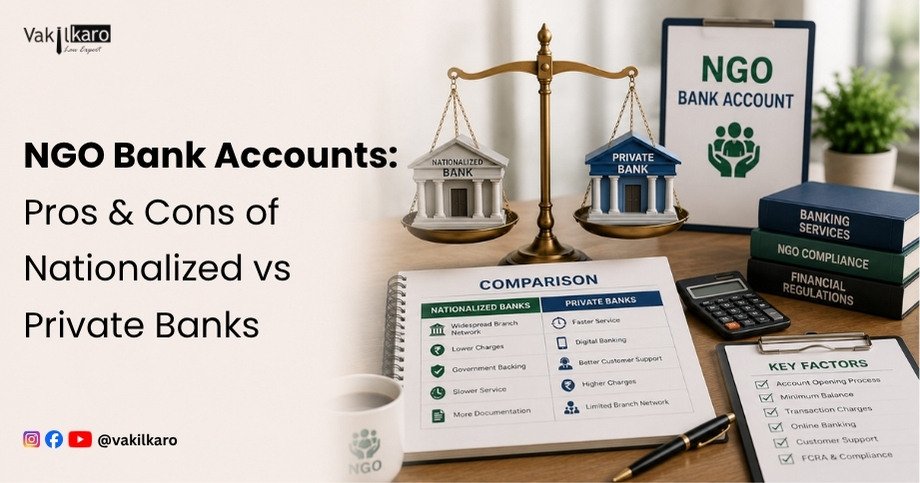
Opening a bank account is vital for NGOs and Section 8 companies handling grants and donations. A common question arises: Should an NGO open an account with a nationalized or a private bank? The decision impacts compliance with NGO registration, Section 8 company registration, 12A and 80G registration, and NGO Darpan listing under NITI Aayog. Nationalized banks offer reliability for government grants and FCRA accounts, while private banks provide better service and technology. NGOs must balance operational efficiency with compliance, keeping in mind the Ministry of Corporate Affairs (MCA) guidelines for long-term financial transparency and credibility.
Key Takeaways
- Faster Processing of Loans and Overdrafts Private banks often approve loans and overdraft facilities quicker than nationalized banks, which can be helpful if the NGO or Section 8 company requires temporary funds for projects.
- Tailored Solutions Some private banks offer specific NGO banking solutions, including zero balance current accounts, bulk transaction facilities, donor management tools, and easier MSME-based loan applications if the NGO has an MSME registration.
- Transparent fund management is crucial to maintain registration on NGO Darpan, and both nationalized and private banks must support this.
- Best Practices for NGO Bank Account Management Regardless of whether an NGO chooses a nationalized or private bank, adopting good practices ensures smooth operations: Dedicated Accounts: Use separate accounts for different funding projects.
- Whether you opt for a nationalized or private bank, ensure that your financial practices are aligned with NGO registration, 12A and 80G certification, NGO Darpan listing, and compliance with NITI Aayog and the Ministry of Corporate Affairs.
Should an NGO Open Its Account in a Nationalized Bank or a Private Bank?
When setting up operations, one of the most critical financial decisions for any NGO or Section 8 company is selecting the right bank to open an account. With frequent transactions like grant receipts, donor contributions, and project-related expenses, NGOs need a reliable banking partner. This raises a key question: Should an NGO open its account in a nationalized bank or a private bank?
The choice significantly influences financial transparency, operational efficiency, and compliance with legal frameworks such as NGO registration, Section 8 company registration, 12A and 80G registration, and platforms like NGO Darpan under NITI Aayog. It also affects audit processes mandated by the Ministry of Corporate Affairs (MCA).
Nationalized banks are often preferred for NGOs dealing heavily with government grants or foreign contributions under FCRA regulations. They offer lower service charges, higher trust for grant disbursements, and are mandatory for setting up FCRA accounts. However, nationalized banks can be slower in processing and may lack advanced digital facilities.
On the other hand, private banks are known for their superior customer service, faster transactions, and advanced digital platforms. NGOs that depend largely on CSR funds, require easy fund tracking, or operate in urban areas often lean towards private banks for operational ease. Nevertheless, private banks usually impose higher service fees and may not be the preferred choice for receiving government grants.
Regardless of the bank type, NGOs must first ensure proper NGO registration, obtain 12A and 80G certificates, and register with NGO Darpan for full compliance. NGOs engaged in commercial activities may also benefit from MSME registration to access additional financial support.
Ultimately, NGOs should choose a bank that balances operational efficiency with strict adherence to financial transparency, compliance, and long-term sustainability goals.
Opening the right bank account is a fundamental decision that significantly shapes the financial journey of any organization, especially for Non-Governmental Organizations (NGOs) and Section 8 companies. These entities operate in a unique space, handling various streams of income such as grants from government bodies, donations from individuals and corporates, CSR funds, and international funding. Managing these inflows efficiently, while ensuring complete transparency and accountability, is critical to maintaining donor trust and regulatory compliance.
Unlike commercial businesses, NGOs and Section 8 companies are subject to strict scrutiny in terms of fund utilization and financial reporting. Every transaction — from grant receipts and donation management to operational expenses and project disbursements — must be transparent and auditable. Hence, the choice of banking partner plays a pivotal role in supporting operational ease, fostering credibility, and ensuring adherence to statutory requirements.
A common and important dilemma faced by these organizations is: Should an NGO open its account in a nationalized bank or a private bank? This decision is not merely about convenience or service speed; it affects how funds are received, managed, and reported. It also impacts compliance with essential legal frameworks such as NGO registration, Section 8 company registration, and the acquisition of 12A and 80G registrations, which offer vital tax exemptions and donor benefits.
Additionally, registrations on platforms like NGO Darpan, managed by NITI Aayog, further demand transparency, often requiring specific banking standards. Government grants, FCRA donations, and CSR partnerships may also influence the choice between a nationalized and private bank.
This blog will explore the critical factors NGOs must consider while making this banking decision, focusing on compliance, financial management best practices, and meeting the regulatory expectations laid down by the Ministry of Corporate Affairs (MCA) and other key statutory bodies.
Understanding NGO Banking Requirements
Before opening a bank account, every NGO must complete its NGO registration under a legal structure: a trust, society, or Section 8 company. Proper documentation like registration certificates, PAN cards, and board resolutions are mandatory.
After registration, obtaining 12A and 80G registrations is vital. 12A provides income tax exemption for the NGO, while 80G enables donors to claim deductions on donations made. Additionally, registration with NGO Darpan, a portal managed by NITI Aayog, is often needed to avail government grants and improve credibility.
Having a valid bank account is mandatory to apply for these registrations and to maintain financial transparency. Thus, the bank selection must support operational ease, compliance, audit trails, and reporting standards.
Nationalized Banks vs. Private Banks: Key Differences
Why Many NGOs Prefer Nationalized Banks?
Government Grants and Donations
Many grant-making authorities, especially government agencies, prefer transferring funds into accounts held in nationalized banks. If an NGO or Section 8 company is registered with NGO Darpan or listed under various schemes with NITI Aayog, it increases credibility when the bank account is with a government-backed institution.
FCRA Compliance for Foreign Funding
If the NGO deals with foreign funding under the Foreign Contribution Regulation Act (FCRA), a designated FCRA account is mandatory. Nationalized banks, particularly the State Bank of India (New Delhi branch), are officially designated to handle FCRA accounts. Private banks cannot be used for initial receipt of foreign funds.
Lower Costs and Charges
Nationalized banks generally impose fewer charges for transactions, account maintenance, and other services—a significant benefit for NGOs that operate on tight budgets.
Audit-Friendly Practices
During audits for 12A and 80G registrations or for annual returns to the Ministry of Corporate Affairs (MCA), accounts with nationalized banks are often perceived as more straightforward and trustworthy by auditors and regulators.
Challenges with Nationalized Banks
Despite their advantages, nationalized banks also come with limitations:
- Slow Processing: Opening an account and handling transactions can involve bureaucratic delays.
- Outdated Technology: Many government banks lag behind private players in digital banking capabilities.
- Limited Personalized Service: NGOs with complex financial needs might find nationalized banks less flexible compared to private banks.
Why Some NGOs Opt for Private Banks?
Superior Customer Service
Private banks offer dedicated relationship managers, quick problem resolution, and proactive service, making daily operations smoother.
Advanced Digital Banking
Private banks excel in providing online portals, mobile apps, instant fund transfer facilities, and advanced payment management systems. This helps NGOs keep better track of multiple funding streams, especially when dealing with numerous grants and CSR donations.
Faster Processing of Loans and Overdrafts
Private banks often approve loans and overdraft facilities quicker than nationalized banks, which can be helpful if the NGO or Section 8 company requires temporary funds for projects.
Tailored Solutions
Some private banks offer specific NGO banking solutions, including zero balance current accounts, bulk transaction facilities, donor management tools, and easier MSME-based loan applications if the NGO has an MSME registration.
Challenges with Private Banks
- Higher Service Charges: Private banks often impose higher charges for account maintenance, transactions, and additional services.
- Preference Issues with Government Funding: Certain government grants may specify transferring funds only into nationalized banks.
- Over-reliance on Technology: Some NGOs based in remote areas may face issues if digital infrastructure is weak.
Key Compliance Considerations for NGOs and Section 8 Companies
Regardless of the type of bank chosen, NGOs must ensure full compliance with statutory requirements:
NGO Registration and Section 8 Company Registration
Before opening a bank account, complete the registration process. A Section 8 company registration provides the added benefit of being regulated under the Ministry of Corporate Affairs (MCA), increasing the organization's credibility.
12A and 80G Registration
Income earned (including donations) must be properly documented for tax benefits. Whether dealing with a private or nationalized bank, financial records must be audit-ready for 12A and 80G compliance.
NGO Darpan Registration
The NGO Darpan portal often mandates submission of bank account details. Transparent fund management is crucial to maintain registration on NGO Darpan, and both nationalized and private banks must support this.
NITI Aayog Accreditation
NITI Aayog emphasizes transparency and accountability. NGOs listed with NITI Aayog must maintain clean, auditable bank accounts.
MSME Registration (Optional)
NGOs involved in social enterprise activities such as skill development, handicrafts, or education can apply for MSME registration, enabling access to low-interest credit schemes and financial support, regardless of the bank type.
Best Practices for NGO Bank Account Management
Regardless of whether an NGO chooses a nationalized or private bank, adopting good practices ensures smooth operations:
- Dedicated Accounts: Use separate accounts for different funding projects.
- Clear Audit Trails: Maintain documentation for every transaction.
- Monthly Reconciliations: Reconcile bank statements with internal records.
- Proper Utilization: Ensure fund utilization strictly for the intended purpose.
- Compliance with MCA and Income Tax Regulations: File annual returns, balance sheets, and audit reports accurately.
Strategic Advice: Nationalized vs. Private Banks
Situation Suggested Bank Type
Dealing primarily with government grants Nationalized Bank
Heavy reliance on CSR donations Private Bank with CSR tools
Need for FCRA accounts Nationalized Bank (mandatory)
Seeking fast loans and overdrafts Private Bank
Located in rural/remote areas Nationalized Bank (branch presence)
Tech-savvy operations and online management Private Bank
Conclusion
Choosing between a nationalized or private bank for an NGO's bank account is not a one-size-fits-all decision. It depends on the organization's funding sources, operational needs, financial planning strategies, and compliance obligations.
For organizations focused on government grants, foreign contributions, or operating in rural areas, a nationalized bank offers trust, government preference, and lower costs. However, NGOs and Section 8 companies that manage multiple donors, need advanced banking solutions, or require fast services may find private banks better suited to their needs.
Whether you opt for a nationalized or private bank, ensure that your financial practices are aligned with NGO registration, 12A and 80G certification, NGO Darpan listing, and compliance with NITI Aayog and the Ministry of Corporate Affairs. NGOs with MSME registration can leverage banking support for business-like activities that advance their mission.
A wise banking choice supports not just financial operations but also builds a stronger, more transparent, and impactful organization.
Why Choose Vakilkaro for NGO Banking and Legal Services?
Choosing the right legal partner is essential when setting up and managing an NGO, Section 8 company, or social enterprise. Vakilkaro offers comprehensive support at every stage, making complex processes simple, efficient, and affordable.
Vakilkaro specializes in NGO registration, Section 8 company registration, 12A and 80G registration, NGO Darpan registration, MSME registration, and ensures full compliance with the Ministry of Corporate Affairs (MCA). Whether you are opening a bank account, obtaining tax exemptions, or maintaining regulatory filings, Vakilkaro delivers reliable, expert-driven solutions.
With a dedicated team of legal experts, Vakilkaro provides end-to-end assistance—from documentation to compliance—ensuring a seamless experience. Their transparent pricing, fast processing, personalized support, and in-depth understanding of NGO-specific legal needs make them a trusted choice for thousands of organizations across India.
Vakilkaro empowers your mission, handling all legal complexities so you can focus on creating real impact.
Official External Resources
Use these primary/official sources to verify rules, forms, fees, timelines and regulatory updates before publication.
Frequently asked questions
NGO Bank Accounts: Pros & Cons of Nationalized vs Private Banks+
Faster Processing of Loans and Overdrafts Private banks often approve loans and overdraft facilities quicker than nationalized banks, which can be helpful if the NGO or Section 8 company requires temporary funds for projects. Tailored Solutions Some private banks offer specific NGO banking solutions, including zero balance current accounts, bulk transaction facilities, donor management tools, and easier MSME-based loan applications if the NGO has an MSME registration.
