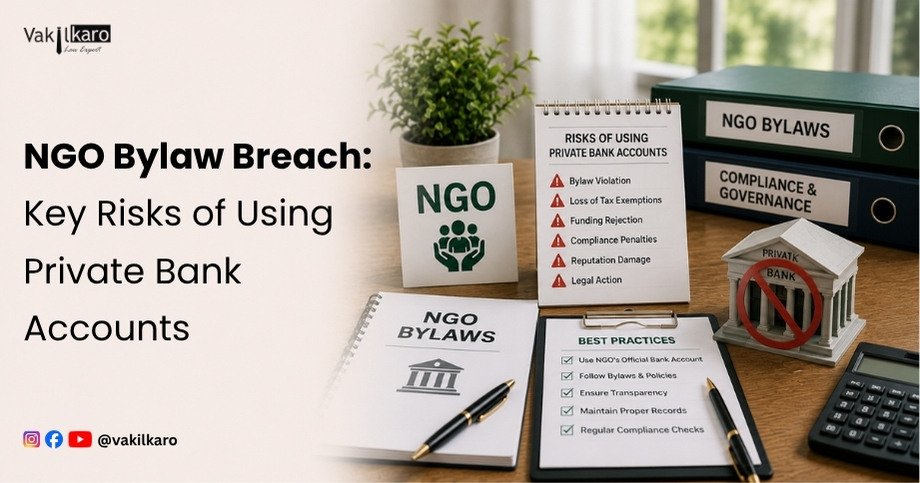
Opening a bank account is vital for NGOs and Section 8 companies to manage grants and donations. However, if an account is opened in a private bank against the NGO’s bylaws, it can create serious legal and compliance issues. Violations may risk 12A and 80G registrations, NGO Darpan listings under NITI Aayog, and lead to scrutiny from the Ministry of Corporate Affairs (MCA). Such actions can harm donor trust, halt funding, and trigger audit flags. Adhering to bylaws is critical to ensure regulatory compliance, maintain credibility, and avoid operational risks that can severely impact an NGO’s sustainability.
Key Takeaways
- Risks of Opening a Private Bank Account Against NGO Bylaws For NGOs and Section 8 companies, managing financial transactions properly is crucial for maintaining transparency, regulatory compliance, and donor trust.
- Opening an account in a private bank against its bylaws can expose the NGO to a range of legal, financial, and compliance risks.
- These documents define the operational framework of the NGO, including: Objectives Management structure Fund management procedures Banking guidelines If the bylaws specifically mention that the NGO must open its bank accounts in a nationalized bank, then violating this rule by opening an account in a private bank can be seen as non-compliance.
- Breach of bylaws has several implications—it affects the organization’s credibility, jeopardizes eligibility for tax exemptions (such as 12A and 80G), risks de-listing from NGO Darpan under NITI Aayog, and could even attract legal action under the Companies Act, 2013 governed by the Ministry of Corporate Affairs.
- Real-World Scenarios: Impact of Bylaw Violations Scenario 1: Loss of Tax Exemptions An NGO working in the education sector, with nationalized bank mandates in its bylaws, opened an account in a private bank for convenience.
Risks of Opening a Private Bank Account Against NGO Bylaws
For NGOs and Section 8 companies, managing financial transactions properly is crucial for maintaining transparency, regulatory compliance, and donor trust. Opening a bank account is a fundamental step—but doing so against the instructions laid out in an organization’s bylaws can expose the NGO to serious risks. Many bylaws clearly specify that the organization's funds must be held in a nationalized bank. If an NGO opens an account in a private bank against this rule, it can face substantial legal, financial, and operational consequences.
First, violating bylaws is a legal breach. Such an action could lead to penalties, cancellation of tax benefits under 12A and 80G registrations, and even scrutiny or deregistration by the Ministry of Corporate Affairs (MCA). Additionally, inconsistencies with bylaws could trigger problems with NGO Darpan registration, affecting access to government grants facilitated through NITI Aayog.
Financially, opening an unauthorized account can create issues during audits, resulting in qualified audit reports that harm the organization’s reputation. Loss of donor confidence is another major risk. Funding agencies and corporate CSR programs often review an NGO’s compliance history before offering grants. A violation can lead to funding being withheld or demands for refunds.
Moreover, NGOs aiming for MSME registration for additional government benefits may find their applications rejected due to poor financial governance practices.
To prevent these risks, NGOs must strictly follow their bylaws or officially amend them before changing banking details. Transparency with all stakeholders, including NGO Darpan, NITI Aayog, and tax authorities, is critical. Consulting legal experts ensures that any amendments are compliant with MCA norms. Ultimately, maintaining strict adherence to bylaws protects an NGO’s credibility, funding prospects, and long-term mission.
For any Non-Governmental Organization (NGO) or Section 8 company, opening a bank account is a critical step in setting up operations. It ensures that funds received from donations, grants, and other sources are transparently managed. However, this seemingly simple act carries legal and operational responsibilities—particularly when choosing the type of bank.
Sometimes, the bylaws or governing documents of an NGO clearly mandate that the organization's accounts must be opened only with a nationalized (government) bank. Opening an account in a private bank against its bylaws can expose the NGO to a range of legal, financial, and compliance risks.
In this blog, we will explore in depth the risks involved in such a decision, the importance of adhering to organizational bylaws, and how this choice impacts NGO compliance processes like NGO registration, Section 8 company registration, 12A and 80G registration, NGO Darpan listing with NITI Aayog, MSME registration, and regulations under the Ministry of Corporate Affairs (MCA).
Understanding NGO Bylaws and Their Legal Importance
When an NGO is formed—whether as a trust, society, or Section 8 company—it must draft a set of rules and regulations called the bylaws. These documents define the operational framework of the NGO, including:
- Objectives
- Management structure
- Fund management procedures
- Banking guidelines
If the bylaws specifically mention that the NGO must open its bank accounts in a nationalized bank, then violating this rule by opening an account in a private bank can be seen as non-compliance.
Breach of bylaws has several implications—it affects the organization’s credibility, jeopardizes eligibility for tax exemptions (such as 12A and 80G), risks de-listing from NGO Darpan under NITI Aayog, and could even attract legal action under the Companies Act, 2013 governed by the Ministry of Corporate Affairs.
Key Risks Involved
Legal Non-Compliance
Bylaws are legally binding once registered. Opening a bank account in contradiction to the bylaws is a violation of the organization's own charter and could be treated as a breach of trust. For Section 8 companies, non-compliance is considered serious under the Companies Act and may attract penalties or even cancellation of their license by the Ministry of Corporate Affairs (MCA).
Legal non-compliance could trigger:
- Show-cause notices from authorities
- Legal suits filed by members, stakeholders, or even donors
- Loss of credibility among beneficiaries and funders
Threat to 12A and 80G Registration
To obtain 12A registration (tax exemption) and 80G registration (donor tax benefit eligibility), NGOs must demonstrate financial transparency and adherence to their stated objectives and procedures.
Opening an account in a private bank when the bylaws specify otherwise may be interpreted as mismanagement of funds. This could lead to:
- Rejection of pending 12A/80G applications
- Revocation of existing 12A/80G approvals
- Increased scrutiny from the Income Tax Department
Without these certificates, the NGO loses significant advantages, including income tax exemption and fundraising appeal to donors.
Issues with NGO Darpan and NITI Aayog Compliance
Registration with NGO Darpan under NITI Aayog is increasingly becoming mandatory for receiving government grants and participating in CSR activities. NGO Darpan profiles must disclose bank account details.
Any discrepancy, such as having an account in a private bank contrary to internal rules, could:
- Lead to rejection or suspension of NGO Darpan ID
- Disqualify the NGO from applying for government schemes or grants
- Harm the organization's reputation among donors and partners
Transparency is the cornerstone of NGO Darpan registration, and deviating from internal governance policies directly impacts this.
Donor Distrust and Funding Risks
Major donors, especially international agencies, CSR wings of corporations, and government departments, often review NGO bylaws and compliance history before releasing funds.
Discovering that the NGO has opened a private bank account against its own bylaws can:
- Cause donors to withhold funding
- Lead to blacklisting from CSR eligibility lists
- Result in demands for fund recalls or refunds
Maintaining strict adherence to governance norms, including banking instructions, reassures donors that their funds are managed responsibly.
Financial Audits and Operational Hurdles
External and internal audits are critical for NGOs. Auditors look at:
- Bank account openings
- Fund flows
- Compliance with organizational policies
An account opened against the bylaws would likely be flagged during audits. It can:
- Result in qualified audit reports (which signal problems to stakeholders)
- Increase the chance of detailed financial inspections
- Delay annual filings with the MCA and Income Tax Department
Qualified audit reports reduce the NGO’s ability to seek future grants, loans (under MSME schemes if applicable), and partnerships.
Challenges in Obtaining or Maintaining MSME Registration
Some NGOs involved in income-generating activities (e.g., vocational training, handicrafts) may seek MSME registration. This provides access to government benefits like subsidized loans.
An NGO found to be mismanaging its banking practices could find it difficult to:
- Obtain MSME registration
- Qualify for credit-linked subsidy schemes
- Avail government procurement opportunities
Clean financial practices are a prerequisite for MSME recognition, just like other regulatory compliances.
Real-World Scenarios: Impact of Bylaw Violations
Scenario 1: Loss of Tax Exemptions
An NGO working in the education sector, with nationalized bank mandates in its bylaws, opened an account in a private bank for convenience. On review, the Income Tax Department cancelled its 12A and 80G registrations, causing donors to stop funding and a 40% drop in revenue within a year.
Scenario 2: Blocked Government Grants
A rural development NGO registered with NGO Darpan was in the final stages of receiving a government grant. However, discrepancies in its bank account details led to suspension of its NGO Darpan profile, halting funding for critical programs.
How to Avoid These Risks?
- Follow Bylaws Strictly:
Always review bylaws before taking operational decisions like opening or shifting bank accounts.
- Amend Bylaws If Needed:
If the organization wishes to work with a private bank for valid reasons (better service, better technology), it should formally amend its bylaws through the prescribed legal procedure and notify the relevant authorities.
- Board Resolutions:
Pass a formal board resolution before making any banking change and record it properly.
- Keep Transparency:
Always update NGO Darpan, NITI Aayog, MCA, Income Tax Department, and donors about any changes to banking details.
- Professional Guidance:
Engage professional services like Vakilkaro to ensure all legal formalities (like amendment filing under MCA or Registrar of Societies) are correctly handled.
When Is It Okay for an NGO to Open a Private Bank Account?
- When the bylaws do not restrict the choice of bank
- When the NGO formally amends its bylaws
- When approvals are obtained through proper board governance mechanisms
- After informing NGO Darpan, NITI Aayog, and compliance authorities
Remember: a bylaw change needs to be registered and updated wherever necessary, especially in case of Section 8 companies regulated under the Ministry of Corporate Affairs.
Conclusion
Opening a private bank account without adhering to the organization's bylaws is not just a minor administrative error—it can pose a serious threat to the very foundation of an NGO or Section 8 company. Such actions can invite legal repercussions, beginning with non-compliance penalties, and extending to the cancellation of critical registrations like 12A and 80G, which are essential for tax exemptions and donor incentives. Additionally, discrepancies in governance practices can result in deactivation or suspension of the NGO’s listing on the NGO Darpan portal under NITI Aayog, further limiting opportunities for government grants and CSR partnerships.
More critically, it risks eroding the trust built with donors, government agencies, and corporate funders. Financial irregularities discovered during statutory audits can significantly damage the credibility of the organization, making it difficult to secure future funding or collaborations. In severe cases, non-compliance can even lead to the revocation of licenses issued by the Ministry of Corporate Affairs (MCA) for Section 8 companies, effectively crippling the organization’s ability to operate legally.
While selecting a capable banking partner is important for operational ease, it should never come at the cost of violating internal governance structures. Strict adherence to bylaws and legal obligations must always take priority. If circumstances necessitate a change—such as shifting to a private bank for better services—organizations must first amend their bylaws through a proper legal process, secure board approvals, and notify all relevant authorities, including NGO Darpan, NITI Aayog, Income Tax Department, and MCA.
By following a diligent and transparent approach, NGOs can maintain operational efficiency, uphold regulatory compliance, safeguard their funding pipelines, and most importantly, continue to build trust among their stakeholders—ensuring their mission-driven work remains uninterrupted and impactful.
Why Choose Vakilkaro for Banking Compliance and Legal Services?
When it comes to setting up an NGO, a Section 8 company, or maintaining strict compliance with bylaws and regulatory frameworks, Vakilkaro stands out as a trusted partner. Vakilkaro offers end-to-end legal, compliance, and advisory solutions tailored specifically for NGOs, social enterprises, and non-profit organizations.
Whether you need assistance with NGO registration, Section 8 company registration, 12A and 80G registration, NGO Darpan enrollment, MSME registration, or ensuring full compliance with the Ministry of Corporate Affairs (MCA), Vakilkaro provides expert support at every step. Our team of seasoned legal professionals ensures that every action—from choosing the right banking partner to amending bylaws legally—is handled with precision and transparency.
Vakilkaro offers:
- Specialized Expertise: Decades of experience dealing with NGO and non-profit compliance.
- Affordable Pricing: Transparent, flat-fee structures with no hidden costs.
- Dedicated Support: Personalized advisory to guide your NGO through legal complexities.
- Fast Turnaround: Swift document processing and registrations without unnecessary delays.
- Comprehensive Services: From registration to annual filings, amendments, compliance updates, and financial governance, everything is managed under one roof.
Choosing Vakilkaro means choosing peace of mind. We help NGOs and Section 8 companies not only set up correctly but also maintain compliance year after year—so you can focus on driving meaningful impact, while we manage the legal framework supporting your mission.
Partner with Vakilkaro — ensuring your organization is legally strong, financially transparent, and fully compliant.
Official External Resources
Use these primary/official sources to verify rules, forms, fees, timelines and regulatory updates before publication.
Frequently asked questions
NGO Bylaw Breach: Key Risks of Using Private Bank Accounts+
Risks of Opening a Private Bank Account Against NGO Bylaws For NGOs and Section 8 companies, managing financial transactions properly is crucial for maintaining transparency, regulatory compliance, and donor trust. These documents define the operational framework of the NGO, including: Objectives Management structure Fund management procedures Banking guidelines If the bylaws specifically mention that the NGO must open its bank accounts in a nationalized bank, then violating this rule by opening an account in a private bank can be seen as non-compliance.
