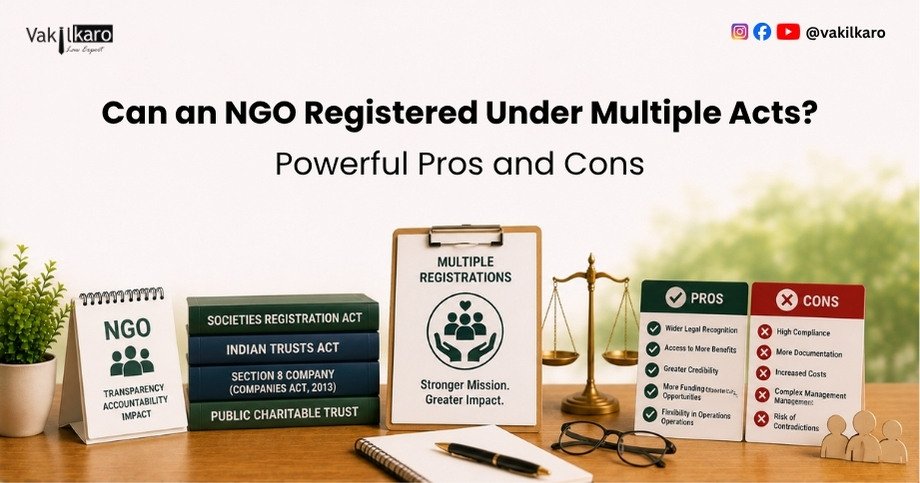
Establishing an NGO in India involves choosing between three legal structures: Trust, Society, or Section 8 Company—each with unique compliance norms and benefits. A common question is whether a single NGO can register under more than one of these Acts. Legally, a single entity cannot hold dual registrations simultaneously (e.g., as both a Society and Section 8 Company). However, separate entities with similar goals can be created. NGO registration must be strategic to avoid duplication, legal risks, and conflicts, especially when applying for 12A and 80G registration. Choose wisely and ensure full compliance with guidance from Vakilkaro.
Key Takeaways
- Understanding NGO Registration: Can an NGO Be Registered Under Multiple Legal Acts?
- A common query among aspiring founders and professionals is whether one NGO can simultaneously be registered under multiple Acts—such as being both a Society and a Section 8 Company.
- Technically and legally, a single legal entity cannot be registered under multiple Acts simultaneously.
- Legal Implications of Dual NGO Registration Attempting to register one organization under multiple Acts without creating separate legal identities can lead to several complications: Rejection of Registration: Registrar of Companies (ROC) or Registrar of Societies may reject duplicate applications if existing registration is found.
- Conclusion: Choose One, Stay Compliant When considering the structure for your NGO, the fundamental takeaway is clear: an NGO cannot be registered under multiple Acts simultaneously using the same identity.
Understanding NGO Registration: Can an NGO Be Registered Under Multiple Legal Acts?
In India, NGOs can be formed under three primary legal structures—Trusts, Societies, or Section 8 Companies. Each form is governed by its own legislative framework, offering distinct legal benefits and compliance responsibilities. A common query among aspiring founders and professionals is whether one NGO can simultaneously be registered under multiple Acts—such as being both a Society and a Section 8 Company. The short answer is no—a single legal entity cannot be registered under more than one Act at the same time.
However, it is legally permissible to establish separate entities under different Acts, provided each one has a distinct name and operates as an independent legal body. For example, an organization may register one wing as a Society and another as a Section 8 Company, provided they function autonomously with separate accounting and governance structures.
That said, dual registration under a single identity is not allowed. Attempting this can result in rejection of registration applications, legal complications, and challenges with tax authorities—especially when applying for 12A and 80G registration, which are essential for securing income tax exemptions and donor benefits.
If an existing NGO wishes to change its structure for strategic or operational reasons, it may opt for conversion—for instance, moving from a Society to a Section 8 Company. This process requires proper legal procedures, including transferring assets and notifying regulatory authorities.
Ultimately, choosing the right structure at the time of NGO registration is critical. Each form affects governance, credibility, funding opportunities, and eligibility for 12A and 80G registration. With the help of experts like Vakilkaro, organizations can ensure full legal compliance while focusing on their mission. Vakilkaro offers end-to-end support for Section 8 company registration, NGO registration, and tax exemptions under Indian law.
Launching a Non-Governmental Organization (NGO) in India requires careful consideration of its legal identity, as this choice shapes governance, reporting, funding access, and public credibility. Broadly, three primary structures are available under Indian law:
- Trusts, formed via a trust deed under the Indian Trusts Act, 1882, are straightforward to establish and well‐suited for asset‐based charitable work. Trustees manage funds directly in line with the deed’s objectives, with relatively minimal ongoing filings.
- Societies, registered under the Societies Registration Act, 1860 (and its state variants), demand a managing committee and democratic membership. They work well for membership‐driven causes—such as educational, cultural, or social welfare initiatives—and require regular general meetings and annual submissions to the Registrar.
- Section 8 Companies, incorporated under Section 8 of the Companies Act, 2013, offer the most structured governance model. These not‐for‐profit corporations must hold board meetings, file audited financials, and comply with corporate secretarial norms. While more rigorous, Section 8 company registration often enhances donor confidence—particularly for CSR and international grants.
A common query among founders and legal advisors is whether a single NGO can hold dual registration—for example, as both a Society and a Section 8 Company. Legally, the same entity cannot register twice under different Acts; each registration creates a separate legal person. Instead, organizations may choose to maintain distinct entities with shared objectives or convert from one form to another, ensuring assets and operations transfer properly.
This discussion probes the legality and practicalities of dual registration, explores how conversions work, and highlights the critical importance of maintaining 12A and 80G registration under the Income Tax Act to secure tax exemptions and ensure donor incentives remain intact.
Understanding the Legal Structures
Before addressing dual registration, it's important to understand the key characteristics of the three types of NGO registration:
- Trusts: Created by a trust deed, usually governed by the Indian Trusts Act, 1882 or relevant state-specific laws. Trusts are suitable for managing assets and carrying out charitable work, typically having a board of trustees.
- Societies: Governed by the Societies Registration Act, 1860, or its state amendments, societies require at least seven members and operate through a managing committee. They are ideal for membership-based organizations focusing on education, art, culture, etc.
- Section 8 Companies: Registered under Section 8 of the Companies Act, 2013, these entities are tightly regulated, requiring board meetings, annual filings, and audits. They are preferred by larger organizations seeking greater transparency and structured governance.
Is Dual NGO Registration Permissible?
Technically and legally, a single legal entity cannot be registered under multiple Acts simultaneously. That is, an NGO cannot be both a Society and a Section 8 Company at the same time using the same legal identity. However, there are nuances worth exploring:
Separate Legal Entities with Shared Objectives
Two distinct entities can be created under different Acts with aligned or similar objectives. For example, an organization may register ABC Foundation as a Society and later register ABC Charitable Services as a Section 8 Company. While both can operate towards a common goal, legally, they are separate entities with independent governance structures.
Operational Collaboration Between Entities
Although dual registration isn't allowed under one identity, multiple registered entities (a trust, society, and Section 8 company) can collaborate. They may share resources, projects, or even funding in some cases, but all financial and legal responsibilities remain distinct.
Conversion from One Form to Another
Instead of dual registration, NGOs often opt for conversion. For example, a registered Society may apply to convert into a Section 8 Company. This involves closing the original registration and initiating a fresh Section 8 company registration, along with the transfer of assets and responsibilities under the supervision of relevant authorities.
Legal Implications of Dual NGO Registration
Attempting to register one organization under multiple Acts without creating separate legal identities can lead to several complications:
- Rejection of Registration: Registrar of Companies (ROC) or Registrar of Societies may reject duplicate applications if existing registration is found.
- Violation of Laws: It may constitute a breach of corporate and NGO laws, leading to penalties or cancellation of registrations.
- Non-compliance Risks: Each entity has different compliance obligations. Overlapping registrations can result in missed filings or misreporting.
Role of 12A and 80G Registration
For any NGO, obtaining 12A and 80G registration under the Income Tax Act is crucial for tax exemption and donor incentives:
- 12A Registration: Grants income tax exemption on NGO surplus income.
- 80G Registration: Allows donors to claim tax deductions on contributions.
Only one entity—be it a Society, Trust, or Section 8 Company—can apply for these registrations. If multiple entities operate under the same branding, each must apply separately and maintain individual accounts.
In case of overlapping registrations, the Income Tax Department can question the legitimacy of financials, donations, and utilization of funds. It may even lead to denial or revocation of 12A and 80G registrations.
Section 8 Company Registration: A Closer Look
Section 8 Company registration is often considered the gold standard in NGO formation due to its structured framework, credibility with foreign donors, and stringent compliance model. Here’s what makes Section 8 registration attractive:
- Corporate Governance: Mandatory board meetings, financial audits, and annual returns enhance accountability.
- Tax Benefits: Easier to secure 12A and 80G registration.
- Funding Prospects: Many CSR initiatives and international agencies prefer funding Section 8 companies.
- Legal Standing: It is treated as a corporate entity, making it easier to enter into contracts and own property.
Given these benefits, many existing societies or trusts choose to convert to Section 8 entities rather than maintaining dual structures.
Case Study: Avoiding Dual Registration Confusion
Let’s consider a hypothetical NGO, "Harmony for All," which initially registered as a Society in 2015 and later wanted to expand its reach, attract CSR funds, and operate on a national level. Believing Section 8 Company registration would help, they attempted to register under the Companies Act without winding up their society registration. Their application was rejected by the ROC due to the similarity in name and objective, which was already in use.
Ultimately, they created a new entity with a different name, aligned their objectives, and secured 12A and 80G registration separately. They now run two legally distinct but operationally collaborative entities.
Best Practices for NGOs Considering Multiple Structures
- Clarify Objectives and Future Plans: Choose the appropriate legal structure based on your scale, funding needs, and long-term goals.
- Avoid Redundancy: Register only one legal entity unless a compelling operational need exists for more.
- Stay Compliant: Each legal form has distinct compliance requirements. Avoid overlapping registrations to prevent legal risks.
- Secure Tax Benefits: Apply for 12A and 80G registration with your primary operating entity.
- Consult Experts: Seek guidance from legal professionals or service providers like Vakilkaro to ensure proper NGO registration, Section 8 company registration, and income tax compliance.
Conclusion: Choose One, Stay Compliant
When considering the structure for your NGO, the fundamental takeaway is clear: an NGO cannot be registered under multiple Acts simultaneously using the same identity. However, there is flexibility in creating multiple legal entities with shared goals but different registrations. For example, you may register one organization as a Society and another as a Section 8 Company. These entities, while working toward the same objectives, must remain distinct in terms of governance, financial management, and operations to ensure compliance with the respective laws under which they are registered.
The decision on whether to register your NGO as a Trust, Society, or Section 8 Company is a crucial one. Each structure has its own advantages, depending on the scale of operations, the nature of the work, and the intended sources of funding. A Trust offers simplicity and flexibility, especially for smaller initiatives, while a Society provides a collaborative, membership-based framework. On the other hand, a Section 8 Company delivers a more structured corporate governance model, suitable for larger organizations looking for greater transparency, easier access to corporate social responsibility (CSR) funds, and a higher level of regulatory compliance.
This decision also impacts other important aspects such as 12A and 80G registration. These registrations, which offer tax exemptions and provide donors with incentives, can only be obtained by a single registered entity. Therefore, ensuring that your organization’s legal structure aligns with your long-term vision and funding strategy is critical.
If you’re uncertain about which registration is best suited for your NGO or if you are considering transitioning to a Section 8 company, Vakilkaro is here to assist. With extensive experience in NGO registration, 12A and 80G approval, and regulatory compliance, Vakilkaro ensures that your NGO is properly structured, legally compliant, and well-positioned for growth and impact. Let us guide you through the complexities of NGO formation and tax registrations, so you can focus on your organization’s mission and goals.
Official External Resources
Use these primary/official sources to verify rules, forms, fees, timelines and regulatory updates before publication.
Frequently asked questions
Can an NGO Registered Under Multiple Acts? Powerful Pros and Cons+
Understanding NGO Registration: Can an NGO Be Registered Under Multiple Legal Acts? A common query among aspiring founders and professionals is whether one NGO can simultaneously be registered under multiple Acts—such as being both a Society and a Section 8 Company.
