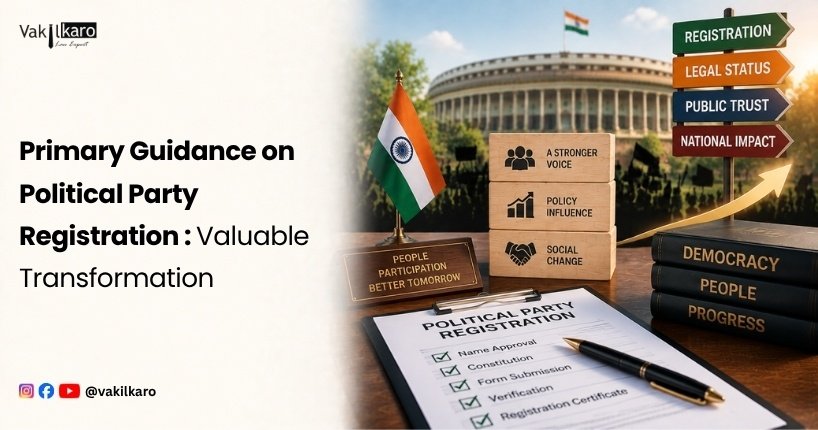
India’s vibrant democracy relies on strong political parties. Registering a party is vital for legitimacy, tax benefits, and access to election symbols. The Representation of the People Act, 1951, governs this process, ensuring transparency and accountability. From drafting your party’s constitution to submitting affidavits and publishing notices, every step requires diligence. New online systems have simplified registration, but compliance remains critical. Vakilkaro guides aspiring parties through documentation, filings, and legal formalities, making the process smooth and efficient. Whether launching a regional platform or a national movement, proper registration empowers your party to participate fully and credibly in India’s democratic process.
Key Takeaways
- A Guide to Political Party Registration in India: Explained India’s dynamic democracy thrives on the participation of countless political parties, ranging from national organizations to regional groups that represent specific communities and interests.
- To operate legally and gain credibility, every political party registration must undergo a formal registration process outlined under the Representation of the People Act, 1951.
- You’ll learn how political party registration works, why it is so important, and how the process has evolved with the introduction of online systems.
- Other Relevant Laws and Guidelines While the Representation of the People Act, 1951 remains the primary law, several additional statutes and rules impact political party registration in India: The Election Symbols (Reservation and Allotment) Order, 1968 governs the allocation and reservation of symbols.
- As political participation grows and new movements emerge, the process of new political party registration online in India has become both more accessible and more essential.
A Guide to Political Party Registration in India: Explained
India’s dynamic democracy thrives on the participation of countless political parties, ranging from national organizations to regional groups that represent specific communities and interests. To operate legally and gain credibility, every political party registration must undergo a formal registration process outlined under the Representation of the People Act, 1951. This legislation establishes the legal backbone for elections, party regulation, and oversight.
Registering a political party is far more than a bureaucratic requirement. It grants essential benefits, including official recognition by the Election Commission of India (ECI), the right to claim an exclusive election symbol, and eligibility for tax exemptions on donations. These advantages not only strengthen a party’s public image but also ensure transparency in funding and operations.
The process begins with drafting a detailed constitution that explains the party’s membership guidelines, internal governance, and financial accountability measures. An application must then be filed with the ECI within 30 days of forming the party, accompanied by affidavits, member declarations, and the necessary fees. Once submitted, the Commission publishes a public notice inviting objections and may seek clarifications or additional documentation before granting registration.
To make this process more accessible, the Election Commission of India (ECI) now offers online tools that allow political groups to download forms, upload documents, and track applications digitally. However, even with digital advancements, the process can be complex, especially for new or grassroots movements unfamiliar with legal requirements.
This is where Vakilkaro plays a pivotal role. Vakilkaro’s experts provide end-to-end support, from drafting the party’s constitution to ensuring all submissions meet statutory guidelines. Their services help founders avoid delays, respond to ECI queries, and maintain compliance with tax and disclosure rules. By leveraging professional guidance, emerging political groups can establish their platform confidently, participate in elections transparently, and contribute meaningfully to India’s democratic fabric.
India, the world’s largest democracy, thrives on a vibrant and diverse multi-party system. From national political behemoths that have shaped the country’s direction for decades to regional outfits that give voice to local aspirations, political parties form the backbone of democratic participation. They play a crucial role in shaping policies, driving social movements, and articulating citizen demands across every corner of the nation.
However, with this immense influence comes an equally vital responsibility: ensuring oversight, transparency, and accountability. A political party is not merely an association of like-minded people; it is an institution that must comply with clear legal standards designed to protect the integrity of India’s electoral system. The laws and rules governing the creation and functioning of political parties ensure that democracy remains fair, representative, and credible.
One of the most common questions that arises among citizens, aspiring politicians, activists, and researchers alike is: What is the primary law regulating political parties in India? The answer lies in the Representation of the People Act, 1951, which provides the statutory framework for party registration, recognition, and compliance obligations. Understanding this framework is essential for anyone looking to start a new political party or evaluate the legitimacy of existing ones.
In this blog, we will demystify the legal provisions that govern the registration, conduct, and regulation of political parties. You’ll learn how political party registration works, why it is so important, and how the process has evolved with the introduction of online systems.
Navigating this legal landscape can feel overwhelming, especially for first-time applicants. This is why professional guidance matters. Vakilkaro specializes in helping political groups and emerging movements complete the registration process accurately and efficiently. From drafting your constitution to filing documents with the Election Commission and ensuring compliance with tax and disclosure requirements, Vakilkaro provides end-to-end support so you can focus on your vision while staying fully compliant with India’s laws.
The Legal Backbone: The Representation of the People Act, 1951
The Representation of the People Act, 1951 is the principal law regulating political parties in India. This landmark legislation was enacted to provide the statutory framework for:
- Conduct of elections to the Houses of Parliament and to the Legislature of each State
- Qualifications and disqualifications for membership
- The process of contesting elections
- Corrupt practices and electoral offenses
- The registration and recognition of political parties
Section 29A of this Act specifically governs political party registration in India. Under this provision, any association or body of individuals calling itself a political party must apply to the Election Commission of India (ECI) for registration within 30 days of its formation.
This provision helps ensure that the political landscape remains orderly and that parties meet minimum standards of transparency and democratic functioning.
Why Is Political Party Registration Important?
Political party registration is not merely an administrative formality. It serves several critical purposes:
- Legitimacy: Registration with the Election Commission grants a political party official recognition and entitles it to certain privileges.
- Election Symbol Allotment: Registered political parties can reserve a unique election symbol, a vital component of campaigning in a country with high illiteracy rates.
- Income Tax Benefits: Registered parties are eligible for income tax exemptions under the Income Tax Act, 1961.
- Funding and Reporting: Registered political parties must adhere to disclosure requirements, including filing audited accounts and submitting statements of donations.
Because of these advantages, new political party registration online in India has become increasingly common. The Election Commission has digitized processes to make it easier for emerging political movements to comply with regulations and formalize their existence.
The Role of the Election Commission of India (ECI)
The Election Commission of India is a constitutional authority entrusted with administering elections in a free, fair, and impartial manner. It is also the statutory regulator for political parties.
When you initiate political party registration in India, the ECI evaluates whether your association meets the legal requirements laid down in Section 29A.
The ECI ensures:
- The proposed party is committed to upholding the Constitution of India.
- It adheres to principles of socialism, secularism, and democracy.
- It abides by the Election Symbols (Reservation and Allotment) Order, 1968.
- Its constitution contains transparent membership rules, disciplinary processes, and financial provisions.
This rigorous scrutiny helps prevent frivolous or fraudulent entities from entering electoral politics.
The Process of Political Party Registration
Here is a step-by-step guide to new political party registration online in India and offline:
Step 1: Drafting the Constitution of the Party
Every aspiring political party must draft a detailed constitution that lays out:
- Membership criteria
- Office bearers and their functions
- Internal democracy and decision-making
- Financial accountability
- Dispute resolution mechanisms
This document is foundational to the party’s registration and future governance.
Step 2: Application to the Election Commission
The party must submit Form PP-1 under Section 29A to the ECI, along with:
- A demand draft for Rs. 10,000 as processing fee
- A printed copy of the party constitution, duly signed
- An affidavit sworn by the President/General Secretary affirming compliance
- A list of at least 100 party members, each attesting that they belong to the organization
- Individual affidavits from these members with photographs and identity proofs
Step 3: Public Notice and Objections
After receiving your application, the ECI will publish a public notice in two national and two local newspapers. If any citizen objects to your political party registration, they must submit written objections within 30 days.
Step 4: Verification and Clarification
The ECI may call for clarifications, additional documents, or personal appearances. During this stage, you should be prepared to demonstrate genuine political objectives and organizational readiness.
Step 5: Issuance of Registration Certificate
Once all formalities are satisfied, the ECI will issue an official certificate of registration. From this moment, your party becomes a recognized political entity.
Online Registration: A Digital Leap Forward
Thanks to the Election Commission’s modernization drive, new political party registration online in India has become significantly more accessible.
Through the ECI’s official portal, political groups can:
- Download application forms and checklists
- Upload scanned copies of affidavits and documents
- Track the status of their applications
- Receive digital communication and clarifications
Digitalization has not only accelerated processing times but also improved transparency and convenience for stakeholders.
Other Relevant Laws and Guidelines
While the Representation of the People Act, 1951 remains the primary law, several additional statutes and rules impact political party registration in India:
- The Election Symbols (Reservation and Allotment) Order, 1968 governs the allocation and reservation of symbols.
- The Conduct of Election Rules, 1961 outline procedures for nominations, polling, and counting.
- The Income Tax Act, 1961 regulates tax exemptions for registered parties.
- The Foreign Contribution (Regulation) Act, 2010 restricts foreign funding.
Additionally, the Supreme Court of India has passed several judgments requiring transparency in candidate selection, criminal background disclosures, and funding reports.
Challenges in Political Party Regulation
While India’s legal framework is robust, enforcement challenges persist:
- Proliferation of dormant or inactive parties registered solely to receive donations and enjoy tax benefits.
- Lack of inner-party democracy in many organizations, despite their constitutional commitments.
- Opaque funding, with large portions of donations coming through untraceable instruments.
- Misuse of election symbols and violations of the Model Code of Conduct.
In this context, reforms are frequently proposed, including stricter audits, mandatory inner-party elections, and public disclosure of funding sources.
Importance of Transparency and Accountability
A strong regulatory framework for political party registration in India is essential to uphold the democratic process. Without transparency, voters cannot make informed choices, and the electoral playing field becomes unequal.
The Election Commission’s emphasis on audited accounts, disclosures, and adherence to democratic principles is intended to ensure that political parties:
- Represent genuine public interests
- Do not function as mere business vehicles
- Are accountable to their members and the electorate
This is why new entrants considering new political party registration online in India must commit to transparency from the outset.
How Vakilkaro Supports Political Party Registration
Navigating the legal requirements for political party registration in India can be daunting, especially for grassroots groups or first-time political aspirants.
Vakilkaro offers end-to-end advisory and compliance support, including:
- Drafting and vetting of party constitutions
- Preparing affidavits and member declarations
- Filing applications and supporting documents with the Election Commission
- Tracking application progress
- Guiding responses to objections or clarifications
- Advising on compliance with tax, CSR funding, and reporting obligations
- Assisting in maintaining statutory records
With Vakilkaro’s expertise, political groups can focus on their mission while ensuring that all legal formalities are fulfilled accurately and efficiently.
The Relevance of Political Party Registration in Today’s Democracy
In a rapidly evolving political landscape, new political party registration online in India has empowered countless communities, ideologies, and regional voices to enter the electoral arena. Whether it is a party representing farmers, youth, women, or linguistic minorities, the registration process enables these groups to:
- Obtain official recognition and legitimacy
- Contest elections under a distinct symbol
- Access tax benefits and public funding support
- Build credibility with voters and institutions
This democratization of political participation is one of the hallmarks of India’s electoral success.
Future of Political Party Regulation
The Election Commission has recommended several measures to further strengthen the system, including:
- De-registration of dormant or non-compliant parties
- Mandatory online disclosure of audited accounts
- Prohibiting cash donations above a low threshold
- Strengthening penalties for non-compliance
In the coming years, these reforms are likely to make political party registration in India even more transparent and robust.
Conclusion
The Representation of the People Act, 1951 remains the primary law regulating political parties in India. This legislation, along with related rules and orders, creates a comprehensive framework for political party registration, oversight, and accountability.
As political participation grows and new movements emerge, the process of new political party registration online in India has become both more accessible and more essential. Whether you are an aspiring leader or a civic-minded citizen, understanding these regulations helps ensure that India’s democracy remains transparent, inclusive, and resilient.
If you are planning to start a political party or need help navigating the complex registration process, Vakilkaro can be your trusted partner. From drafting your constitution to securing your registration certificate, Vakilkaro’s experienced professionals guide you every step of the way, ensuring compliance with all legal requirements.
Would you like help preparing your party’s constitution, affidavits, or a step-by-step checklist for registration? Get in touch today, and let Vakilkaro make your political journey simpler, compliant, and successful.
Official External Resources
Use these primary/official sources to verify rules, forms, fees, timelines and regulatory updates before publication.
Frequently asked questions
Primary Guidance on Political Party Registration: Valuable Transformation+
A Guide to Political Party Registration in India: Explained India’s dynamic democracy thrives on the participation of countless political parties, ranging from national organizations to regional groups that represent specific communities and interests. To operate legally and gain credibility, every political party registration must undergo a formal registration process outlined under the Representation of the People Act, 1951.
