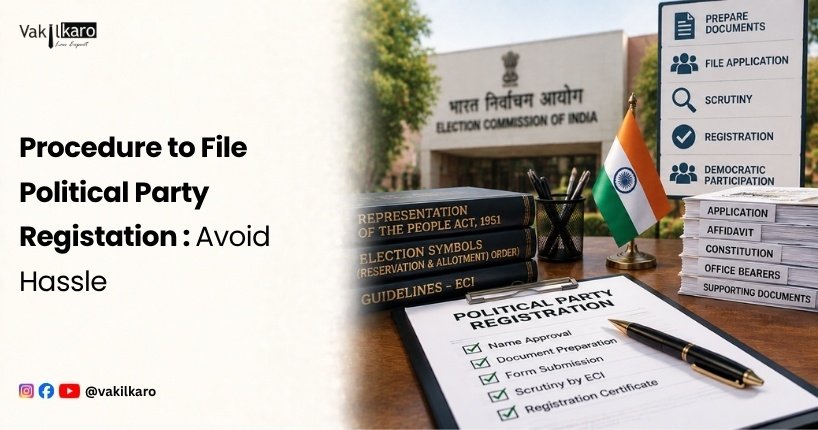
India offers every citizen the right to form a political party, but official political party registration is essential to gain recognition and contest elections legally. This blog explains how to file political party registration in India step by step, from drafting your party’s Constitution and choosing a unique name to publishing public notices and submitting your application to the Election Commission. It also covers timelines, fees, common mistakes, and tips for new political party registration online in India. By following these guidelines, you can avoid delays and ensure your party is ready to participate in India’s democratic process confidently.
Key Takeaways
- This blog explains how to file political party registration in India step by step, from drafting your party’s Constitution and choosing a unique name to publishing public notices and submitting your application to the Election Commission.
- For any organization to be legally recognized as a political party—and to enjoy the privileges and benefits associated with that status—it must comply with the official process of political party registration in India as laid down by the Election Commission of India.
- As important as it is, the procedure can feel complex and overwhelming, particularly for those attempting new political party registration online in India without prior experience.
- This detailed blog will walk you through the entire process of applying for political party registration, eligibility criteria, documentation, timelines, and frequently asked questions.
- Step-by-Step Process to Apply for Registration of a Political Party Below is the stepwise procedure to complete new political party registration online in India or by submitting physical forms: 1.
How to Register a Political Party Registration in India: Step-by-Step Guide
In India, forming a political party is more than gathering like-minded people under one banner. To participate in elections and receive official recognition, every group must complete a formal process of political party registration through the Election Commission of India (ECI).
The first step is drafting a comprehensive party Constitution. This document should clearly outline your objectives, internal democracy procedures, membership guidelines, and a commitment to uphold the Indian Constitution. It must also explicitly state that no party member will pledge allegiance to any foreign power or act against national interests.
Next, you’ll need to select a unique party name that does not resemble existing political entities or use religious or offensive language. Once finalized, your organization must publish a public notice announcing your intention to register. This notice should appear in two national and two local newspapers and invite any objections within 30 days.
After publishing the notice, you must submit your registration application to the ECI. The application must include your Constitution, affidavits from at least 100 verified members, a demand draft for the registration fee, a list of office bearers, and proof of your public notice. Although new political party registration online in India is available, you still have to send physical copies of documents for official verification.
Once your application is received, the Election Commission will scrutinize all submissions and wait for any objections. If no issues arise, the ECI will issue a Certificate of Registration, granting your party legal standing to contest elections, apply for reserved symbols, and receive donations lawfully.
Following this process carefully helps avoid delays and ensures your party is fully compliant. Whether you apply offline or use new political party registration online in India, attention to detail and timely submission are essential to establish a credible political platform.
India, the world’s largest democracy, provides its citizens with the fundamental right to form associations and political parties to participate in shaping the nation’s political landscape. This right is essential in a diverse society, where people come together to represent varied social, economic, cultural, and ideological interests. Political parties are the cornerstone of representative democracy, allowing citizens to organize, contest elections, and advocate policies that reflect their communities’ aspirations.
However, creating a political party in India is not merely about gathering a group of supporters who share common beliefs or political goals. For any organization to be legally recognized as a political party—and to enjoy the privileges and benefits associated with that status—it must comply with the official process of political party registration in India as laid down by the Election Commission of India. Without formal registration, a group cannot contest elections under a common symbol, claim tax benefits on donations, or secure access to facilities such as allocated broadcast time during campaigns.
This process involves several technical steps, including drafting a detailed party Constitution, publishing notices to invite objections, submitting affidavits and membership lists, and adhering to strict timelines. As important as it is, the procedure can feel complex and overwhelming, particularly for those attempting new political party registration online in India without prior experience.
That’s where professional guidance becomes invaluable. Vakilkaro, a trusted legal service platform, plays a crucial role in helping aspiring political organizations navigate every aspect of registration. Vakilkaro’s experienced team assists in preparing the necessary documents, ensuring compliance with the Election Commission’s requirements, verifying affidavits, and avoiding common mistakes that can delay or derail the process. Whether you need help drafting your party’s Constitution or submitting your application online, Vakilkaro provides step-by-step support to make registration straightforward and hassle-free.
This detailed blog will walk you through the entire process of applying for political party registration, eligibility criteria, documentation, timelines, and frequently asked questions. Whether you plan to register your political party independently or wish to leverage Vakilkaro’s expertise for faster, error-free filing, this guide will equip you with all the information you need to get started confidently.
Why Register a Political Party?
Before diving into the step-by-step process, it’s essential to understand why political party registration in India is so important. Registration is not just a bureaucratic formality—it establishes a party’s legal standing and unlocks significant benefits that are critical to functioning effectively in India’s electoral system:
- Legal Recognition:
Only a registered political party is officially acknowledged by the Election Commission of India (ECI). This recognition is what allows your organization to contest elections under a single banner and field candidates in the name of the party. Without registration, your candidates must run as independents, which makes it harder to build a recognizable brand, rally supporters, and secure a consistent voter base.
- Tax Benefits:
Donations to registered political parties are eligible for tax exemptions under the Income Tax Act, 1961. This provides a compelling incentive for individuals and corporations to contribute financially. Donors can claim deductions under Section 80GGC, which can significantly boost fundraising efforts and sustain party activities over the long term.
- Election Symbols:
One of the most crucial advantages of political party registration is the ability to reserve an election symbol under the Election Symbols (Reservation and Allotment) Order, 1968. A reserved symbol—such as a lotus, hand, or broom—helps voters easily identify your candidates across constituencies, even if literacy levels are low. A recognizable symbol becomes part of your party’s identity and electoral strategy.
- Entitlements:
Registered political parties receive several privileges during elections, including free airtime on state-run media like Doordarshan and All India Radio to broadcast their campaign messages. They also receive copies of the electoral roll, access to public venues for rallies, and other logistical support, which are critical to conducting an effective campaign.
- Transparency and Compliance:
Registration ensures your party operates within the legal framework of the Representation of the People Act, 1951. This transparency reinforces public trust, as your party is required to maintain audited accounts, declare sources of funding, and adhere to reporting obligations. The Election Commission can monitor compliance, helping prevent misuse of political funding and promoting clean elections.
In short, registering a political party in India is essential not only for legal and electoral legitimacy but also for building credibility with voters, attracting funding, and gaining access to institutional support. This is why understanding and completing political party registration in India is the foundation of any serious political movement.
Governing Authority for Political Party Registration in India
The responsibility for regulating and supervising political party registration in India lies exclusively with the Election Commission of India (ECI). Established as an autonomous constitutional body, the ECI is headquartered in New Delhi and is tasked with ensuring free, fair, and transparent elections across the country.
The Election Commission derives its authority to register political parties under Section 29A of the Representation of the People Act, 1951. This section lays down the legal framework that governs how new political parties are formed, registered, and regulated. It empowers the Commission to set the rules, scrutinize applications, and grant official recognition to qualifying organizations.
Section 29A specifies that any association or body of Indian citizens that wants to be registered as a political party must submit an application to the ECI within 30 days of its formation. The application must be made in the prescribed format and accompanied by essential documents, including:
- A copy of the party’s constitution detailing its objectives, membership rules, and commitment to democratic functioning.
- An affidavit affirming that the party pledges allegiance to the Constitution of India and upholds the sovereignty, unity, and integrity of the nation.
- A list of office bearers and at least 100 verified members, along with their voter information.
- Proof of public notice published in newspapers inviting objections.
Once received, the Election Commission thoroughly examines the application to ensure compliance with all legal requirements. It also allows a 30-day window for the public to raise objections, if any, against the proposed registration.
The ECI plays a critical role not only as the registering authority but also as the regulator, ensuring that political parties remain accountable and operate within the framework of the law. All registered parties must regularly submit audited accounts, annual returns, and statements of donations to the Commission.
In recent years, the ECI has modernized the process by introducing facilities for new political party registration online in India, making it more efficient and transparent. However, even when applying online, parties must send physical documents for record verification.
Ultimately, the Election Commission of India remains the sole and final authority to approve, monitor, and, if necessary, deregister political parties that fail to comply with statutory obligations.
Who Can Form a Political Party?
Any group of Indian citizens can come together to form a political party. There is no minimum educational qualification or specific age requirement (other than being an adult). However, to be eligible for political party registration in India, your group must:
- Be organized with the aim of contesting elections.
- Have a clear Constitution and memorandum.
- Maintain democratic principles within the organization.
Step-by-Step Process to Apply for Registration of a Political Party
Below is the stepwise procedure to complete new political party registration online in India or by submitting physical forms:
Drafting the Party Constitution
The first step in political party registration is to create a detailed Constitution. The Election Commission insists that your Constitution must:
- Clearly define the party’s aims and objectives.
- Enshrine democratic principles (elections within the party, accountability of office bearers, etc.).
- Specify rules about membership, expulsion, dispute resolution, and party funds.
- Include a commitment to uphold the Indian Constitution and sovereignty.
The Constitution must also state that no member will owe allegiance to any foreign power or act against national interests.
Choosing the Party Name
The Election Commission will scrutinize the name of your proposed party to ensure:
- It does not have any religious or caste connotation.
- It is not identical or deceptively similar to existing political parties.
- It does not contain obscene or objectionable expressions.
Therefore, during new political party registration online, you should propose a unique and appropriate party name.
Publication of Public Notice
After preparing your Constitution and deciding the name, you must publish a public notice announcing your intention to register. The public notice must:
- Be published in two national daily newspapers and two local daily newspapers in the region where the party office is located.
- Include the proposed name of the party and the address of the main office.
- State that any objections should be sent to the Election Commission within 30 days.
This is a mandatory step in political party registration in India to invite objections and ensure transparency.
Filing the Application
Within 30 days of publishing the notice, the party must submit its application to the Secretary of the Election Commission. The application must be:
- Typed on the party’s letterhead.
- Signed by the chief office bearer (usually the President or General Secretary).
- Accompanied by the following documents:
- A copy of the party’s Constitution.
- A demand draft for Rs. 10,000 in favor of the Secretary, Election Commission of India (this is the processing fee).
- Authenticated affidavits from at least 100 party members, confirming their membership and attesting to the genuineness of the application.
- A copy of the public notice as published in the newspapers.
- A list of office bearers and members, along with their addresses and voter ID details.
- A clear photograph of the party symbol you wish to request (if any).
In recent years, the Election Commission has also allowed new political party registration online in India, where applicants can upload their documents on the official ECI portal. However, you still need to submit physical copies for record verification.
Scrutiny and Objections
After receiving your application, the Election Commission will:
- Check all documents for compliance.
- Wait for the mandatory 30-day period to see if any objections have been filed by the public or other parties.
- Send communications to you for clarifications if needed.
If objections are raised, the Commission will give your party an opportunity to respond and may conduct a hearing before taking a decision.
Decision and Registration Certificate
If the Election Commission finds no issues and all requirements are met, it will issue a Certificate of Registration. From this date, your party becomes officially recognized under Section 29A of the Representation of the People Act.
This registration allows your party to:
- Contest elections.
- Apply for common symbols.
- Receive donations legally.
- Access electoral benefits.
Timeline for Political Party Registration
The timeline varies depending on the completeness of your documents and objections raised. Generally, the process takes 3-4 months:
- Drafting Constitution: 2-3 weeks.
- Publication of notice and waiting for objections: 30 days.
- Application review and clarifications: 4-6 weeks.
If you use new political party registration online in India, this can reduce delays, but you still must allow time for postal communications and verifications.
Key Points to Remember
When planning political party registration, keep these crucial points in mind:
- Submit your application within 30 days of forming the party.
- Make sure affidavits are properly notarized.
- Publish the notice in newspapers as specified.
- Maintain all records and keep scanned copies for future reference.
- Respond promptly to any queries from the Election Commission.
- Do not start using the party name or symbol officially until you receive the registration certificate.
Common Mistakes in Political Party Registration
Many applicants make errors that delay or derail the process:
- Incomplete Constitution – Missing provisions on internal elections or financial transparency.
- Improper Publication – Not publishing notices in the correct newspapers.
- Wrong Fee Payment – Submitting incorrect demand drafts.
- Late Submission – Exceeding the 30-day period after public notice.
- Unverified Affidavits – Signatures without proper notary attestation.
- Name Conflicts – Selecting names already taken or sounding similar to existing parties.
These issues can be avoided by consulting legal professionals or carefully following the ECI guidelines.
Frequently Asked Questions
Can I apply for political party registration online?
Yes, the Election Commission offers a facility for new political party registration online in India through its official portal. However, physical submission of original documents is still required.
Can a foreign national be a member of a registered political party?
No, only Indian citizens are eligible to be members of registered political parties.
How long is the registration valid?
Registration remains valid unless canceled by the Election Commission for non-compliance, such as failure to submit audited accounts or not contesting elections for several years.
Is registration the same as recognition?
No, registration is the first step that grants legal status. Recognition as a state or national party depends on performance in elections, based on criteria like vote share and seats won.
How can I reserve a party symbol?
After registration, you can apply for a symbol under the Election Symbols (Reservation and Allotment) Order. Until then, you may request an unreserved symbol for elections.
Role of New Political Party Registration Online in India
Digital transformation has simplified the process of political party registration in India. By using the ECI’s online systems, you can:
- Download forms.
- Upload scanned copies of your Constitution, affidavits, and membership lists.
- Track your application status.
- Receive alerts and notifications.
This has made new political party registration online in India faster and more transparent, reducing delays and errors from manual submissions.
Conclusion
The process to apply for registration of a political party is not just a formality—it is the essential first step toward participating meaningfully in India’s democratic system. Whether you are a small group of passionate citizens determined to challenge the status quo or a large network with a vision to expand nationally, political party registration in India ensures your movement operates within the framework of law and gains the legitimacy needed to build public trust.
From drafting a clear, robust party Constitution to preparing affidavits, publishing public notices, and submitting your application, every stage of this journey demands careful attention to detail. Successfully completing the process demonstrates your commitment to democratic principles, transparency, and accountability. It also unlocks important benefits, such as eligibility to contest elections under a common symbol, access to tax-exempt donations, and entitlement to election resources that can amplify your message to voters.
In today’s digital age, the introduction of new political party registration online in India has made it easier and faster to initiate this process. Yet, many applicants still face challenges—whether it’s drafting compliant documents, avoiding common mistakes, or responding to queries from the Election Commission. Small oversights can lead to delays or rejection, costing precious time and resources.
This is where Vakilkaro becomes a valuable partner in your journey. Vakilkaro’s team of experienced legal professionals specializes in helping new political parties navigate the registration process seamlessly. From preparing legally sound Constitutions and affidavits to guiding you through online submissions and clarifying compliance requirements, Vakilkaro provides end-to-end support to ensure your application is accurate, complete, and timely. With their assistance, you can avoid procedural hassles and focus on building your organization’s vision and strategy.
If you are considering forming a political party or need guidance to complete your registration, don’t hesitate to seek expert help. Let your vision for a better, more inclusive society take flight—start your political party registration today with Vakilkaro by your side.
Official External Resources
Use these primary/official sources to verify rules, forms, fees, timelines and regulatory updates before publication.
Frequently asked questions
Procedure to File Political Party Registration: Avoid Hassle+
This blog explains how to file political party registration in India step by step, from drafting your party’s Constitution and choosing a unique name to publishing public notices and submitting your application to the Election Commission. As important as it is, the procedure can feel complex and overwhelming, particularly for those attempting new political party registration online in India without prior experience.
