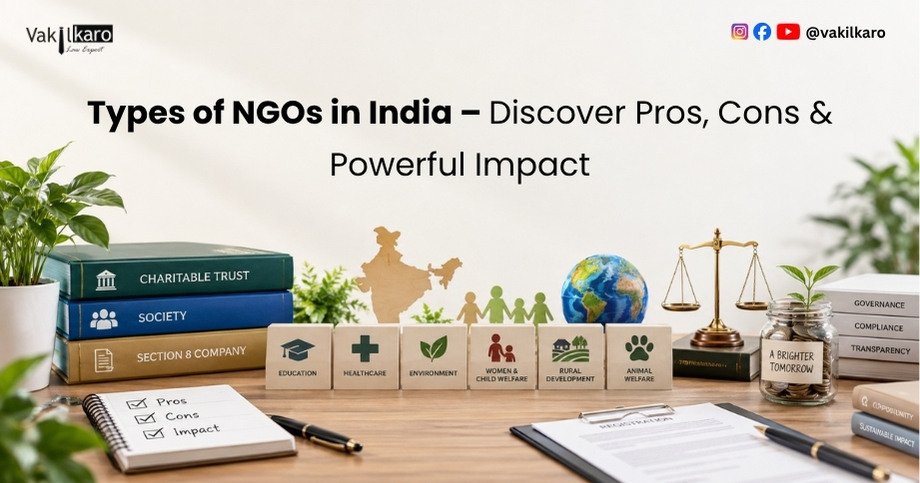
India recognizes various types of NGOs—Trusts, Societies, Section 8 Companies, religious institutions, and informal groups—each governed by different laws and suited to specific objectives. This blog explores these NGO types, their features, legal frameworks, and the importance of key registrations such as Section 8 company registration, NGO registration, 12A and 80G registration, NGO Darpan, NITI Aayog, MSME registration, and filings with the Ministry of Corporate Affairs. Whether you're launching an NGO or seeking compliance clarity, understanding the right structure will help you scale impact while maintaining transparency, legal status, and funding eligibility in India’s nonprofit ecosystem.
Key Takeaways
- India recognizes various types of NGOs—Trusts, Societies, Section 8 Companies, religious institutions, and informal groups—each governed by different laws and suited to specific objectives.
- Understanding the Various Types of NGOs in India India’s nonprofit ecosystem is vast and diverse, with multiple legal frameworks available for those looking to create social impact.
- Broadly, NGOs in India are categorized into five types: Trusts, Societies, Section 8 Companies, religious institutions, and unregistered informal groups.
- This blog will provide a detailed overview of the various types of NGOs in India, their distinctive characteristics, and how these legal frameworks and compliance tools enhance their operational capacity and public trust.
- Legal and Tax Registrations Required for All NGO Types While the structure may vary, all NGOs in India benefit from a common set of legal and tax registrations: 1.
Understanding the Various Types of NGOs in India
India’s nonprofit ecosystem is vast and diverse, with multiple legal frameworks available for those looking to create social impact. NGOs—Non-Governmental Organizations—can be structured in several ways, each offering different levels of flexibility, governance, and statutory oversight. Choosing the right type of NGO is crucial for anyone planning to establish a charitable organization or scale existing operations.
Broadly, NGOs in India are categorized into five types: Trusts, Societies, Section 8 Companies, religious institutions, and unregistered informal groups. Each category is governed by different laws. Trusts are usually registered under the Indian Trusts Act, 1882 or state-specific public trust laws. Societies are governed by the Societies Registration Act, 1860, while Section 8 companies function under the Companies Act, 2013, regulated by the Ministry of Corporate Affairs (MCA).
Section 8 companies are considered the most transparent and professionally managed due to mandatory MCA filings and strong internal governance. On the other hand, Societies and Trusts are relatively easier to form and manage but may lack the regulatory credibility Section 8 structures offer.
Regardless of the structure chosen, all NGOs can—and should—apply for NGO registration, as well as 12A and 80G registration, which allow them and their donors to enjoy tax benefits. Additionally, registering on platforms like NGO Darpan, managed by NITI Aayog, and obtaining MSME registration (if applicable) enhances their credibility and access to funding opportunities.
Unregistered or informal groups may be active in grassroots work but face challenges in raising funds and forming partnerships due to their lack of legal status. Formalizing their efforts by registering as a Trust, Society, or Section 8 company can unlock numerous benefits. Ultimately, selecting the right legal framework and completing essential registrations are foundational steps toward creating a sustainable and impactful NGO in India.
Non-Governmental Organizations (NGOs) are a vital part of India's socio-economic fabric, serving as agents of change and innovation across a wide range of developmental sectors. From fighting poverty and illiteracy to delivering healthcare in underserved regions and promoting environmental sustainability, NGOs have consistently filled critical gaps left by government programs and market forces. Their ability to mobilize communities, leverage donor support, and implement grassroots-level projects makes them indispensable to the nation’s progress.
However, not all NGOs are the same in how they are structured or governed. India offers a variety of legal frameworks for establishing NGOs, each suited to different purposes, scale of operations, and levels of regulatory oversight. Whether you’re an individual aiming to start a small charitable initiative or a corporate entity looking to support social causes through a formal channel, understanding these organizational models is crucial.
Some NGOs operate as Trusts, others as Societies, and some opt for the more corporate structure of a Section 8 company under the Companies Act, 2013. Each format has its own rules, formation process, and compliance obligations. Additionally, to ensure legal recognition and access to tax benefits, NGOs must complete key registrations such as NGO registration, 12A and 80G registration with the Income Tax Department, and Section 8 company registration with the Ministry of Corporate Affairs (MCA).
To increase their visibility and eligibility for government and CSR funding, NGOs are also encouraged to register with NGO Darpan, a portal managed by NITI Aayog, and, in some cases, obtain MSME registration for project-based benefits and schemes.
This blog will provide a detailed overview of the various types of NGOs in India, their distinctive characteristics, and how these legal frameworks and compliance tools enhance their operational capacity and public trust.
Trusts
Overview:
Trusts are among the oldest forms of NGO structures in India. They are typically formed when a group of individuals comes together to manage property or assets for charitable purposes.
Governing Law:
- Indian Trusts Act, 1882 (for private trusts)
- State-specific Public Trust Acts (e.g., Maharashtra Public Trusts Act)
Features:
- Require a trust deed for registration
- Must specify settlor, trustees, and objectives
- Cannot be easily dissolved once formed
Relevance:
While forming a trust, organizations must undergo NGO registration with their respective state authorities. They can also apply for 12A and 80G registration to enjoy tax exemptions and offer tax benefits to donors.
Trusts can also register on NGO Darpan, a platform maintained by NITI Aayog, to gain visibility and qualify for government funding and CSR grants.
Societies
Overview:
Societies are associations of individuals united by a common charitable goal. They are particularly popular among educational, cultural, and scientific organizations.
Governing Law:
- Societies Registration Act, 1860
- State-specific amendments in various states
Features:
- Minimum of seven members required
- Must have bylaws, memorandum of association, and a governing council
- Must hold periodic meetings and maintain transparency
Relevance:
Societies require NGO registration with the state Registrar of Societies. They also need to maintain minutes, accounts, and annual filings to remain compliant.
To receive tax benefits and donor support, societies must apply for 12A and 80G registration from the Income Tax Department. Once registered, they can appear on NGO Darpan and register with NITI Aayog to build credibility and access government partnerships.
Societies can also consider MSME registration if they provide community services in skill development, education, or health, qualifying them for subsidies and government schemes.
Section 8 Companies
Overview:
Section 8 companies are a modern and highly regulated form of nonprofit organizations under the Companies Act, 2013. These companies are formed with the sole objective of promoting charitable activities like education, environment, art, sports, or social welfare.
Governing Law:
- Companies Act, 2013
- Supervised by the Ministry of Corporate Affairs (MCA)
Features:
- Must apply for a Section 8 company registration
- No minimum capital requirement
- Can be formed by individuals or companies
- Profits must be reinvested in the objective and not distributed as dividends
Relevance:
Section 8 companies are considered the most credible form of NGOs due to their strict compliance and transparent governance. Registration is done through the Ministry of Corporate Affairs, including obtaining a license under Section 8 and filing necessary incorporation documents.
Once incorporated, Section 8 companies can:
- Apply for 12A and 80G registration
- Register on NGO Darpan for visibility and access to NITI Aayog schemes
- Opt for MSME registration to access small-business benefits if they engage in vocational training or livelihood promotion
Due to stringent audit and reporting requirements to the MCA, Section 8 companies are ideal for organizations looking to scale and attract foreign funding or CSR donations.
Non-Profit Religious Institutions
Overview:
These are organizations formed around religious or spiritual objectives but also undertake charitable activities such as feeding the poor, running orphanages, or offering free medical services.
Governing Law:
- Varies by religion and state (e.g., Wakf Act for Muslim institutions)
Features:
- Often created through public contributions or endowments
- Managed by religious leaders or governing committees
- Usually exempt from taxes but must maintain charitable status
Relevance:
To access formal donations and tax benefits, religious NGOs often seek 12A and 80G registration. They may also register on NGO Darpan to interact with NITI Aayog initiatives or state-level welfare programs.
Though not required to register under Section 8 company registration, many modern religious charities opt to formalize their social work arm as a Section 8 company to improve transparency and attract funding.
Informal or Unregistered Groups
Overview:
Some groups function without legal registration, especially at the grassroots level. While they can conduct charitable activities, their ability to fundraise, scale, or partner with governments is limited.
Limitations:
- No legal identity
- Cannot open bank accounts in the group’s name
- Not eligible for 12A or 80G registration
- Cannot apply for NGO Darpan, NITI Aayog, or MSME registration
Recommendation:
Such groups are advised to formalize their operations by choosing an appropriate structure—Trust, Society, or Section 8 company—and completing the required NGO registration process to access legal and financial benefits.
Legal and Tax Registrations Required for All NGO Types
While the structure may vary, all NGOs in India benefit from a common set of legal and tax registrations:
12A and 80G Registration
- 12A allows NGOs to be exempt from income tax on their surplus income.
- 80G allows donors to claim tax deductions on donations made to the NGO.
Applicable to all types—Trusts, Societies, and Section 8 Companies—these registrations are critical for sustainability and donor confidence.
NGO Darpan Registration
- Managed by NITI Aayog, the NGO Darpan portal is a mandatory registration platform for NGOs seeking government grants or CSR funds.
- It requires details like registration certificates, PAN, and governing body details.
MSME Registration
- Though typically for businesses, NGOs involved in vocational training, rural entrepreneurship, or production units can register under MSME to access government incentives, easier credit, and tender opportunities.
Ministry of Corporate Affairs (MCA) Filings
- Only applicable to Section 8 companies, this involves regular filings of annual returns, financial statements, and governance reports.
- Ensures transparency and builds credibility with regulators and donors.
Choosing the Right Structure: Which Type of NGO is Best?
Conclusion
India offers diverse legal frameworks for NGOs, each with its own advantages and limitations. Whether you choose to establish a Trust, Society, or a Section 8 company, the key to success lies in selecting the structure that aligns with your mission, funding goals, and operational vision.
While Trusts are ideal for small, localized efforts, Societies offer flexibility and are easier to manage across regions. Section 8 companies, although more demanding in terms of compliance, offer unmatched credibility and scalability—making them the preferred choice for organizations seeking long-term growth, corporate partnerships, or foreign funding.
Whatever the structure, ensuring NGO registration, applying for 12A and 80G registration, registering on NGO Darpan, and complying with platforms like NITI Aayog and the Ministry of Corporate Affairs will strengthen your organization’s legitimacy, enhance donor trust, and unlock greater opportunities for impact.
If you’re ready to take the next step in your nonprofit journey, choose your structure wisely, stay compliant, and commit to transparency. These foundations will not only empower your organization but also help you drive meaningful change across India.
Official External Resources
Use these primary/official sources to verify rules, forms, fees, timelines and regulatory updates before publication.
Frequently asked questions
Types of NGOs in India – Discover Pros, Cons & Powerful Impact+
Understanding the Various Types of NGOs in India India’s nonprofit ecosystem is vast and diverse, with multiple legal frameworks available for those looking to create social impact. This blog will provide a detailed overview of the various types of NGOs in India, their distinctive characteristics, and how these legal frameworks and compliance tools enhance their operational capacity and public trust.
