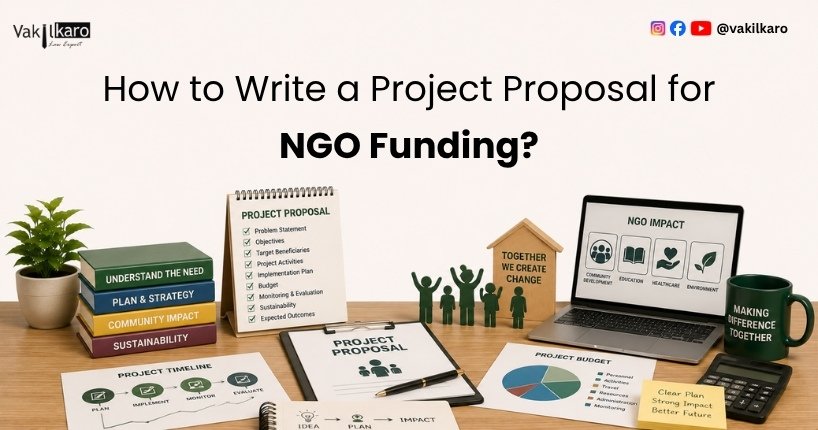
Securing funding is vital for any NGO’s success. A well-crafted project proposal not only outlines your mission but also builds donor trust. Whether newly formed or established, NGOs must highlight compliance credentials like Section 8 company registration, NGO registration, and 12A and 80G registration to boost credibility and funding eligibility. This guide covers the key components of a winning proposal—from the cover letter and executive summary to budgeting, impact, and sustainability planning. Legal structure and transparency matter greatly, especially for institutional donors. With proper compliance and a compelling proposal, your NGO can successfully attract support for its impactful work.
Key Takeaways
- How to Write a Project Proposal for NGO Funding: A Compliance-Focused Guide For any non-profit organization, obtaining funding is a critical step toward achieving its mission.
- Whether your NGO is just starting out or has years of experience, the quality of your project proposal can significantly influence a donor's decision to contribute.
- In conclusion, a compelling proposal backed by Section 8 company registration, NGO registration, and valid 12A and 80G certifications significantly improves your NGO’s chances of securing the funding it needs to drive meaningful change.
- Understanding the Basics of NGO Funding Before beginning the process of writing a project proposal, it's vital to have a clear understanding of how funding for NGOs typically works.
- Key Components of a Project Proposal for NGO Funding Writing a project proposal for NGO funding involves more than just listing goals and expected outcomes.
How to Write a Project Proposal for NGO Funding: A Compliance-Focused Guide
For any non-profit organization, obtaining funding is a critical step toward achieving its mission. Whether your NGO is just starting out or has years of experience, the quality of your project proposal can significantly influence a donor's decision to contribute. A well-structured proposal doesn’t just explain your goals—it demonstrates your NGO’s capacity to make a measurable difference in the lives of the people you serve.
An essential element of writing a strong project proposal is highlighting your NGO's legal and compliance credentials. In India, NGOs can be registered under various structures such as Trusts, Societies, or as a Section 8 company under the Companies Act, 2013. Among these, Section 8 company registration is highly preferred due to its transparent governance and strong regulatory framework. Clearly stating this legal status in your proposal adds to your organization’s credibility in the eyes of potential donors.
Moreover, compliance with tax regulations is vital for attracting funding, particularly from corporate or international donors. NGOs must obtain 12A and 80G registration from the Income Tax Department to be eligible for income tax exemptions and to allow donors to claim tax deductions on their contributions. These certifications are often prerequisites for receiving grants and donations and should be prominently mentioned in both the proposal and annexures.
Beyond legal compliance, the proposal itself must be clear, focused, and results-driven. Each section—from the executive summary and problem statement to budgeting and sustainability planning—should be carefully crafted to show how your project will create long-term impact. Donors are more likely to support NGOs that are transparent, well-organized, and legally compliant.
In conclusion, a compelling proposal backed by Section 8 company registration, NGO registration, and valid 12A and 80G certifications significantly improves your NGO’s chances of securing the funding it needs to drive meaningful change.
Securing financial support is often the lifeline for any non-profit organization. No matter how noble the cause or how impactful the mission, an NGO cannot sustain or scale its operations without adequate funding. For both newly formed organizations and long-established entities, the ability to attract and retain donor interest is a decisive factor in long-term success. One of the most effective tools to secure this support is a well-crafted project proposal.
A compelling project proposal does more than simply request financial assistance—it tells a story. It outlines your NGO’s vision, explains the problem you are trying to solve, details the strategies you plan to use, and demonstrates how your actions will lead to measurable, meaningful change in society. Donors want to know that their money is being invested wisely, and your proposal is their first point of insight into your organization’s intent, capability, and accountability.
In today’s competitive funding landscape, it’s not enough to merely present a good idea. NGOs must also demonstrate their legitimacy and legal compliance. In India, this means having proper legal recognition through NGO registration, preferably under the structure of a Section 8 company, which is known for its transparency and structured governance. Furthermore, obtaining 12A and 80G registration is essential—not only does it offer income tax exemptions to the NGO, but it also allows donors to claim deductions on their contributions, making your organization more attractive to potential supporters.
This guide aims to walk you through the essential elements of writing a powerful and persuasive project proposal. It will also emphasize how compliance with legal requirements such as Section 8 company registration, NGO registration, and 12A and 80G registration can significantly boost your chances of receiving funding by establishing your NGO as a trustworthy and accountable entity.
Understanding the Basics of NGO Funding
Before beginning the process of writing a project proposal, it's vital to have a clear understanding of how funding for NGOs typically works. Non-profit organizations rely heavily on external funding to carry out their social impact initiatives, and this funding can come from a wide range of sources—individual donors, corporate entities, government grants, or international foundations. However, all donors, regardless of type, have one common expectation: accountability. They want assurance that their financial support will be used effectively and transparently for the intended purpose. This is where a well-prepared project proposal becomes indispensable. A good proposal not only presents a strong case for funding but also builds trust by demonstrating the NGO’s commitment to responsible use of funds.
In India, NGOs can be legally registered under several frameworks—namely as a Trust, Society, or Section 8 Company. While all three are legally valid structures, Section 8 company registration, governed by the Companies Act, 2013 is often considered the most robust in terms of governance and regulatory compliance. Section 8 companies are subject to stricter financial reporting, regular audits, and board-level oversight, making them more attractive to corporate and institutional donors. The transparent nature of a Section 8 company inspires confidence in funders that their contributions are being managed with integrity and efficiency.
In addition to basic NGO registration there are two other critical compliance requirements for funding eligibility: 12A and 80G registration. The 12A certificate grants income tax exemption to the NGO on its surplus income, while the 80G certificate allows donors to claim tax deductions on their donations. Together, these registrations are often prerequisites for receiving substantial grants, especially from CSR initiatives, government programs, and foreign donors. In fact, many funders won’t even review a proposal unless these registrations are in place, making them an essential part of the fundraising ecosystem for any NGO operating in India.
Key Components of a Project Proposal for NGO Funding
Writing a project proposal for NGO funding involves more than just listing goals and expected outcomes. It is a carefully structured document designed to gain the trust and support of potential donors. A strong proposal clearly articulates the project’s purpose, approach, expected impact, and financial accountability. Here’s a comprehensive breakdown of each essential component:
Cover Letter
The cover letter serves as the first impression. It should be brief, engaging, and tailored to the donor. Start by introducing your NGO, stating your legal structure (such as Section 8 company), and highlighting your eligibility to receive tax-deductible donations through valid NGO registration, 12A and 80G registration.
Example:
“We are a registered Section 8 company operating in the field of rural education since 2018. With valid NGO registration and 12A & 80G certification, we are eligible to receive tax-exempt donations and government grants.”
Executive Summary
This one-page section is a snapshot of the entire proposal. It should include the project's name, the issue it addresses, goals, key activities, the population it serves, and expected results. It should also reflect your NGO’s legal compliance and tax-exempt status to enhance credibility.
Tips:
- Focus on outcomes and impact.
- Highlight urgency and relevance.
- Briefly mention legal certifications like 12A and 80G.
Introduction to the Organization
This section provides context about your NGO. Share your history, mission, vision, key programs, and achievements. Clearly mention your registration details such as being a Section 8 company under the Companies Act, your NGO registration number, and the validity of your 12A and 80G registrations.
Include:
- Year of establishment
- Legal structure (Society, Trust, Section 8 Company)
- Certification copies
- Major accomplishments
- Geographic areas of operation
Statement of the Problem
Describe the specific issue your project addresses. Back it up with reliable data, reports, and surveys. Donors want to invest in causes that are urgent, real, and measurable.
Example:
“According to the District Education Report, 70% of rural children in [district] lack access to digital learning tools. Our project addresses this gap by setting up digital learning centers.”
Project Objectives
Objectives should be SMART: Specific, Measurable, Achievable, Relevant, and Time-bound. This helps donors evaluate the project’s feasibility and potential impact.
Example:
- Provide digital education to 1,000 students in 10 villages over 12 months.
- Train 20 teachers in digital teaching tools by the third quarter.
Project Activities and Methodology
List all planned activities in chronological order. Describe the methodology, team roles, and tools. Include a Gantt chart or activity timeline. If you’re a Section 8 company, mention your governance practices, which reflect transparency and professionalism.
Include:
- Activity schedule
- Implementation methods
- Resources needed
- Monitoring plans
Target Beneficiaries
Clearly define the demographics of the beneficiaries. Describe how your project will serve them, engage them, and improve their lives.
Tip:
Use real-life stories or profiles (anonymized) to emotionally connect with donors.
Expected Outcomes and Impact
List the short-term (immediate), mid-term (within the project cycle), and long-term (beyond the project cycle) outcomes. Include both qualitative and quantitative indicators. Highlight how your legal structure and tax-exempt status (12A and 80G) ensure funds will be used transparently and effectively.
Example:
- Short-term: 200 students enrolled in digital classes
- Mid-term: Improved academic performance
- Long-term: Reduced dropout rates
Monitoring and Evaluation (M&E)
Explain how you will measure the project's success. Provide key performance indicators, tools for data collection, and reporting timelines. A strong M&E system proves your NGO’s accountability.
Include:
- Baseline and endline surveys
- Evaluation tools (interviews, focus groups)
- Monthly or quarterly progress reports
Budget and Financial Plan
Present a clear, well-organized budget. Each cost must be justified and connected to an activity. Mention financial controls, auditing processes, and your ability to receive tax-free donations via 12A and 80G registration
Include:
- Detailed line-item costs
- Administrative vs program costs
- Resource allocation
- Audit plans
Sustainability Plan
Explain how your project will continue after the funding period ends. Donors prefer initiatives with long-term viability. Mention partnerships, future revenue generation, or community involvement to sustain impact.
Example:
- Training community volunteers to run centers
- Partnering with local schools and CSR sponsors
- Creating income-generating models
Annexures and Supporting Documents
Attach all relevant documents to establish credibility and legal eligibility. Most donors will not consider your proposal without these.
Essential Documents:
- Section 8 company registration certificate (or Trust/Society)
- NGO Darpan registration (if applicable)
- 12A and 80G certificates
- PAN and Aadhaar of directors
- List of board members
- Audited financials (last 3 years)
- Past project reports
Best Practices for Writing an NGO Project Proposal
Creating a compelling and persuasive project proposal requires more than just listing objectives and budgets. Donors expect clear, tailored, and impactful proposals that reflect professionalism and credibility. Here are some best practices to follow when drafting your NGO funding proposal:
Use Clear and Simple Language
Avoid technical jargon or overly complex language. While your team may understand the nuances of community development or educational frameworks, donors may not. Aim for clarity and brevity. Your proposal should be easily understandable by people from diverse backgrounds, including non-specialists.
Tip: Use short sentences, active voice, and define any necessary technical terms in layman’s language.
Tailor the Proposal to Donor Interests
A one-size-fits-all approach rarely works. Every donor—whether an individual, CSR partner, foundation, or international agency—has unique priorities and funding guidelines. Take the time to research the donor’s mission, past grants, and focus areas. Then, customize your proposal to align your project’s objectives with their interests.
Tip: Mention how your project supports the donor’s values, goals, or geographic priorities.
Highlight Legal Compliance and Eligibility
Donors are increasingly cautious and prefer working with organizations that follow proper legal and financial protocols. Clearly state your NGO’s compliance with Indian laws by mentioning:
- Section 8 company registration (if applicable)
- NGO registration under relevant Acts (Society, Trust, or Company)
- 12A and 80G registration, which allow donors to receive tax exemptions and demonstrate financial transparency
This builds trust and assures donors that their funds will be used appropriately.
Focus on Impact, Not Just Activities
Rather than listing a series of tasks, show how your activities will create meaningful change. Explain the “why” and “so what” of your actions. Donors want to fund transformation, not just transactions.
Example:
Instead of saying "We will conduct 10 workshops," say "These workshops aim to increase school enrollment by 25% in the targeted villages within six months."
Use Visuals to Enhance Understanding
Adding charts, graphs, infographics, timelines, and images makes your proposal more engaging and easier to follow. Visuals help break down complex information and provide a quick snapshot of your project plan, budget, or expected impact.
Suggested Visuals:
- Gantt chart for project timeline
- Pie chart for budget allocation
- Infographics showing current needs vs. proposed solutions
- Photos (if available) of previous work or community impact
Review, Edit, and Proofread
Nothing undermines a proposal like typos, inconsistent data, or formatting errors. Always review your document thoroughly before submission. Ideally, involve another team member or an external expert to provide a fresh perspective and spot mistakes you may have missed.
Checklist:
- Spelling and grammar
- Consistent formatting and font
- Clear section headers
- Accurate data and budget figures
- Updated contact and legal information
Why Section 8 Company Registration Matters in Fundraising?
When it comes to attracting substantial and sustained funding, especially from corporate donors and international agencies, the legal structure of your NGO plays a significant role. In India, NGOs can be registered as Trusts, Societies, or Section 8 Companies. Among these, the Section 8 Company Registration is often viewed as the most credible and professional structure for fundraising—and for good reason.
Structured Governance under the Companies Act, 2013
Section 8 companies are registered under the Companies Act, 2013, which means they must adhere to a strict regulatory framework. This includes appointing directors, maintaining a registered office, and following proper board governance. Institutional donors appreciate this structure because it ensures that the organization is not only legitimate but also professionally managed with defined responsibilities and decision-making processes.
Mandatory Audited Financial Records
One of the biggest advantages of a Section 8 company is the requirement to maintain audited financial statements annually. This includes balance sheets, income-expenditure reports, and statutory filings with the Ministry of Corporate Affairs (MCA). Donors—particularly those disbursing large amounts or CSR funds—look for such transparency and financial discipline before making a commitment.
Regular Compliance and Legal Accountability
Unlike Trusts or Societies, which often have minimal reporting obligations, Section 8 companies are required to comply with various statutory regulations such as:
- Annual returns filing
- Directors’ disclosures
- Board meeting documentation
- Income tax filings
These compliance requirements not only build donor confidence but also protect your NGO from legal liabilities, ensuring long-term operational sustainability.
Enhanced Donor Trust Through Transparency
Due to their regulated structure, Section 8 companies are widely perceived as more transparent and accountable. This perception is especially crucial when seeking funding from:
- CSR programs of large corporations
- International foundations
- Government grants
- Development finance institutions
Donors feel more secure knowing that funds given to a Section 8 company are governed by corporate-level accountability.
Boosts Eligibility for CSR and Tax-Exempt Funding
Combining Section 8 company registration with 12A and 80G certification makes your NGO even more appealing to donors. While 12A registration allows your NGO to be exempt from income tax, 80G offers tax benefits to your donors, encouraging larger contributions. This is a major requirement for companies giving funds under the Corporate Social Responsibility (CSR) mandate as outlined in the Companies Act.
In fact, many CSR programs specifically require:
- NGO Darpan registration
- 12A & 80G certification
- Section 8 company registration
This triple compliance positions your NGO at the top tier of credibility and funding eligibility.
Importance of 12A and 80G Registration in Fundraising
When it comes to NGO fundraising in India, compliance is not just a legal requirement—it’s a critical tool for building credibility and securing financial support. Among the most important compliance elements are 12A and 80G registrations under the Income Tax Act, 1961 These registrations go beyond providing tax benefits—they serve as essential trust-building mechanisms that reassure donors of your NGO’s legitimacy and financial integrity.
What is 12A Registration and Why It Matters?
12A Registration allows an NGO to claim complete exemption from income tax on the surplus or income generated for charitable purposes. Without 12A, the income of the NGO becomes taxable, which may reduce the funds available for actual project implementation.
From a donor’s perspective, an NGO with valid 12A registration demonstrates that:
- The organization is formally recognized as a charitable institution by the Income Tax Department
- Donations made will be used entirely for non-profit objectives.
- The organization adheres to proper accounting and financial disclosure norms.
This level of compliance gives donors—particularly institutional ones—confidence that their contributions will not be diverted for personal or commercial gain.
What is 80G Registration and Why It Attracts Donors?
80G Registration enables donors—whether individuals or corporate entities—to claim deductions on their income tax, usually up to 50% of the donated amount. This financial incentive encourages larger and more frequent donations.
For NGOs, holding a valid 80G certificate:
- Makes them more attractive to potential donors.
- Increases the probability of receiving funds from CSR initiatives and philanthropic investors.
- Signals a higher level of transparency and accountability.
A Prerequisite for CSR and Institutional Funding
Most CSR funders, government departments, and international agencies require NGOs to possess both 12A and 80G registrations as a basic eligibility criterion. These certifications often act as the first filter in proposal evaluation processes. Without them, even well-written project proposals may not be considered.
Showcase Compliance in Your Proposal
In your project proposal:
- Clearly mention that your NGO holds valid 12A and 80G registrations.
- Specify the date of issuance and validity period.
- Include scanned copies of both certificates in the annexures section of the proposal document.
Doing so not only meets donor requirements but also sets your NGO apart as a transparent, tax-compliant, and well-governed entity.
Common Mistakes to Avoid in NGO Project Proposals
- Unrealistic Goals: Don’t overpromise. Donors prefer realistic and achievable goals.
- Lack of Data: Avoid vague claims—support everything with data.
- Ignoring Compliance: Not mentioning NGO registration, Section 8 status, or tax certifications could disqualify your proposal.
- No Sustainability Plan: Donors want long-term impact, not one-off efforts.
- Generic Proposals: Copy-pasting the same proposal for every donor won’t work. Tailor your proposal.
Conclusion
Writing a compelling project proposal is both an art and a science. It requires clarity, structure, passion, and professionalism. Whether you’re aiming to uplift underprivileged communities, promote education, or protect the environment, a strong proposal will help secure the funds you need.
Make sure your NGO’s legal foundation is solid with proper NGO registration, preferably as a Section 8 company. Don’t forget to obtain 12A and 80G registration, as these are often non-negotiable for receiving grants and donations. When your documents and compliance are in order, and your proposal is well-crafted, your chances of receiving funding improve significantly.
So, gather your team, align your mission, and start writing a proposal that speaks to the hearts and minds of donors!
Why Choose Vakilkaro for NGO Registrations and Legal Services
Vakilkaro has emerged as a trusted name in the legal and compliance space, offering end-to-end support for NGOs, startups, and businesses across India. If you're looking to secure 12A and 80G registration or navigate the legal landscape for your NGO or company, here’s why Vakilkaro is the ideal partner.
Expertise in NGO and Section 8 Registrations
Vakilkaro specializes in Section 8 company registration, Trust Registration and Society registration, and NGO Darpan registration—making them a one-stop solution for all NGO compliance needs. Their legal experts guide clients through the entire documentation and registration process, ensuring a smooth and error-free experience.
Fast and Transparent 12A & 80G Registration Process
Vakilkaro simplifies the complicated tax exemption process:
- End-to-end application filing with IT Department.
- Assistance in preparing necessary documents like financials, board resolutions, and activity reports.
- Quick turnaround with regular updates until your 12A and 80G certificates are secured.
Trusted by Thousands Across India
Vakilkaro has successfully served thousands of NGOs, companies, and individuals across India. Their clients range from grassroots-level non-profits to growing startups and mid-sized companies, all relying on Vakilkaro for legal accuracy and timely delivery.
Wide Range of Legal and Compliance Services
Beyond NGO registrations, Vakilkaro offers:
- Company Incorporation (Pvt Ltd, LLP, OPC, Section 8)
- GST Registration & Filing
- Trademark Registration
- Accounting & Bookkeeping
- Startup Advisory Services
- FSSAI, ISO, Import-Export Code (IEC)
- Loan and License Assistance
- M&A and Corporate Restructuring
- Labour Law and Business Licenses Compliance
Personalized Support with Affordable Pricing
Vakilkaro provides personalized consultation, a dedicated relationship manager, and cost-effective packages designed for NGOs and small businesses. Their approach is client-focused, ensuring each organization gets the support it needs without the high cost often associated with legal firms.
Digital-first and Hassle-Free Process
Vakilkaro leverages technology to ensure that all filings and submissions are done online, saving time and effort. You can submit documents, track progress, and consult with experts—all from the comfort of your home or office.
Official External Resources
Use these primary/official sources to verify rules, forms, fees, timelines and regulatory updates before publication.
Frequently asked questions
How to Write a Project Proposal for NGO Funding?+
How to Write a Project Proposal for NGO Funding: A Compliance-Focused Guide For any non-profit organization, obtaining funding is a critical step toward achieving its mission. Understanding the Basics of NGO Funding Before beginning the process of writing a project proposal, it's vital to have a clear understanding of how funding for NGOs typically works.
