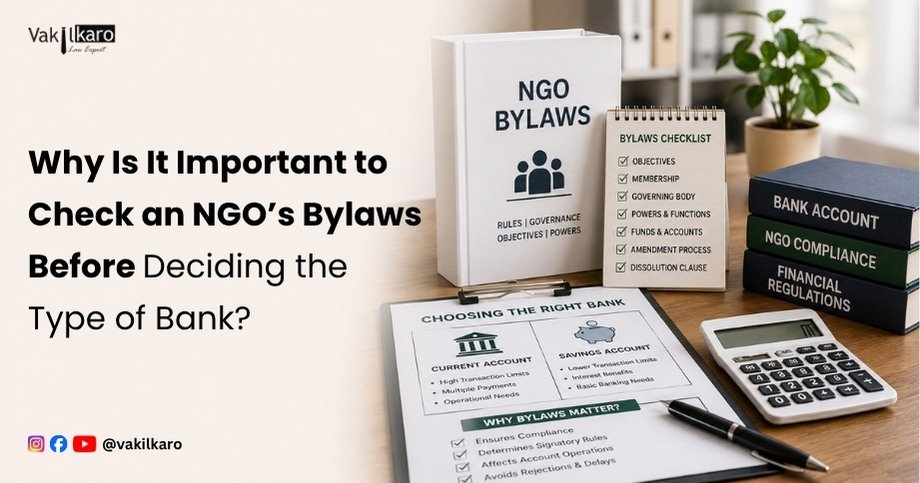
Opening a bank account is a vital step for any NGO or Section 8 company, but it must be done in accordance with the organization’s bylaws. Bylaws define governance rules, including where and how bank accounts can be held. Ignoring these rules may lead to non-compliance, audit issues, donor distrust, and loss of registrations such as 12A, 80G, NGO Darpan, and even MSME benefits. For Section 8 companies, violations may attract action from the Ministry of Corporate Affairs. This blog highlights why reviewing and, if needed, amending bylaws before selecting a bank is essential to ensure transparency and legal protection.
Key Takeaways
- Opening a bank account is a vital step for any NGO or Section 8 company, but it must be done in accordance with the organization’s bylaws.
- Why Reviewing an NGO’s Bylaws Is Essential Before Choosing a Bank?
- However, before selecting a bank—whether public or private—it is crucial to first review the NGO’s bylaws.
- These documents define: The mission and vision of the organization Structure and responsibilities of the governing body Financial management protocols Banking guidelines, including the type of bank account to be opened For Section 8 companies, the bylaws are approved and regulated under the Companies Act, 2013 and overseen by the Ministry of Corporate Affairs (MCA).
- Non-compliance can trigger: Penalties under the Companies Act Cancellation of the company’s license Legal action against directors This makes it even more important for Section 8 companies to cross-check bylaws before making banking decisions.
Why Reviewing an NGO’s Bylaws Is Essential Before Choosing a Bank?
For any NGO or Section 8 company, opening a bank account is one of the foundational steps in operational setup. It enables the organization to receive and manage funds from grants, donations, and CSR contributions. However, before selecting a bank—whether public or private—it is crucial to first review the NGO’s bylaws.
Bylaws are the legally binding internal rules created at the time of NGO registration or Section 8 company registration. These documents often outline specific instructions about financial practices, including the type of bank where the organization is allowed to maintain its accounts. Ignoring these directives can lead to significant legal, regulatory, and reputational consequences.
For instance, if the bylaws require the NGO to operate only through a nationalized bank, but the organization opens an account with a private institution instead, this can be considered a breach of governance. Such violations may raise red flags during audits, jeopardize 12A and 80G registrations, and even lead to suspension from NGO Darpan, which is managed by NITI Aayog. It can also result in scrutiny from the Ministry of Corporate Affairs (MCA), particularly for Section 8 companies.
Moreover, compliance with bylaws affects an NGO’s eligibility for MSME registration, which provides access to government schemes, subsidies, and credit. Donors and funding agencies often assess an NGO’s adherence to its own rules as a measure of credibility and integrity.
To avoid these risks, organizations must ensure that banking decisions are fully aligned with their bylaws. If changes are necessary, formal amendments should be made through board resolutions and proper filings with regulatory bodies. In doing so, NGOs protect their reputation, maintain legal compliance, and build lasting trust with stakeholders.
For Non-Governmental Organizations (NGOs) and Section 8 companies, establishing a bank account is not just a routine task—it is a foundational element of operational readiness. From receiving public donations and government grants to managing CSR funds, project expenses, and recurring operational costs, a properly managed bank account ensures financial discipline and transparency. It also lays the groundwork for trust with stakeholders, including donors, auditors, government agencies, and the general public.
However, amid the rush to open an account and begin operations, one crucial step is often neglected—the thorough review of the organization’s bylaws. These bylaws, which are formal legal documents created at the time of NGO registration or Section 8 company registration, serve as the internal rulebook for governance. Among other things, they may include specific provisions related to financial administration—such as stipulations on which type of bank (nationalized, cooperative, or private) the NGO must use for its financial transactions.
Overlooking such provisions can result in significant legal, regulatory, and reputational risks. Opening an account in violation of the bylaws may be seen as a breach of governance and could raise concerns during audits, threaten 12A and 80G registration, affect eligibility for NGO Darpan registration under NITI Aayog, or even jeopardize compliance with the Ministry of Corporate Affairs (MCA) for Section 8 companies. It may also disqualify the organization from availing benefits tied to MSME registration.
In this blog, we will explore why it is essential to carefully examine an NGO’s bylaws before selecting a banking partner. We’ll look at how this simple but critical step ensures not only legal and financial compliance but also strengthens organizational integrity and promotes long-term sustainability.
Understanding NGO Bylaws: The Foundation of Governance
Bylaws are legally binding documents created at the time of NGO registration—whether as a trust, society, or Section 8 company. These documents define:
- The mission and vision of the organization
- Structure and responsibilities of the governing body
- Financial management protocols
- Banking guidelines, including the type of bank account to be opened
For Section 8 companies, the bylaws are approved and regulated under the Companies Act, 2013 and overseen by the Ministry of Corporate Affairs (MCA). Any deviation from these rules can lead to penalties or even cancellation of their incorporation.
What Happens When Bylaws Are Ignored?
If an NGO bypasses its bylaws and opens a bank account—say, in a private bank when it is mandated to use a nationalized one—it could result in:
- Legal Non-compliance: The organization may be held legally accountable for acting against its own constitution.
- Audit Red Flags: Auditors may flag such activities, leading to qualified reports.
- Loss of Tax Benefits: Authorities may reject or revoke 12A and 80G registrations.
- Delisting from NGO Darpan/NITI Aayog: Government agencies may suspend profiles, cutting off access to grants.
- Donor Distrust: Key funding partners may withdraw support due to poor governance practices.
Linking Bylaws with NGO Registration and Banking
During NGO registration, the bylaws are submitted to the registrar (or MCA in the case of Section 8 companies). These documents are not mere formality—they are legal declarations. If the bylaws specify that the organization must operate its financial affairs through a nationalized bank, it is binding.
Before choosing a banking partner, NGOs must revisit these bylaws and:
- Ensure there are no restrictions on the type of bank
- Seek legal amendments if changes are needed
- Pass board resolutions to approve new banking arrangements
Bylaws and Section 8 Company Registration: A Legal Mandate
Section 8 company registration is more tightly regulated than trusts and societies. Since these are governed by the Ministry of Corporate Affairs, the legal consequences of not adhering to internal documents like bylaws can be serious.
In such cases, the MCA may:
- Demand explanations through notices
- Penalize directors or the organization
- Even revoke the license if financial mismanagement is proven
This is especially important when filing annual reports or financial statements via MCA e-filing platforms, where any discrepancy in declared and actual operations can be scrutinized.
12A and 80G Registration: Why Bank Compliance Matters
To apply for or maintain 12A and 80G registrations, an NGO must demonstrate full compliance in terms of governance and financial practices. These certifications allow the organization to:
- Receive income tax exemption (12A)
- Offer tax benefits to donors (80G)
If an NGO opens a bank account against the instructions in its bylaws, the Income Tax Department may view this as a governance lapse. Consequences include:
- Delays or rejection of registration
- Cancellation of existing approvals
- Demand for repayment of tax-exempt income
Therefore, reviewing and following the bylaws ensures smooth processing and renewal of these valuable certifications.
NGO Darpan and NITI Aayog: Transparency Is Key
The NGO Darpan portal, maintained by NITI Aayog, is a central database for Indian NGOs to connect with various government departments and ministries. During registration, NGOs must:
- Submit copies of their bylaws
- Disclose banking details
- Demonstrate financial transparency
If the bank account is opened in violation of bylaws, NGO Darpan may suspend or reject the registration, which in turn:
- Restricts access to central and state-level funding
- Disqualifies the NGO from CSR collaborations
- Affects public credibility and online visibility
What About MSME Registration?
Some NGOs, especially those involved in vocational training, handicrafts, or small-scale production, may seek MSME registration to benefit from government schemes.
To qualify, the NGO must:
- Show clean, compliant financial practices
- Provide valid documentation including bank account details
Opening a bank account against the bylaws could lead to rejection of the MSME application or withdrawal of benefits, including:
- Priority sector loans
- Subsidies and grants
- Government procurement access
Thus, checking the bylaws before choosing a bank is essential for ensuring eligibility for MSME benefits.
Risk Scenarios: Real-World Consequences
Scenario 1: Audit Failures and Fund Freezes
An NGO working in child education had its bylaws state banking must be through a nationalized bank. However, for convenience, it opened an account in a private bank. During audit, this was flagged, and the organization received a qualified report, delaying its 80G renewal and freezing a pending CSR donation.
Scenario 2: Delisting from NGO Darpan
A women’s empowerment NGO listed under NGO Darpan changed its bank without updating bylaws or informing NITI Aayog. This led to a mismatch in records, and the NGO was delisted, causing it to lose access to several central government schemes.
How to Amend Bylaws Legally?
If your NGO or Section 8 company truly needs to switch to a private or cooperative bank, follow these steps:
- Board Meeting: Convene a meeting and propose a bylaw amendment.
- Pass a Resolution: Get approval through a majority vote as required by your constitution.
- Update the Registrar/MCA: Submit changes to the relevant authority (Registrar of Societies, Charity Commissioner, or MCA for Section 8 companies).
- Notify Stakeholders: Inform banks, donors, and platforms like NGO Darpan, NITI Aayog, and Income Tax authorities.
- Maintain Documentation: Keep copies of resolutions, approvals, and updated bylaws for audits and future reference.
Best Practices for Financial Governance in NGOs
- Always Read Your Bylaws First: Before opening or changing bank accounts, ensure your actions align with the bylaws.
- Use Board Resolutions: Document every major financial decision through formal board meetings.
- Stay Updated: Amend bylaws legally when operational changes are needed.
- Maintain Transparency: Keep your records aligned with entries in NGO Darpan, MCA filings, and tax documents.
- Seek Legal Help: Partner with professionals like Vakilkaro for expert advice and compliance management.
The Role of the Ministry of Corporate Affairs (MCA)
For Section 8 companies, the Ministry of Corporate Affairs plays a central role in monitoring financial governance. All significant decisions—including opening a bank account—must be recorded and reflected in annual returns and audits.
Non-compliance can trigger:
- Penalties under the Companies Act
- Cancellation of the company’s license
- Legal action against directors
This makes it even more important for Section 8 companies to cross-check bylaws before making banking decisions.
Conclusion
Choosing a bank may seem like a simple operational decision, but for NGOs and Section 8 companies, it is one rooted deeply in governance, legal compliance, and financial integrity. The bylaws of an organization serve as a legal contract with stakeholders, regulatory authorities, and donors.
Ignoring what the bylaws prescribe regarding banking—such as selecting a private bank over a nationalized one—can have serious consequences. It may lead to issues with NGO registration, cancellation of 12A and 80G certificates, suspension from NGO Darpan, loss of MSME benefits, and even regulatory action from the Ministry of Corporate Affairs.
Therefore, it is essential to review bylaws before making such decisions. If needed, NGOs must go through the proper legal channels to amend those bylaws. By doing so, they protect their credibility, ensure compliance, and maintain smooth operations—ensuring that their mission remains the priority, not paperwork problems or regulatory pitfalls.
Why Choose Vakilkaro for NGO Legal Compliance and Advisory Services?
Navigating legal requirements like NGO registration, Section 8 company formation, 12A and 80G certification, NGO Darpan registration, MSME registration, and ensuring compliance with the Ministry of Corporate Affairs (MCA) can be overwhelming. That’s where Vakilkaro comes in.
Vakilkaro offers specialized, end-to-end legal and compliance services tailored to the unique needs of NGOs, social enterprises, and charitable organizations. From reviewing bylaws before opening a bank account to guiding you through amendments, financial governance, and annual filings, our team ensures that every step aligns with legal standards and your organizational goals.
Why Vakilkaro?
- ✅ Expertise in Non-Profit & Section 8 Compliance
Our legal experts are well-versed in the laws and procedures governing NGOs and Section 8 companies.
- ✅ End-to-End Support
We handle everything—from drafting bylaws to securing registrations, amending legal documents, and representing you before government authorities.
- ✅ Fast, Transparent Process
No hidden fees. No delays. Just clear, professional service from start to finish.
- ✅ Dedicated Advisors
Every client gets personalized attention and proactive guidance tailored to their specific stage of growth and compliance needs.
- ✅ One-Stop Platform
Whether you need MCA filings, tax exemption certificates, or government registration like NGO Darpan or MSME, Vakilkaro manages it all under one roof.
With Vakilkaro, you get more than just legal support—you gain a trusted compliance partner committed to helping your organization grow legally strong and impact-driven.
Choose Vakilkaro. Focus on your mission—we’ll handle the law.
Official External Resources
Use these primary/official sources to verify rules, forms, fees, timelines and regulatory updates before publication.
Frequently asked questions
Why Is It Important to Check an NGO’s Bylaws Before Deciding the Type of Bank?+
Why Reviewing an NGO’s Bylaws Is Essential Before Choosing a Bank? However, before selecting a bank—whether public or private—it is crucial to first review the NGO’s bylaws.
