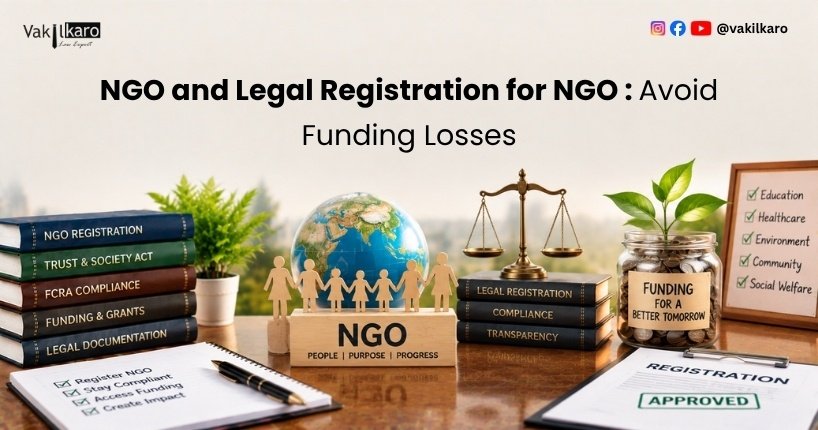
Legal registrations play a crucial role in building donor trust and securing funding for NGOs. From basic NGO registration and Section 8 company incorporation to obtaining 12A and 80G tax exemptions, each step enhances credibility. Platforms like NGO Darpan under NITI Aayog and MSME registration further boost visibility and access to grants. Compliance with the Ministry of Corporate Affairs ensures financial transparency, a key factor for institutional and CSR donors. Vakilkaro provides comprehensive support to help NGOs complete these legal processes, enabling them to operate professionally, access funds, and make a lasting social impact in India’s development sector.
Key Takeaways
- How Legal Registrations Build Donor Trust and Unlock Funding for NGO Registration In India’s dynamic nonprofit ecosystem, legal registration is more than a formality—it’s the foundation of trust.
- Whether it’s through NGO registration, Section 8 company formation, or obtaining 12A and 80G certifications, each legal step enhances the organization’s transparency and trustworthiness.
- For starters, having formal NGO registration —whether as a Trust, Society, or Section 8 Company—signifies that the organization operates within a recognized legal framework.
- Furthermore, registration allows NGOs to apply for various tax exemptions, government grants, CSR funding, and access to platforms like NGO Darpan and the Ministry of Corporate Affairs.
- Section 8 Company Registration: A Professional Edge When choosing a legal structure for an NGO in India, opting for Section 8 company registration offers distinct advantages in terms of governance, transparency, and funding potential.
How Legal Registrations Build Donor Trust and Unlock Funding for NGO Registration
In India’s dynamic nonprofit ecosystem, legal registration is more than a formality—it’s the foundation of trust. NGOs and social enterprises that aim to drive meaningful change must first establish their credibility with donors, and legal compliance is central to achieving that. Whether it’s through NGO registration, Section 8 company formation, or obtaining 12A and 80G certifications, each legal step enhances the organization’s transparency and trustworthiness.
For starters, having formal NGO registration—whether as a Trust, Society, or Section 8 Company—signifies that the organization operates within a recognized legal framework. Among these, Section 8 company registration under the Companies Act, 2013, provides a robust structure with high governance standards. This reassures donors, especially CSR and international funders, who often prefer legally accountable partners.
Tax-related registrations such as 12A and 80G offer further incentives. While 12A provides tax exemption on an NGO’s income, 80G allows donors to claim tax deductions on their contributions. This not only boosts donor confidence but also makes the NGO eligible for more funding from government and private sources.
Platforms like NGO Darpan, managed by NITI Aayog, play a key role in improving an NGO’s visibility and grant eligibility. Similarly, MSME registration—though traditionally used by small businesses—can benefit NGOs engaged in social enterprise or vocational training by unlocking government schemes and easing access to funding.
Maintaining compliance with the Ministry of Corporate Affairs (MCA) ensures that financial records and operations remain transparent. Filing annual returns and financial statements on time showcases accountability.
In essence, each registration—NGO, tax, MSME, or MCA—contributes to a layered image of legitimacy. Supported by experts like Vakilkaro, NGOs can navigate these processes efficiently, building lasting trust with donors and securing the financial resources needed to sustain their missions.
In today's rapidly changing world, the work of non-governmental organizations (NGOs) is more essential than ever. These organizations are often at the forefront of tackling urgent social issues—ranging from education and healthcare to environmental sustainability and poverty alleviation. But to make a lasting impact, NGOs need more than just passion and purpose; they need the trust of those who support them. This trust—especially from donors—is the foundation upon which sustainable operations are built.
For NGOs, trust is not just an abstract concept; it’s a measurable, actionable requirement. It is built through transparency, accountability, and consistent performance. And one of the most effective ways to establish these qualities is through proper legal registration and compliance.
Legal registrations serve multiple roles. Firstly, they give the NGO a legitimate identity—making it a recognized entity under Indian law. Secondly, they ensure the organization meets certain standards of governance and financial transparency, which donors actively look for before funding a cause. Most importantly, legal recognition opens doors to funding—both from government schemes and private donors—by fulfilling the eligibility requirements set by funding agencies.
This blog will examine how different legal registrations such as basic NGO registration (as a Trust, Society, or Section 8 Company), Section 8 company registration under the Companies Act, 12A and 80G certification for tax benefits, NGO Darpan registration with NITI Aayog, MSME registration for funding and scheme access, and compliance with the Ministry of Corporate Affairs (MCA) contribute to building donor confidence. By understanding these legal pathways, NGOs can not only establish themselves more effectively but also access sustainable funding and resources needed to drive meaningful social change.
Importance of Legal Identity Through NGO Registration
Establishing a formal legal identity is the cornerstone for any nonprofit organization aiming to operate in India. Without this legal foundation, an NGO cannot access many of the tools and opportunities required for meaningful and sustained impact. Legal registration is not merely a bureaucratic formality—it is what transforms a group of individuals with a cause into a recognized and credible organization.
In India, NGOs can be registered under one of three primary legal structures: as a Trust under the Indian Trusts Act, a Society under the Societies Registration Act, or a Section 8 Company under the Companies Act, 2013. Each of these structures provides a unique governance and compliance framework, but all offer the NGO a legally recognized status. This means the organization can legally own property, open and operate a bank account, hire staff, enter into contracts, and—most importantly—receive donations and grants.
For donors, particularly large institutional funders and international agencies, legal registration is a non-negotiable prerequisite. A registered NGO signals to potential funders that the organization is serious, structured, and committed to long-term operations. It implies that the NGO is accountable to legal standards, is governed transparently, and can be audited or scrutinized if needed. This level of accountability is essential in a sector where trust is paramount and where misuse of funds can quickly tarnish reputations.
Furthermore, registration allows NGOs to apply for various tax exemptions, government grants, CSR funding, and access to platforms like NGO Darpan and the Ministry of Corporate Affairs. In short, legal identity is not just about being officially recognized—it’s about building a foundation of credibility that unlocks doors to funding, partnerships, and sustainable growth.
Section 8 Company Registration: A Professional Edge
When choosing a legal structure for an NGO in India, opting for Section 8 company registration offers distinct advantages in terms of governance, transparency, and funding potential. Established under the Companies Act, 2013 and regulated by the Ministry of Corporate Affairs (MCA), a Section 8 company is specifically designed for organizations that promote charitable objectives such as education, social welfare, arts, and environmental protection—without the intention of making profits.
Unlike Trusts and Societies, Section 8 companies are bound by a stringent legal and regulatory framework. They must maintain detailed records, hold regular board meetings, file annual financial statements, and comply with corporate governance practices. This high level of regulatory oversight not only ensures better internal management but also builds confidence among stakeholders, especially donors.
Corporate donors and international funding agencies often prefer Section 8 companies because of their transparent reporting mechanisms and strong legal safeguards. These companies are seen as professionally run, accountable, and reliable—qualities that are crucial when large sums of money and long-term partnerships are involved. Additionally, since many corporations must fulfill their Corporate Social Responsibility (CSR) obligations, they often look to Section 8 companies as ideal implementation partners. This is because Section 8 companies align well with CSR guidelines, especially in terms of financial compliance and impact reporting.
Moreover, being registered with the Ministry of Corporate Affairs lends further credibility, helping these organizations gain recognition not just in India but also globally. A Section 8 company, therefore, is not only a vehicle for social impact but also a symbol of professionalism and integrity. For NGOs looking to scale their efforts and attract substantial funding, Section 8 company registration is often the most strategic and rewarding path.
12A and 80G Registration: Tax Benefits That Build Donor Confidence
Tax benefits are a powerful incentive for individuals and institutions to support charitable causes. In India, the 12A and 80G registrations play a crucial role in enhancing an NGO’s credibility and appeal among potential donors. These registrations, issued by the Income Tax Department, serve a dual purpose: they not only make donations more attractive by offering tax deductions to donors but also position the NGO as a tax-exempt, trustworthy entity.
12A registration exempts the NGO from paying income tax on any surplus or income it generates, provided the funds are used for charitable purposes. This means that the entire income of the NGO can be reinvested into its mission-driven activities without the burden of taxation. For donors and grant-making agencies, this shows that the organization operates within a clear legal framework and is accountable for its financial conduct.
80G registration, on the other hand, directly benefits the donor. It allows individuals and organizations to claim a tax deduction of up to 50% of the amount they donate to an NGO. This provision is a significant driver of philanthropic contributions, as it aligns social good with financial prudence.
These registrations are especially important for corporate donors, CSR funders, and international agencies, many of whom mandate them before releasing grants or donations. Moreover, government departments often make 12A and 80G a prerequisite for NGOs seeking to collaborate on public welfare schemes.
In short, securing 12A and 80G registrations goes beyond compliance—it builds trust, increases financial efficiency, and opens the door to larger, sustained funding opportunities, making them indispensable for any NGO serious about its growth and impact.
NGO Darpan and NITI Aayog: Enhancing Visibility, Transparency, and Credibility
In the competitive landscape of the nonprofit sector, visibility and credibility are as important as the work being done on the ground. One of the most significant tools for building both is NGO Darpan, an online platform managed by NITI Aayog, the policy think tank of the Government of India. This portal serves as a vital bridge between NGOs and various government ministries, departments, and public-sector units, enabling better coordination and trust in grant-making and project partnerships.
Registering on NGO Darpan is increasingly becoming a mandatory requirement for NGOs that wish to apply for or receive government grants and schemes. Through this registration, NGOs are required to submit key organizational details such as their legal status, objectives, governing body members, PAN, registration certificates, and key financial information. This transparency not only satisfies government criteria but also reassures private donors and CSR funders that the organization meets regulatory and ethical standards.
Maintaining an active and updated profile on NGO Darpan shows that the organization is operationally transparent, responsive, and engaged with the larger development ecosystem. This can significantly increase funding opportunities, especially for NGOs seeking recognition at the national level or wanting to participate in public-private partnerships.
Moreover, visibility on a centralized platform like NGO Darpan improves discoverability by potential collaborators, donors, and research institutions. It also ensures alignment with the development goals and standards set by NITI Aayog, making the NGO a more attractive and reliable partner for multi-stakeholder projects.
In essence, being listed on NGO Darpan is more than just a formal step—it's a strategic move that strengthens the organization’s position within the development sector and enhances donor trust and funding access.
MSME Registration: Unlocking New Opportunities for NGOs
While the Micro, Small and Medium Enterprises (MSME) registration is primarily associated with for-profit businesses, it has growing relevance for NGOs—particularly those engaged in social entrepreneurship, vocational training, rural development, or skill-building initiatives. For such organizations, MSME registration opens up a broader spectrum of support, funding opportunities, and institutional recognition that can significantly enhance their operational capabilities and appeal to donors.
An NGO involved in income-generating or livelihood-based activities often runs units that function similarly to small enterprises. By obtaining MSME registration, these NGOs become eligible for a variety of government subsidies, incentives, and credit facilities offered under MSME development schemes. This includes schemes from ministries such as the Ministry of Skill Development and Entrepreneurship, and the Ministry of MSME, which actively support nonprofit-led micro enterprises.
One of the major advantages of MSME registration is enhanced eligibility for public procurement tenders. Several government procurement policies offer specific quotas or relaxed norms for registered MSMEs, enabling NGOs to participate in supply and service delivery projects, especially in sectors like education, health, sanitation, and infrastructure.
Additionally, financial institutions and banks are often more inclined to approve loans or working capital support for NGOs with MSME credentials, as it reflects a structured and scalable business model. This is particularly helpful for NGOs that need funds to expand social enterprises or initiate large-scale livelihood programs.
From a donor or CSR funder’s perspective, MSME-registered NGOs project a strong image of institutional maturity, financial prudence, and self-sustainability. This structured approach makes them more trustworthy and attractive as funding partners.
In summary, MSME registration is not just a formality—it is a strategic asset that boosts an NGO’s credibility, operational scope, and funding potential in both the government and private sectors.
Ministry of Corporate Affairs (MCA): Ensuring Compliance and Transparency for NGOs
For NGOs registered as Section 8 companies under the Companies Act, 2013, the Ministry of Corporate Affairs (MCA) plays a central role in regulating their operations. The MCA provides a structured legal and compliance framework that helps nonprofits maintain accountability, transparency, and trustworthiness—all of which are crucial factors for attracting and retaining donors.
The MCA mandates that Section 8 companies must comply with several statutory requirements, similar to those followed by for-profit companies. These include the filing of annual returns, audited financial statements, and director disclosures. In addition, Section 8 companies must hold regular board meetings and maintain proper books of accounts, which are subject to external audits.
This stringent regulatory oversight ensures that Section 8 NGOs maintain financial discipline and are transparent about how they manage funds. For donors—especially corporate funders, international agencies, and institutional grant providers—this level of formal compliance reduces the risk of misappropriation, inefficiency, or legal complications.
Moreover, by being visible in MCA records, Section 8 companies reinforce their legitimacy and long-term intent. Since donors often perform due diligence before disbursing large grants or CSR fundings, the availability of publicly accessible MCA filings can help reassure them of an NGO’s credibility.
Non-compliance, on the other hand, can lead to penalties, reputational damage, or even cancellation of registration—making MCA compliance not just a legal obligation, but a strategic necessity. Regular adherence also ensures eligibility for government partnerships, CSR funds, and foreign contributions.
In conclusion, compliance with MCA regulations helps an NGO present itself as a well-governed, transparent, and professionally managed organization, significantly enhancing its chances of securing donor support and scaling social impact.
Cumulative Impact on Donor Trust
Each layer of legal registration builds upon the previous one to create a credible, compliant, and fundable NGO. Here’s how:
- Legal identity through NGO or Section 8 registration creates the foundation
- 12A and 80G Registration add financial legitimacy and incentives for donors
- NGO Darpan registration strengthens government linkages
- MSME recognition opens non-traditional funding avenues
- MCA compliance demonstrates financial and operational integrity
Together, these registrations craft a narrative of professionalism, accountability, and long-term commitment—attributes every donor looks for.
How Vakilkaro Helps?
Navigating the legal landscape of NGO formation and compliance can be complex. Vakilkaro offers end-to-end support in:
- Choosing the right legal structure (Trust, Society, or Section 8 Company)
- Completing the NGO registration and Section 8 company registration
- Securing 12A and 80G registration
- Enrolling on NGO Darpan and with NITI Aayog
- Filing for MSME registration
- Maintaining compliance with the Ministry of Corporate Affairs
With Vakilkaro’s expert assistance, NGOs can establish a strong legal foundation, gain donor trust, and unlock diverse funding opportunities.
Conclusion
In the nonprofit sector, trust is the most valuable currency, and building that trust requires more than just good intentions—it demands transparency, accountability, and legal credibility. Legal registrations serve as the foundation of an NGO’s legitimacy, demonstrating a commitment to ethical governance, financial integrity, and long-term social impact.
From the very first step—NGO registration—an organization sets itself on a path that enhances its visibility, invites institutional credibility, and lays the groundwork for sustainable funding. Whether it is Section 8 company registration under the Ministry of Corporate Affairs, 12A and 80G registration for tax benefits, or enrolling on platforms like NGO Darpan through NITI Aayog, each registration increases the NGO’s attractiveness to donors and partners.
Moreover, legal compliance is not just a checklist to secure funding—it’s a signal to the world that your organization is serious, well-managed, and worthy of support. Donors, especially corporate CSR teams, international grant agencies, and government ministries, prioritize NGOs that demonstrate strong legal and financial discipline.
Registration under the MSME portal further broadens your operational scope, enabling access to business grants and entrepreneurial opportunities—especially vital for NGOs involved in vocational training, livelihood programs, or social enterprises.
Ultimately, NGOs that invest in their legal framework and compliance ecosystem are not just ticking boxes—they are building a future-ready, resilient organization capable of creating meaningful, long-lasting impact.
So, whether you are in the early stages of forming an NGO or looking to scale your existing operations, remember: legal compliance is not a formality—it is your strategic asset. By aligning with the legal norms, your NGO will not only gain donor confidence but also become a stronger force for positive change in India’s developmental landscape.
Official External Resources
Use these primary/official sources to verify rules, forms, fees, timelines and regulatory updates before publication.
Frequently asked questions
NGO and Legal Registration for NGO: Avoid Funding Losses+
How Legal Registrations Build Donor Trust and Unlock Funding for NGO Registration In India’s dynamic nonprofit ecosystem, legal registration is more than a formality—it’s the foundation of trust. Whether it’s through NGO registration, Section 8 company formation, or obtaining 12A and 80G certifications, each legal step enhances the organization’s transparency and trustworthiness.
