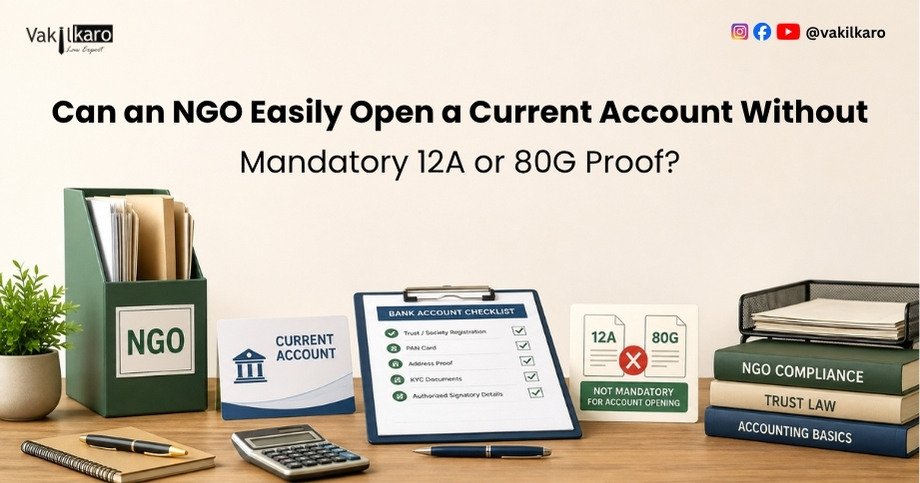
Setting up an NGO through NGO registration, Section 8 Company registration, or MSME registration involves several legal steps, including opening a bank account. Many new NGOs wonder if they can open a current account without 12A and 80G registration certificates. The answer is yes. Banks only require basic registration documents, PAN card, address proof, KYC documents, and a board resolution. 12A and 80G are not mandatory for banking but are critical for long-term growth, enhancing fundraising, NGO Darpan registration under NITI Aayog, and securing government grants. Early compliance planning and professional banking practices build lasting credibility and success.
Key Takeaways
- A common question that arises among newly formed NGOs is: If the NGO does not yet have 12A and 80G registration certificates, can it still open a current account?
- An NGO can legally open a current account immediately after registration without possessing 12A and 80G registration certificates.
- While 12A and 80G registration certificates are extremely valuable for fundraising and long-term credibility, they are not prerequisites for opening either a savings account or a current account after NGO registration or Section 8 Company registration.
- Can an NGO Open a Current Account Without 12A and 80G?
- Best Practices for NGOs Opening Current Accounts Without 12A and 80G Prepare Core Documents: Ensure NGO registration papers, PAN, address proof, KYC, and board resolution are ready.
Can NGOs Operate Financially Without 12A and 80G Certificates?
Establishing an NGO in India, whether through NGO registration, Section 8 Company registration, or MSME registration for social enterprises, involves important legal and financial steps. One critical requirement for operational readiness is opening a bank account under the NGO’s official name. Naturally, many new organizations wonder: Is it possible to open a current account without having 12A and 80G registration certificates?
The answer is a clear yes.
Banks do not mandate 12A and 80G certificates for opening a current account. They primarily require the NGO’s registration certificate (such as a Trust Deed, Society Registration Certificate, or Section 8 Incorporation Certificate), a valid PAN card, proof of the registered office address, KYC documents of the authorized signatories, and a board resolution approving the opening of the account.
While 12A and 80G are not necessary for banking operations, securing these registrations soon after setting up the bank account is highly recommended. 12A registration allows an NGO to enjoy tax exemptions on its income, while 80G registration gives donors the benefit of tax deductions, making the NGO more attractive to contributors.
Furthermore, NGOs looking to register with NGO Darpan, managed by NITI Aayog, or those planning to participate in government grant programs, would greatly benefit from holding these certifications. It strengthens their profile and credibility, making it easier to access funding and collaborative opportunities.
NGOs also stand to gain significant advantages by pursuing MSME registration, which offers access to subsidies, easier loans, and participation in public tenders. Maintaining a current account, alongside complying with NGO Darpan and Ministry of Corporate Affairs expectations, positions an NGO for sustainable success.
Ultimately, setting up a current account early, maintaining proper financial records, and proactively applying for 12A and 80G registration are key steps for an NGO's long-term impact and credibility.
Setting up a non-governmental organization (NGO) in India is a meaningful and impactful endeavor, but it comes with its share of regulatory requirements and procedural complexities. Whether the NGO is established through NGO registration, incorporated under Section 8 Company registration governed by the Ministry of Corporate Affairs, or registered as a social enterprise under MSME registration, each path demands a structured approach to financial and operational compliance.
One of the very first practical steps for any newly registered NGO is to open a formal bank account in the name of the organization. This account is critical not only for receiving donations and grants but also for managing day-to-day operational expenses, disbursing project funds, maintaining transparency in financial dealings, and building a credible financial history that supports audits and future grant applications.
A common question that arises among newly formed NGOs is:
If the NGO does not yet have 12A and 80G registration certificates, can it still open a current account?
The answer is reassuring: Yes, it can.
An NGO can legally open a current account immediately after registration without possessing 12A and 80G registration certificates. However, to make informed decisions, it is important to understand the broader legal, financial, and strategic implications surrounding this.
In this blog, we will explore several key areas essential for a newly formed NGO:
- The actual role and benefits of obtaining 12A and 80G registration
- How NGO registration and Section 8 Company registration influence the banking setup
- The critical importance of being listed on NGO Darpan under the supervision of NITI Aayog
- How MSME registration can further enhance an NGO's financial prospects
- Step-by-step guidance and best practices for successfully opening and managing a current account without initially having 12A and 80G
Let’s dive deeper into each of these important aspects to ensure your NGO’s financial foundation is strong, compliant, and ready for sustainable growth!
Understanding NGO Registration and Financial Setup
Once an NGO completes its legal registration — whether as a Trust, Society, or through Section 8 Company registration under the Ministry of Corporate Affairs (MCA) — setting up a dedicated bank account becomes an immediate necessity.
An NGO needs a formal bank account to:
- Receive domestic and foreign donations
- Handle grants and project funds
- Pay employees, vendors, and administrative expenses
- Maintain transparent financial records for audits
- Strengthen its credibility among donors, funders, and government bodies
For NGOs intending to register on NGO Darpan, a platform managed by NITI Aayog, having a proper bank account in the NGO's name is mandatory.
Thus, banking readiness is a critical operational milestone immediately after NGO registration.
12A and 80G Registration Certificates: What Are They?
12A registration provides an NGO with income tax exemption on its surplus income, meaning any income earned for charitable purposes is not taxable.
80G registration benefits the donors: it allows individuals and corporations who contribute to the NGO to claim tax deductions on their donations.
While 12A and 80G registration certificates are extremely valuable for fundraising and long-term credibility, they are not prerequisites for opening either a savings account or a current account after NGO registration or Section 8 Company registration.
Can an NGO Open a Current Account Without 12A and 80G?
Yes, absolutely.
Banks do not require 12A and 80G certificates to open a current account. What they do require are:
- NGO’s Registration Certificate (Trust Deed, Society Registration Certificate, or Incorporation Certificate under Section 8)
- NGO’s Permanent Account Number (PAN) card
- Proof of the registered office address
- Copy of the Memorandum of Association (MOA) and Articles of Association (AOA) or Trust Deed/Rules & Regulations
- KYC documents of authorized signatories (such as Aadhaar, PAN, Passport, etc.)
- Board Resolution authorizing account opening and nominating signatories
12A and 80G registration certificates are linked to tax benefits, not banking permissions.
Thus, NGOs can freely open current accounts and start their financial operations while simultaneously applying for or planning to apply for 12A and 80G.
Why Opt for a Current Account Instead of a Savings Account?
A current account is recommended for NGOs because:
- Unlimited transactions: Savings accounts often restrict the number of free transactions, while current accounts allow unlimited cash deposits, withdrawals, and transfers.
- Higher operational flexibility: NGOs often have multiple funding sources, grants, and donation events, requiring frequent banking transactions.
- Credibility: Current accounts project a more professional image when working with CSR donors, grant agencies, and during audits.
- NGO Darpan and Government Collaborations: NGOs registered on NGO Darpan under NITI Aayog are expected to maintain professional banking systems, which is better supported by a current account.
For NGOs formed through Section 8 Company registration, the importance of maintaining a current account becomes even more critical, given the regulations enforced by the Ministry of Corporate Affairs regarding financial transparency.
NGO Darpan, NITI Aayog, and Banking Compliance
NGO Darpan is a government portal managed by NITI Aayog to create a verified database of NGOs working across various sectors in India.
While 12A and 80G registration are not mandatory for NGO Darpan registration, having them enhances the NGO’s credibility and improves chances of accessing:
- Government grants
- Ministry partnerships
- CSR collaborations
To complete NGO Darpan registration, NGOs must disclose:
- Legal documents
- Contact details
- Areas of operation
- Financial details including bank account information
Thus, opening a current account right after NGO registration or Section 8 Company registration helps prepare the NGO for faster NGO Darpan approval and future funding opportunities.
How MSME Registration Supports NGOs?
In recent years, MSME registration (now Udyam Registration) has been made available to Section 8 Companies and social enterprises working in fields like education, healthcare, environmental protection, and rural development.
Benefits for NGOs under MSME registration include:
- Access to government subsidies
- Priority in government tenders
- Easier loan processing
- Eligibility for grants and funding schemes
During MSME audits, maintaining a current account — alongside having proper compliance like NGO registration, Section 8 Company registration, and eventually 12A and 80G — boosts the NGO’s financial profile and grant readiness.
Practical Example: Real-Life Scenario
Let’s consider a practical case:
HopeRoots Foundation, a newly registered NGO under Section 8 Company registration, completed its incorporation in February 2024.
Steps taken:
- Immediately opened a current account using the Incorporation Certificate, PAN, address proof, MOA, AOA, and board resolution.
- Started managing local fundraising events and small donor contributions without needing 12A/80G initially.
- Within six months, prepared and filed applications for 12A and 80G registration.
- Simultaneously registered on NGO Darpan to access upcoming government programs under NITI Aayog.
- Applied for MSME registration to seek government-supported livelihood development grants.
Result?
By maintaining a compliant and professional banking setup through a current account, HopeRoots Foundation qualified for CSR funding and public sector grant opportunities by its second year.
Best Practices for NGOs Opening Current Accounts Without 12A and 80G
- Prepare Core Documents: Ensure NGO registration papers, PAN, address proof, KYC, and board resolution are ready.
- Start Early Compliance Planning: Even if not immediately required, initiate preparation for 12A and 80G registration within the first operational year.
- Separate Personal and Organizational Funds: Always keep personal transactions separate from NGO financial activities.
- Maintain a Clean Fund Trail: Issue receipts for all donations, maintain ledgers, and reconcile accounts monthly.
- Register on NGO Darpan Early: Even before having 12A and 80G, registering on NGO Darpan positions your NGO favorably for future opportunities.
- Consider MSME Registration: If applicable, register under MSME for additional benefits.
- Stay Audit-Ready: Maintain clean documentation anticipating future NGO Darpan audits, grant audits, and Ministry of Corporate Affairs inspections.
Common Misunderstandings
Misconception Reality
12A and 80G are mandatory for bank accounts No, only basic NGO registration documents are required
NGO Darpan requires 12A/80G certificates No, but it boosts your profile
NGOs can operate savings accounts forever No, larger NGOs should migrate to current accounts
MSME registration is only for businesses No, Section 8 Companies and social enterprises are eligible too
Conclusion
To summarize, NGOs — whether formed through NGO registration, Section 8 Company registration, or MSME registration — can open a current account without having 12A and 80G registration certificates. Banks only require basic legal and KYC documents for account opening, not tax exemption certifications.
However, while not mandatory for banking, obtaining 12A and 80G registration remains essential for future fundraising, donor credibility, and government collaborations, especially on platforms like NGO Darpan under NITI Aayog. Similarly, NGOs planning to leverage MSME registration benefits or work under grants from ministries governed by the Ministry of Corporate Affairs must aim for full compliance over time.
By setting up a current account early, maintaining clean financial practices, and proactively planning for 12A/80G certification, NGOs can lay a strong foundation for sustainable growth, regulatory compliance, and lasting social impact.
Why Choose Vakilkaro for Your NGO and Legal Services?
When it comes to setting up and running an NGO in India — from NGO registration, Section 8 Company registration, MSME registration, to obtaining vital certifications like 12A and 80G registration, choosing the right legal partner can make all the difference. Vakilkaro stands out as a trusted, experienced, and affordable service provider dedicated to simplifying complex legal processes for NGOs, startups, and social enterprises.
At Vakilkaro, our team of seasoned experts ensures end-to-end support — from drafting documents, completing registrations with the Ministry of Corporate Affairs, securing compliance with NGO Darpan under NITI Aayog, and guiding you through the intricacies of tax exemptions and government grants. Whether you need help opening a bank account, preparing a detailed project report for funding, filing timely compliance documents, or registering under MSME, Vakilkaro ensures smooth, error-free, and quick service delivery.
We pride ourselves on:
- Personalized Consultation: Every organization is unique, and so are its legal needs. We offer tailor-made solutions that align with your goals.
- Affordable Pricing: High-quality legal support doesn’t have to be expensive. Vakilkaro offers transparent, budget-friendly service packages.
- End-to-End Assistance: From document drafting to final certificate delivery, we handle the entire process while keeping you informed at every step.
- Speed and Efficiency: We value your time. Our streamlined processes and expert guidance help you achieve registrations and compliance faster.
- Post-Registration Support: Our relationship doesn’t end at registration — we offer ongoing advisory for compliance, grant applications, and NGO management.
Choosing Vakilkaro means choosing a hassle-free, compliant, and growth-focused journey for your NGO or enterprise. Let us help you focus on your mission — while we take care of the legal work!
Official External Resources
Use these primary/official sources to verify rules, forms, fees, timelines and regulatory updates before publication.
Frequently asked questions
Can an NGO Easily Open a Current Account Without Mandatory 12A or 80G Proof?+
A common question that arises among newly formed NGOs is: If the NGO does not yet have 12A and 80G registration certificates, can it still open a current account? An NGO can legally open a current account immediately after registration without possessing 12A and 80G registration certificates.
