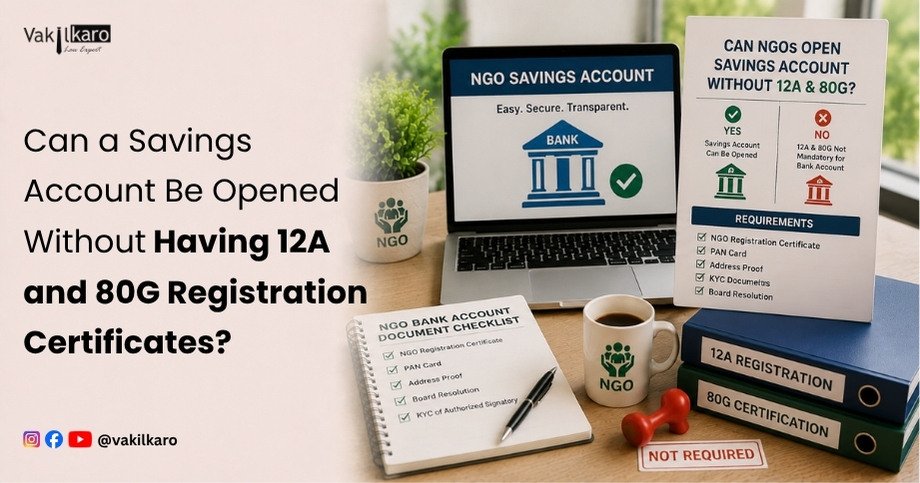
NGOs in India can open a savings account without 12A and 80G registration certificates. After NGO registration, banks require documents like the registration certificate, PAN, address proof, and board resolution—not 12A or 80G. However, while not mandatory initially, obtaining these registrations is crucial for future fundraising, donor trust, tax exemptions, and eligibility for CSR funds or NGO Darpan registration. Savings accounts suit early-stage NGOs, but for scaling operations and managing frequent donations, a current account becomes essential. Strategic planning around banking and compliance strengthens an NGO’s credibility, operational growth, and long-term impact in the social development sector.
Key Takeaways
- NGOs in India can open a savings account without 12A and 80G registration certificates.
- Can an NGO Open a Savings Account Without 12A and 80G Registration Certificates?
- Among new NGO founders, a common question often arises: Is it possible to open a savings account without having 12A and 80G certificates?
- The short and clear answer is yes — an NGO can legally open a savings account without having 12A and 80G registration certificates.
- Conclusion Yes, an NGO can open a savings account without having 12A and 80G certificates.
Can an NGO Open a Savings Account Without 12A and 80G Registration Certificates?
When starting an NGO in India, whether through NGO registration, Section 8 Company registration, or MSME registration as a social enterprise, setting up a bank account is one of the first operational priorities. A common question many founders ask is: Can an NGO open a savings account without 12A and 80G certificates? The answer is yes. It is legally permissible to open a savings account without having obtained 12A and 80G registrations, but there are several important factors to consider.
Most banks allow NGOs to open savings accounts based on basic documents like the registration certificate, PAN card, address proof, Memorandum of Association (MOA) or Trust Deed, and a board resolution. The 12A and 80G certificates, which grant income tax exemptions and donor tax benefits, are not mandatory at the account opening stage.
However, while an NGO can function initially with just a savings account, the absence of 12A and 80G can limit future fundraising opportunities. Donors, particularly corporates offering CSR funds, prefer NGOs that provide tax deductions under Section 80G. Furthermore, government platforms like NGO Darpan under NITI Aayog recommend these certifications for securing grants and partnerships, although they are not mandatory for opening a bank account.
Operating through a savings account is feasible for smaller NGOs in the early stages, but as the organization grows, managing multiple donors and larger cash flows may trigger the need for a current account for unlimited transactions and better financial governance.
In the long run, obtaining 12A and 80G certifications strengthens an NGO’s credibility, improves its fundraising capacity, ensures tax compliance, and enhances its eligibility for both domestic and international grants. Strategic planning around banking and compliance ensures that NGOs build a solid foundation for sustainable growth and greater societal impact.
Establishing an NGO in India—whether through NGO registration, Section 8 Company registration, or by forming a social enterprise under MSME registration—involves navigating several crucial regulatory and operational milestones. One of the earliest and most important steps after completing registration is opening a bank account in the organization's name. This bank account acts as the financial backbone of the NGO, enabling it to receive donations, manage grants, handle operational expenses, and maintain transparency with donors and regulatory bodies.
Among new NGO founders, a common question often arises: Is it possible to open a savings account without having 12A and 80G certificates? The straightforward answer is yes. NGOs are legally allowed to open a savings account immediately after registration, without waiting to obtain 12A and 80G certifications. Banks primarily require basic documentation such as the NGO's registration certificate, PAN card, proof of address, and a board resolution to authorize account operations.
However, while legally permissible, opening a savings account without securing 12A and 80G certifications carries broader strategic implications. These certificates not only offer tax exemptions for NGOs and tax benefits to donors but also significantly boost the credibility and fundraising potential of an organization. Without them, attracting large donations, securing corporate CSR funding, and applying for government grants can become challenging.
This blog aims to explore this important topic in-depth. We will examine the legal requirements for opening a bank account, the advantages and limitations of operating without 12A and 80G, the impact on NGO Darpan and NITI Aayog compliance, and practical advice for new NGOs planning to manage their finances effectively from the start. Understanding these nuances will help NGOs make informed decisions that support both short-term operations and long-term growth and sustainability.
Understanding NGO Registration and Banking Basics
Once an NGO in India successfully completes its registration—whether as a Trust, Society, or under Section 8 Company registration—attention must quickly turn to setting up the necessary operational frameworks. One of the very first and most crucial steps in this process is opening a dedicated bank account in the organization's name.
Having a formal bank account is essential for a number of reasons. First, it allows the NGO to legally and systematically receive donations and grants from individuals, corporates, and institutions. Second, it facilitates the management of operational expenses, including staff salaries, vendor payments, project expenses, and administrative costs. Most importantly, maintaining a separate organizational bank account ensures financial transparency, a factor that is critical for establishing credibility with donors, auditors, regulatory bodies, and government agencies.
A professional and well-managed banking system also plays a pivotal role in building a strong financial foundation that supports smooth audits, compliance with statutory obligations, and eligibility for tax benefits like 12A and 80G registrations.
Types of Bank Accounts for NGOs
There are primarily two types of bank accounts NGOs can consider, depending on the size, scope, and financial needs of their operations:
- Savings Account:
Ideal for smaller NGOs that deal with limited financial transactions. Savings accounts are suitable for holding corpus funds, managing restricted grants, or operating at an early stage when donation inflows are modest. They offer interest earnings on deposits, but often come with limits on the number of free transactions per month, which could be a constraint as the organization grows.
- Current Account:
Designed for NGOs with high-volume financial activities, current accounts allow unlimited transactions without penalties, making them mandatory for larger NGOs, those receiving frequent donations, or collaborating with government agencies and CSR partners. Although they typically do not offer interest, current accounts provide the flexibility and transparency required for scaling up operations.
Choosing the right type of account early on sets the tone for efficient fund management and regulatory compliance throughout the NGO’s journey.
12A and 80G Registration: What Are They?
When operating an NGO in India, understanding the significance of 12A and 80G registrations is critical for building long-term financial sustainability and credibility. These certifications, issued by the Income Tax Department of India, play a pivotal role in the NGO’s ability to maximize its fundraising efforts and offer tax benefits to both the organization and its donors.
12A Registration
The 12A registration provides NGOs with a complete exemption from paying income tax on their surplus income. This means that any excess of income over expenditure earned by the NGO in the course of its charitable activities will not be taxed, provided the income is used solely for the organization’s stated charitable objectives. Without 12A registration, the NGO’s surplus income would be taxed at the applicable rates, reducing the funds available for its social initiatives. Obtaining 12A certification ensures that the NGO can retain and reinvest more resources into its mission, thereby enhancing its ability to grow and sustain operations.
80G Registration
The 80G registration is designed to incentivize donations to NGOs by offering tax deductions to donors. When an NGO is registered under Section 80G, its donors can claim a deduction of 50% or 100% of the donated amount (depending on the nature of the donation) when filing their income tax returns. This financial incentive makes the NGO far more attractive to individual contributors, corporations, and CSR initiatives, significantly boosting fundraising efforts.
Important Note
While both 12A and 80G registrations are highly beneficial for an NGO’s financial and operational strategy, they are not mandatory for opening a bank account. An NGO can open a savings or current account with its basic registration documents (such as Trust Deed, Society Certificate, or Section 8 Incorporation Certificate) even before applying for or obtaining 12A and 80G status.
Nonetheless, for long-term fundraising, donor engagement, and credibility, securing 12A and 80G registrations soon after setting up the bank account is strongly recommended.
Can an NGO Open a Savings Account Without 12A and 80G Registration Certificates?
The short and clear answer is yes — an NGO can legally open a savings account without having 12A and 80G registration certificates. In India, the process of opening a bank account for an NGO focuses primarily on verifying the organization's legal existence, structure, and authorized representatives, rather than its tax exemption status.
Most banks require a specific set of documents to proceed with opening a savings account in the name of the NGO. These typically include:
- Certificate of Registration: This could be a Trust Deed (for Trusts), a Society Registration Certificate (for Societies), or a Certificate of Incorporation (for Section 8 Companies registered under the Companies Act, 2013).
- PAN Card: The Permanent Account Number (PAN) issued in the name of the NGO is mandatory for tax and compliance purposes.
- Proof of Registered Office Address: Valid documentation showing the NGO’s official address, such as a utility bill, rental agreement, or ownership document.
- Memorandum of Association (MOA) and Articles of Association (AOA): (for Societies and Section 8 Companies) or the Rules and Regulations (for Trusts and Societies) These outline the NGO's objectives and governance structure.
- KYC Documents of Authorized Signatories: Identity and address proofs (such as Aadhaar, PAN, passport) of the individuals authorized to operate the account.
- Board Resolution: A formal resolution passed by the NGO's governing body authorizing the opening of the bank account and specifying the names of the authorized signatories.
Importantly, 12A and 80G certificates are not part of the mandatory documentation required by banks at the time of account opening. These certificates pertain to the organization's income tax benefits and fundraising capabilities, but not to its basic eligibility to establish a financial account.
Thus, newly registered NGOs can proceed with operational banking activities even before applying for or obtaining 12A and 80G registrations.
Then Why Pursue 12A and 80G Registration?
Although it is legally possible for NGOs to open a savings account without first obtaining 12A and 80G certificates, it is highly advisable to pursue these registrations early in the NGO’s journey. These certifications offer substantial strategic advantages that go far beyond simply opening a bank account — they fundamentally impact the organization's fundraising capacity, legal compliance, and overall credibility in the sector.
Here’s why obtaining 12A and 80G registration is crucial:
Tax Exemptions for the NGO (12A)
With 12A registration, an NGO is exempted from paying income tax on the surplus income it generates from its charitable activities. This ensures that more resources stay within the organization to further its mission, rather than being lost to taxation. Without 12A registration, the NGO's income could be taxed at standard rates, significantly reducing the funds available for social projects and operational needs.
Tax Benefits for Donors (80G)
80G registration provides a major incentive for donors, as it allows them to claim tax deductions on the donations made to the NGO. This makes the NGO a far more attractive option for both individual and corporate donors, particularly for businesses fulfilling their CSR (Corporate Social Responsibility) obligations. The ability to offer tax deductions can significantly boost an NGO’s fundraising efforts and help build long-term donor relationships.
Enhanced Credibility with Corporates, Foundations, and Grant Agencies
Organizations that hold 12A and 80G certificates are perceived as more credible, transparent, and professionally managed. Corporations, funding foundations, and large grant agencies often make 80G certification a precondition for partnership or funding, ensuring that the NGO aligns with recognized compliance standards.
Essential for Government Grants via NGO Darpan and NITI Aayog
While 12A and 80G are not mandatory for basic registration on the NGO Darpan portal managed by NITI Aayog, having these registrations greatly enhances the chances of securing government grants. Many government departments prefer working with NGOs that already demonstrate strong tax compliance and financial transparency through their 12A and 80G status.
Practical Scenarios
NGO Darpan and NITI Aayog: Role in Financial Compliance
In India, NGO Darpan is a key online platform managed by the NITI Aayog, the government's premier policy think tank. While registration on NGO Darpan is voluntary, it is highly recommended for NGOs that aspire to work closely with government agencies, apply for government grants, forge CSR partnerships, and build public credibility. Being listed on NGO Darpan enhances an NGO’s visibility, legitimacy, and access to major funding opportunities.
NGOs that register on the NGO Darpan portal are required to submit comprehensive details about their organization, including:
- Legal status (Trust, Society, or Section 8 Company)
- Areas of operation
- Key contact information
- Financial records and annual reports
- Bank account details associated with the NGO’s official name
Providing accurate bank account information is a mandatory part of the registration process. NGOs must have either a savings or current account that is specifically opened in the organization's name. This requirement ensures that all financial transactions, donations, and grants are traceable to the NGO's official banking system, thereby maintaining transparency and accountability.
Importantly, holding 12A and 80G certificates is not compulsory to register on NGO Darpan or to open a bank account. However, possessing these certifications significantly strengthens the NGO’s profile. NGOs with 12A and 80G registrations are viewed as more credible by both government departments and CSR funders, improving their chances of being shortlisted for funding programs, collaborations, and grants.
Moreover, NGOs that are serious about long-term impact, scaling operations, and receiving institutional support are strongly encouraged to secure 12A and 80G registrations soon after registration and opening a bank account. This proactive compliance enhances the NGO’s appeal to donors, funding agencies, and government bodies.
Key Points to Consider Before Opening a Savings Account Without 12A and 80G Registration
Future Fundraising Limitations
Without 12A and 80G:
- Donations are not tax-deductible for donors.
- You may struggle to attract large donors or corporate CSR funds.
- Some international grants may insist on tax exemption proof.
Thus, if your NGO intends to raise significant funds, it's better to apply for 12A/80G soon after opening your savings account.
Bank Perception and Requirements
While banks allow savings accounts without 12A/80G, many may encourage or prefer NGOs with these certificates because:
- It shows operational seriousness.
- It assures the bank that the NGO follows proper tax practices.
Especially for Section 8 Companies, banks expect professional documentation and often require a current account rather than a savings account.
Audit and Financial Management
Managing financial transactions through a savings account:
- Is acceptable for very small NGOs.
- Becomes problematic for NGOs with multiple donors and frequent transactions.
Savings accounts limit the number of free transactions, and large cash inflows could trigger tax authority scrutiny (especially post-₹10 lakh annual deposits).
Thus, for organizations scaling up, opening a current account alongside the savings account is advisable.
Advantages and Disadvantages of Opening a Savings Account First
When an NGO is newly registered, opening a savings account can seem like the easiest and fastest way to get operations started. While it is a practical step for early-stage organizations, it comes with both advantages and disadvantages that must be carefully considered depending on the NGO’s future plans.
Advantages of Opening a Savings Account First
- Immediate Operational Start After NGO Registration
A savings account allows a newly formed NGO to start its financial activities right away. Receiving initial donations, paying for administrative expenses, and setting up basic operations become possible without waiting for additional compliance steps like 12A and 80G registrations.
- Time to Prepare Documents for 12A and 80G Applications
Once the savings account is in place, NGOs can focus on gathering and preparing the necessary documentation required for applying for 12A and 80G certifications, such as audited financial statements, activity reports, and governing board details. This provides breathing room to meet compliance obligations properly without delaying operational readiness.
- Suitable for Early-Stage, Grassroots NGOs
For small, community-based organizations or NGOs operating at a very local level with limited financial activity, a savings account is often sufficient in the beginning. It provides a simple, low-maintenance banking solution while helping build a basic financial history.
Disadvantages of Opening a Savings Account First
- Limits Fundraising Opportunities
Without 12A and 80G certifications—and operating solely through a savings account—an NGO may struggle to attract larger donations, particularly from corporate CSR programs or high-net-worth individuals who look for tax deduction benefits.
- Complicates Financial Reporting as Donations Grow
Savings accounts typically have transaction limits and simpler reporting features. As donation volumes and financial transactions increase, it becomes difficult to maintain proper financial records, segregate project funds, and meet audit standards.
- May Necessitate Switching to a Current Account Later
Once the NGO scales up, it will likely need to shift to a current account to accommodate unlimited transactions, manage grants, and meet compliance expectations. This transition requires additional paperwork, updates in regulatory filings, and may temporarily disrupt operations if not handled efficiently.
Best Practices for NGOs Opening Savings Accounts Without 12A and 80G Registration
- Separate Organizational and Personal Funds
Never mix personal and NGO funds in the savings account.
- Pass a Board Resolution
Document a formal resolution authorizing the opening of the bank account.
- Proper Record Keeping
Maintain clear ledgers showing donations received, interest earned, and expenses made.
- Plan for Future Compliance
Apply for 12A/80G certificates within the first financial year to avoid fundraising roadblocks.
- Prepare for NGO Darpan Registration
Organize financial documentation to smoothly register with NGO Darpan when needed.
- KYC Updates
Keep bank KYC (Know Your Customer) documents updated regularly.
Practical Example: A Startup NGO Journey
An environmental NGO named "GreenWorld Foundation" registered as a Trust in January 2024:
- Opened a savings account without 12A/80G.
- Focused first on local fundraising through community events.
- Within six months, applied for 12A and 80G registration.
- Upgraded to a current account in their second year to handle growing donations.
- Registered with NGO Darpan and applied for government grants successfully.
- Benefited from MSME registration to access small-business grants for environmental awareness campaigns.
Result: Professionalism, compliance, and donor confidence led to a 5x increase in funding within two years.
Conclusion
Yes, an NGO can open a savings account without having 12A and 80G certificates. It is a valid and often necessary step for newly registered NGOs to start their operations.
However, for long-term success, scaling donations, tax benefits, and eligibility for government programs like those under NGO Darpan and NITI Aayog, obtaining 12A and 80G Registration Certificates becomes crucial.
Eventually, NGOs handling significant donations or frequent transactions must also consider opening a current account for seamless, compliant financial management.
By aligning banking practices with regulatory expectations, NGOs can build credibility, gain donor trust, qualify for government support, and maximize their impact.
Official External Resources
Use these primary/official sources to verify rules, forms, fees, timelines and regulatory updates before publication.
Frequently asked questions
Can a Savings Account Be Opened Without Having 12A and 80G Registration Certificates?+
NGOs in India can open a savings account without 12A and 80G registration certificates. Can an NGO Open a Savings Account Without 12A and 80G Registration Certificates?
