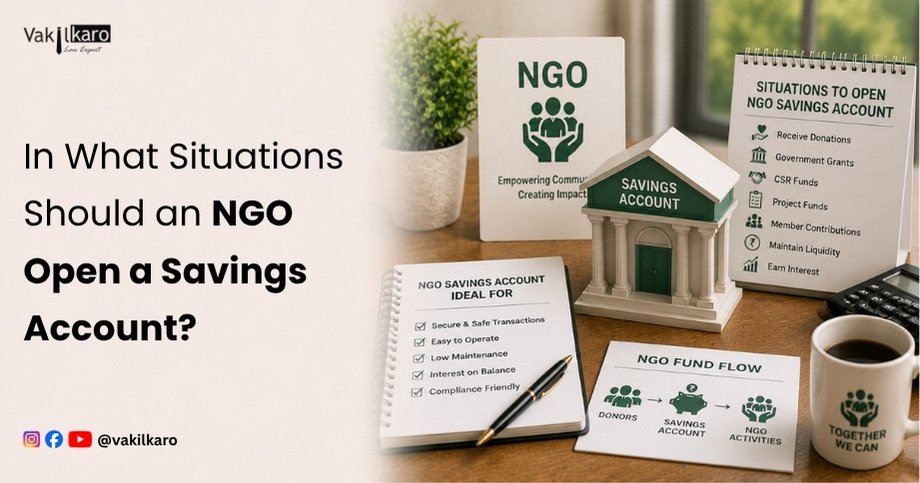
When managing an NGO in India — whether through NGO registration, Section 8 Company registration, or MSME registration — financial discipline is crucial. While current accounts are standard for daily operations, there are specific scenarios where opening a savings account is strategic, such as managing corpus funds, earmarked donations, scholarship programs, or reserve funds. Savings accounts help NGOs meet compliance requirements under 12A and 80G registration, and maintain transparency for platforms like NGO Darpan managed by NITI Aayog. This blog explores when NGOs should use savings accounts while ensuring full compliance and financial professionalism.
Key Takeaways
- For instance, when an NGO receives corpus donations — permanent contributions that must remain intact — these funds can be placed in a savings account to earn modest interest while preserving the principal amount.
- Situations Where an NGO Should Open a Savings Account 1.
- If an NGO maintains a savings account — particularly for corpus funds or project-specific donations — it must clearly declare these accounts at the time of registration and whenever updates are required.
- Key Rules for NGOs Operating a Savings Account If an NGO decides to maintain a savings account, it must adhere to strict financial discipline: No Personal Transactions: Savings accounts must be used solely for the organization's funds.
- Case Study: How Strategic Use of Savings Accounts Helped an NGO An education-focused NGO registered as a Section 8 Company opened a savings account specifically for their Scholarship Corpus Fund.
When Should an NGO Consider Opening a Savings Account?
Managing an NGO’s financial operations efficiently is crucial for long-term success, particularly after completing NGO registration, Section 8 Company registration, or even MSME registration for social enterprises. While most NGOs are advised to operate primarily through a current account to facilitate frequent transactions, there are specific scenarios where maintaining a savings account becomes strategically beneficial.
Savings accounts, typically designed to encourage money retention and offer interest on deposits, are ideal for storing funds that are not required for daily operations. For instance, when an NGO receives corpus donations — permanent contributions that must remain intact — these funds can be placed in a savings account to earn modest interest while preserving the principal amount. This helps NGOs demonstrate prudent financial management, an important aspect during 12A and 80G registration audits.
Similarly, donations received for specific projects, such as scholarships or healthcare initiatives, can be better managed through a separate savings account. Having a dedicated account simplifies fund tracking, ensures accountability, and meets compliance expectations for grants registered through platforms like NGO Darpan managed by NITI Aayog.
Savings accounts are also helpful for building reserve funds. NGOs can set aside surplus donations during high-funding periods, ensuring operational stability during leaner times. Moreover, certain donors may request a dedicated account for monitoring grant utilization, making savings accounts a practical solution.
However, it’s essential that NGOs maintain clear segregation of funds, proper documentation, and full disclosure of all accounts during regulatory filings and audits. Any financial mismanagement could affect credibility, future fundraising prospects, and legal standing.
In conclusion, while the current account remains the backbone of NGO financial operations, opening a savings account for specific needs offers a strategic advantage — provided it is managed transparently and in line with the NGO’s legal obligations.
Establishing and managing an NGO in India demands more than just a vision for social impact — it requires strong financial management practices. After completing essential steps like NGO registration, Section 8 Company registration, or MSME registration for social enterprises, one of the earliest operational decisions an NGO must make is how to handle its finances effectively. Setting up the right type of bank account becomes crucial, not only for smooth day-to-day transactions but also for ensuring regulatory compliance and building donor trust.
Typically, NGOs are advised to open a current account, which is designed for organizations handling frequent and high-volume transactions. Current accounts facilitate seamless financial operations, helping NGOs pay vendors, disburse project funds, and collect donations without restrictions on the number of transactions. However, there are particular situations where opening a savings account becomes not just beneficial, but strategically necessary.
Savings accounts, traditionally associated with personal finance, can serve important roles for NGOs — particularly for managing corpus funds, earmarked donations, scholarship funds, and reserve capital. By earning interest on parked funds and segregating specific sources of income, savings accounts help NGOs maintain financial discipline and transparency, key requirements when applying for 12A and 80G registration for tax benefits and exemptions.
Moreover, maintaining clear and well-organized bank accounts is a fundamental expectation under regulatory platforms like NGO Darpan, managed by NITI Aayog, which governs NGO participation in government-funded schemes and projects. Proper banking practices are also evaluated during audits, annual filings, and when applying for grants or CSR funding.
In this blog, we will explore in detail when and why NGOs should consider opening a savings account, the compliance frameworks that govern such financial decisions, and best practices to maintain regulatory integrity and operational excellence.
Banking Basics for NGOs: Current vs. Savings Accounts
Before we dive into specific scenarios, it is important to understand the difference:
- Current Account: Designed for high-frequency transactions typical in business and NGO operations. No limit on transactions but no or very low interest is offered.
- Savings Account: Intended for storing money and earning interest. Limited transactions allowed monthly, but suitable for funds that are not used frequently.
For most NGOs, a current account is mandatory for regular activities. However, under certain conditions, a savings account offers strategic advantages.
Situations Where an NGO Should Open a Savings Account
Managing Corpus Funds
Corpus funds are permanent donations that the organization must preserve. Only the interest generated is typically used for operations.
Savings Account Role:
- Storing corpus funds in a savings account helps generate interest income.
- Ensures separation from operational funds handled through the current account.
Compliance Angle:
- During audits for 12A registration and 80G registration, NGOs must show proper corpus fund management.
- Proper management improves credibility with grant-giving bodies and CSR donors.
Handling Earmarked Donations
Certain donors or funding organizations provide money specifically for a single cause or project, such as building a school or running a healthcare initiative.
Savings Account Role:
- Opening a dedicated savings account for such funds helps in tracking the inflow and outflow clearly.
- Makes compliance and reporting easy, especially for donor audits.
Regulatory Importance:
- Ensures transparency during NGO Darpan registration and partnerships with NITI Aayog schemes.
- Clear fund tracking satisfies both government and private auditing requirements.
Retaining Reserve Funds
NGOs often need to build reserves to support operations during lean funding periods or emergencies.
Savings Account Role:
- A savings account can serve as a safe place to hold reserves and earn some interest.
- Provides operational security without affecting the current account’s regular transactions.
Strategic Advantage:
- Helps NGOs maintain financial resilience, a factor considered during MSME registration and government grant applications.
Managing Scholarship or Endowment Funds
Some NGOs manage scholarships, endowments, or special purpose grants that must be disbursed over a long period.
Savings Account Role:
- Keeping these funds separate from operational money ensures clarity.
- Earned interest can contribute to future scholarship rounds.
Audit Benefit:
- Separate accounts simplify fund management and enhance audit-readiness for Section 8 Companies and charitable trusts.
Low-Volume NGOs in Early Stage
Very small NGOs, especially at the start, may not require heavy transactions.
Savings Account Role:
- If transactions are minimal, a savings account can initially suffice to manage early donations.
- Once the NGO scales, transitioning to a current account becomes necessary.
Regulatory Caution:
- Even if a savings account is used initially, it must be upgraded before applying for 12A/80G registration or listing on NGO Darpan.
How Savings Accounts Support Compliance Efforts?
Maintaining proper banking practices is not just good financial management for NGOs — it is also a critical part of regulatory compliance. Opening and managing savings accounts thoughtfully can greatly support an NGO’s compliance with major legal frameworks and government platforms.
NGO Darpan and NITI Aayog Compliance
When NGOs register with NGO Darpan, a platform managed by NITI Aayog, they are required to provide comprehensive financial disclosures. These disclosures include full details of bank accounts, fund utilization, and financial flows.
If an NGO maintains a savings account — particularly for corpus funds or project-specific donations — it must clearly declare these accounts at the time of registration and whenever updates are required. Transparent banking records strengthen an NGO’s credibility and facilitate smoother collaboration with government bodies for grants, schemes, and CSR partnerships.
12A and 80G Registrations: Tax Exemption Compliance
During the process of obtaining 12A registration (for income tax exemption) and 80G registration (for donor tax deduction eligibility), NGOs must prove financial discipline and fund utilization accuracy.
Savings accounts dedicated to corpus donations or specific projects help in maintaining a clear separation of funds. During audits and tax scrutiny, demonstrating that different categories of income and donations are properly segregated strengthens the NGO's case and speeds up approval processes for tax benefits.
Section 8 Company Filings: ROC Requirements
NGOs that have undergone Section 8 Company registration must comply with the strict filing and disclosure requirements under the Companies Act, 2013.
The Registrar of Companies (ROC) expects full disclosure of all bank accounts maintained by the organization. Keeping operational funds and corpus or earmarked donations in separate accounts — such as a savings account — simplifies financial reporting, audit trails, and annual compliance filings.
MSME Registration and Benefits
NGOs registered under MSME registration as social enterprises must maintain clean, auditable financial records to qualify for government subsidies, grants, and loan benefits.
By utilizing savings accounts for non-operational, reserved funds, NGOs can easily differentiate between active project income and long-term reserves. This distinction enhances financial transparency, making it easier to pass audits and maintain eligibility for MSME-related schemes.
Key Rules for NGOs Operating a Savings Account
If an NGO decides to maintain a savings account, it must adhere to strict financial discipline:
- No Personal Transactions: Savings accounts must be used solely for the organization's funds.
- Separate Ledger Maintenance: Distinct accounting records for each bank account.
- Board Resolutions: Formal board approval for opening, operating, and using savings accounts.
- Audit Transparency: Disclose all accounts during audits, ROC filings, NGO Darpan registration, and income tax returns.
- Fund Usage Policy: Clearly define how savings account funds will be used (e.g., corpus utilization, scholarship payouts).
Best Practices for NGOs Using Both Current and Savings Accounts
- Define Purpose: Open a savings account only for a clear, designated purpose.
- Board Oversight: Regular board reviews to monitor account balances and usage.
- Monthly Reconciliation: Cross-verify all entries to prevent errors or compliance issues.
- Document Transfers: If transferring money between accounts, document it through board resolutions and accounting entries.
- Separate Audits if Needed: Large NGOs might consider separate internal audits for corpus and operational funds.
Common Mistakes to Avoid
- Commingling Funds: Mixing operational and restricted donations in the same account creates confusion.
- Non-Disclosure: Failing to declare the savings account during 12A, 80G, or NGO Darpan filing can cause legal penalties.
- Personal Transactions: Even a single personal transaction through an NGO’s savings account can invite serious tax issues.
- Idle Funds: Keeping large balances in savings accounts without board oversight can trigger questions about fund utilization.
Case Study: How Strategic Use of Savings Accounts Helped an NGO
An education-focused NGO registered as a Section 8 Company opened a savings account specifically for their Scholarship Corpus Fund.
- They earned annual interest which was then used to fund scholarships, keeping the principal untouched.
- Proper separation of accounts and transparent reporting helped them secure 80G registration easily.
- Their registration with NGO Darpan under NITI Aayog was approved swiftly because of their professional banking setup.
- They later leveraged their clean banking records to qualify for MSME benefits and scale their operations.
Lesson: A savings account, if managed strategically, can become a tool for growth and compliance.
Conclusion
While current accounts are the primary banking vehicle for NGOs due to their operational flexibility, there are several situations where opening a savings account is not only permissible but advisable. Managing corpus funds, handling earmarked donations, supporting scholarship programs, maintaining reserves, or ensuring audit-friendly practices are all strong reasons to maintain a savings account alongside a current account.
However, NGOs must remember that multiple accounts require greater diligence, clear documentation, transparent reporting, and strict compliance with frameworks like Section 8 Company registration, 12A/80G registration, NGO Darpan, and MSME registration.
By strategically operating both types of accounts, NGOs can build financial strength, donor trust, and regulatory excellence, laying a strong foundation for their mission-driven growth.
Official External Resources
Use these primary/official sources to verify rules, forms, fees, timelines and regulatory updates before publication.
Frequently asked questions
In What Situations Should an NGO Open a Savings Account?+
Situations Where an NGO Should Open a Savings Account 1. If an NGO maintains a savings account — particularly for corpus funds or project-specific donations — it must clearly declare these accounts at the time of registration and whenever updates are required.
