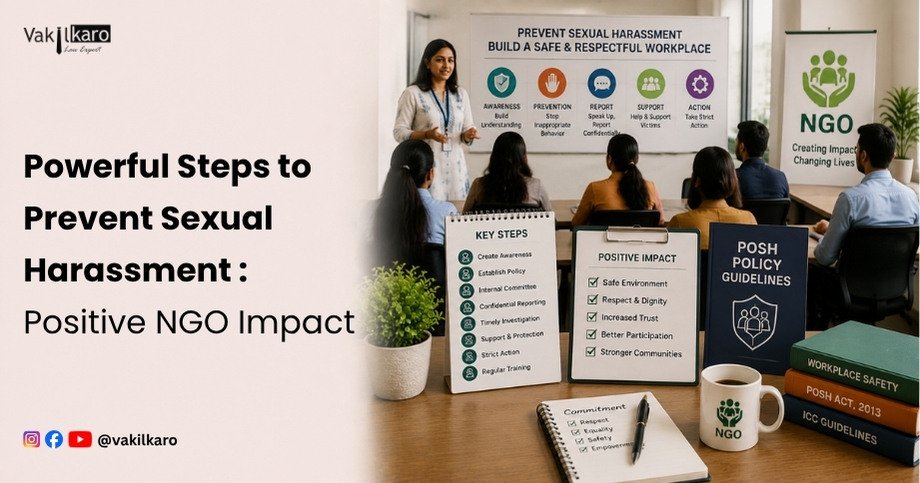
Sexual harassment of women is a widespread issue demanding urgent action. While legal frameworks exist, NGOs are critical in bridging the gap through awareness, legal aid, and advocacy. NGOs with proper registration—particularly those with Section 8 company registration, along with 12A and 80G registration—can amplify their impact by accessing funding, building trust, and collaborating with corporates on CSR initiatives. This blog explores the importance of structured NGO registration, the benefits of compliance, and how legally recognized NGOs can drive social change in preventing harassment and empowering women across India.
Key Takeaways
- How Legally Registered NGOs Help Prevent Sexual Harassment of Women?
- Understanding Sexual Harassment: Its Scope and Deep-Rooted Impact Sexual harassment is a complex and deeply damaging form of gender-based violence that can occur in various environments—be it the workplace, public spaces, educational institutions, or even at home.
- Its key features include: No minimum capital requirement Tax exemptions under 12A and 80G registration Corporate governance structure Can receive foreign contributions with FCRA approval High credibility among donors and CSR partners In the context of preventing sexual harassment, a Section 8 company can offer structured interventions, credible advocacy, and robust support systems.
- If you are looking to start an organization aimed at fighting sexual harassment, consider registering it as a Section 8 company, and pursue 12A and 80G registration.
- Why Choose Vakilkaro for Legal Services Related to Preventing Sexual Harassment Expert Legal Guidance: Vakilkaro offers access to legal professionals who specialize in sexual harassment laws and NGO registration and regulations, ensuring you receive accurate and relevant advice tailored to your needs.
How Legally Registered NGOs Help Prevent Sexual Harassment of Women?
Sexual harassment remains a serious and widespread issue affecting women in various settings, including workplaces, educational institutions, and public spaces. Despite having protective laws like the Sexual Harassment of Women at Workplace (Prevention, Prohibition and Redressal) Act, 2013, implementation challenges continue due to lack of awareness, societal stigma, and inadequate support systems. To address these gaps, Non-Governmental Organizations (NGOs) play a critical role in prevention, awareness, and legal support.
For NGOs to work effectively and gain credibility, proper legal registration is essential. NGOs registered as Section 8 companies under the Companies Act, 2013, have a strong legal structure and are well-suited for addressing sensitive social issues like sexual harassment. These organizations are non-profit entities dedicated to promoting social welfare and can receive funding and partnerships more easily when they have proper compliance in place.
Moreover, 12A and 80G registration provide key financial benefits. With 12A registration, NGOs are exempt from income tax, making their operations more sustainable. 80G registration allows donors to claim tax deductions, which increases the likelihood of financial contributions from individuals and corporations. This financial transparency and legal accountability make such NGOs reliable partners for CSR initiatives and government collaborations.
By leveraging legal recognition, funding access, and organizational structure, NGOs with Section 8 company registration and 12A/80G compliance can deliver impactful programs. These include POSH (Prevention of Sexual Harassment) training, legal aid for victims, and gender sensitization campaigns.
In essence, legally compliant NGOs are not only better equipped to address sexual harassment but are also empowered to scale their efforts, collaborate with stakeholders, and influence policy—ultimately creating safer environments for women across the country.
Sexual harassment of women remains one of the most pressing societal issues globally. It affects women across socio-economic strata, age groups, and professional domains. In India, despite progressive legislation like the Sexual Harassment of Women at Workplace (Prevention, Prohibition and Redressal) Act, 2013, implementation often falls short due to lack of awareness, cultural taboos, and systemic negligence.
Preventing sexual harassment requires a multifaceted approach involving legal frameworks, education, community involvement, and organizational responsibility. Non-Governmental Organizations (NGOs) play a crucial role in bridging gaps between policy and practice. Particularly, NGOs with Section 8 company registration, valid NGO registration, and 12A and 80G registration can significantly contribute by leveraging legal recognition, financial support, and organizational credibility.
In this blog, we explore the causes, consequences, and prevention strategies for sexual harassment of women and emphasize the pivotal role that legally registered NGOs can play in combating this menace.
Understanding Sexual Harassment: Its Scope and Deep-Rooted Impact
Sexual harassment is a complex and deeply damaging form of gender-based violence that can occur in various environments—be it the workplace, public spaces, educational institutions, or even at home. It encompasses a broad spectrum of behaviors, including but not limited to unwelcome physical advances, inappropriate touching, sexually suggestive comments, offensive gestures, lewd jokes, stalking, and coercive demands in exchange for professional or academic benefits. In digital spaces, harassment can also manifest as cyberstalking, explicit messages, or non-consensual sharing of private content.
The consequences of such harassment are far-reaching and profoundly affect the mental, emotional, and professional well-being of the victims. Survivors often suffer from anxiety, depression, post-traumatic stress disorder (PTSD), and a deep sense of shame and isolation. Many women lose their confidence, experience disruption in their career trajectories, and in extreme cases, are forced to leave their jobs or educational paths entirely. The social withdrawal that follows not only affects their personal growth but also deprives society of their potential contributions.
Despite progressive legal frameworks like the Sexual Harassment of Women at Workplace (Prevention, Prohibition and Redressal) Act, 2013, implementation remains a major hurdle. Victims often choose silence over justice due to several systemic and cultural barriers, such as:
- Fear of social stigma and victim-blaming
- Limited awareness about legal rights and support systems
- Inaccessible or inadequate redressal mechanisms
- Power imbalances and deeply rooted gender biases in professional hierarchies
As a result, legal reform alone cannot create a harassment-free society. What is equally essential is active civil society participation. This is where NGOs, especially those with Section 8 company registration, step in as vital catalysts for change. By combining grassroots activism, legal support, education, and advocacy, these registered NGOs play a pivotal role in translating laws into actionable support systems that genuinely empower women and prevent future harassment.
The Role of NGOs in Preventing Sexual Harassment
Non-Governmental Organizations (NGOs) are uniquely positioned to influence change through education, legal assistance, advocacy, and community outreach. But to operate effectively and transparently, NGOs must undergo proper NGO registration and obtain Section 8 company registration if they aim to function as non-profit companies under the Companies Act, 2013.
Here’s how registered NGOs contribute:
Awareness Campaigns and Training
Many women, especially in rural and semi-urban areas, are unaware of what constitutes sexual harassment. NGOs conduct sensitization workshops and training programs for:
- School and college students
- Office employees and employers
- Rural women and community leaders
With Section 8 company registration, such NGOs can partner with corporations and educational institutions to deliver certified training programs. Moreover, having 12A and 80G registration allows these NGOs to attract donations, which are tax-deductible for donors—thereby expanding their outreach.
Legal Aid and Support
NGOs often provide:
- Legal counseling
- Assistance in filing FIRs
- Representation in court
- Support during workplace inquiries
Only NGOs with proper NGO registration and recognized status can collaborate with legal authorities and be taken seriously by law enforcement. Section 8 companies, due to their structured compliance, are particularly reliable in handling such sensitive legal matters.
Policy Advocacy and Government Partnerships
Registered NGOs with 12A and 80G registration can access grants and collaborate with governmental bodies on policy advocacy. Their data, reports, and ground insights help shape progressive laws and improve the implementation of existing legislation.
Why NGO Registration Matters?
In India, Non-Governmental Organizations (NGOs) play a crucial role in driving social change, addressing issues such as gender inequality, education, healthcare, and human rights. However, to operate effectively, sustainably, and credibly, legal registration of an NGO is not just important—it is essential.
A legally registered NGO gains formal recognition from the government, which enhances its ability to raise funds, collaborate with public and private stakeholders, and build trust with the communities it serves. Legal registration also enables the organization to enter into formal agreements, open a bank account in the NGO's name, hire staff, receive donations (both domestic and foreign), and apply for grants and CSR (Corporate Social Responsibility) funding.
In India, NGOs can be registered under one of the following three legal frameworks:
- The Society Registration Act, 1860 – Commonly used for cultural, educational, and charitable societies. It requires a minimum of seven members and is governed at the state level.
- The Indian Trusts Act, 1882 – Primarily used for charitable trusts. It is simpler to set up but lacks a centralized governance structure.
- Section 8 Company under the Companies Act, 2013 – This is the most structured and professional form of NGO registration. Section 8 companies are non-profit organizations formed to promote social objectives like education, poverty relief, and women’s rights.
Among these, Section 8 company registration stands out for organizations aiming to make a long-term, large-scale social impact. These companies are required to follow corporate governance practices, which ensures higher transparency and accountability. This structured framework increases confidence among donors, CSR partners, and government bodies.
Additionally, Section 8 companies can also apply for 12A and 80G registration, which allows them to claim tax exemptions and offer tax benefits to their donors, thereby enhancing fundraising potential. They can also become eligible for FCRA registration to receive foreign donations, provided they meet the required criteria.
In summary, legal registration—particularly under Section 8—is not just a formality. It is a strategic step toward building a credible, impactful, and financially sustainable organization that can drive lasting change in society.
The Advantage of Section 8 Company Registration
A Section 8 company is a non-profit organization established for promoting commerce, art, science, sports, education, research, social welfare, religion, charity, and protection of environment. Its key features include:
- No minimum capital requirement
- Tax exemptions under 12A and 80G registration
- Corporate governance structure
- Can receive foreign contributions with FCRA approval
- High credibility among donors and CSR partners
In the context of preventing sexual harassment, a Section 8 company can offer structured interventions, credible advocacy, and robust support systems.
How to Register a Section 8 Company?
To obtain Section 8 company registration, the organization must:
- Apply to the Ministry of Corporate Affairs (MCA)
- Draft MOA and AOA aligned with social objectives
- Submit INC-12 form with prescribed documents
- Receive a license and Certificate of Incorporation
Once registered, the NGO must apply for 12A registration to claim income tax exemption and 80G registration to allow donors to avail tax deductions.
What is 12A and 80G Registration?
These registrations are crucial for an NGO's financial sustainability and public trust.
12A Registration
- Offers income tax exemption to NGOs
- Validates the organization’s charitable status
- Required for applying for government grants
80G Registration
- Allows donors to claim tax deductions for their donations
- Boosts credibility and increases fundraising potential
- Encourages CSR collaborations with companies
Together, 12A and 80G registration enable NGOs to receive funding with minimal tax liabilities and appeal to a broader donor base.
How NGOs Can Collaborate with Corporate India?
Under the Companies Act, 2013, corporations with a net worth of ₹500 crore or more, a turnover of ₹1,000 crore or more, or a net profit of ₹5 crore or more are mandated to spend 2% of their average net profits on Corporate Social Responsibility (CSR) activities. This creates significant opportunities for NGOs to partner with the corporate sector on impactful social initiatives. To be eligible, NGOs must have proper legal standing, typically through Section 8 company registration, along with 12A and 80G registration for income tax exemption and donor benefits. Section 8 companies, in particular, are preferred CSR partners due to their structured governance, financial transparency, and accountability. NGOs can collaborate with corporate India on a range of initiatives including POSH (Prevention of Sexual Harassment) training and compliance, gender sensitization programs, sexual harassment redressal support systems, and research or policy recommendations. These partnerships allow corporates to meet their CSR obligations while enabling NGOs to scale their impact through increased funding and institutional support.
Technology and Innovation in Prevention
Section 8 companies often adopt innovative tech-based approaches to drive awareness and reporting. Examples include:
- Mobile apps for anonymous reporting
- AI-driven chatbots for legal guidance
- Online POSH certification courses
- Digital helplines and tele-counseling
Being a Section 8 company enables access to tech grants and venture philanthropy, which other NGO forms may struggle to secure.
Call to Action: Empower Through Registration
Whether you're an individual seeking to make a difference or a collective ready to drive change, it starts with legal recognition. By opting for NGO registration and going the route of a Section 8 company, you gain the structure, credibility, and resources necessary to effect real change.
Don’t forget the importance of 12A and 80G registration —these not only support tax benefits but also establish your organization as transparent and accountable, crucial traits when working with vulnerable populations like women facing harassment.
Final Thoughts
Preventing sexual harassment of women requires a collective societal effort. NGOs with proper registration, structure, and compliance can serve as catalysts for change. Through education, legal support, advocacy, and partnerships, they can ensure women are safe, respected, and empowered.
If you are looking to start an organization aimed at fighting sexual harassment, consider registering it as a Section 8 company, and pursue 12A and 80G registration. It's more than just paperwork—it’s a commitment to building a society where every woman feels safe and heard.
Why Choose Vakilkaro for Legal Services Related to Preventing Sexual Harassment
- Expert Legal Guidance: Vakilkaro offers access to legal professionals who specialize in sexual harassment laws and NGO registration and regulations, ensuring you receive accurate and relevant advice tailored to your needs.
- Comprehensive Support for NGOs: Whether you are starting a new NGO or seeking to enhance your existing organization’s structure, Vakilkaro provides step-by-step assistance with Section 8 registration, and 12A & 80G registration and compliance, helping you secure the necessary legal standing to operate effectively.
- Training and Awareness Programs: Vakilkaro can assist in developing and implementing training programs on the Prevention of Sexual Harassment (POSH), raising awareness within communities, workplaces, and educational institutions.
- Funding and Resource Access: With proper legal registration, Vakilkaro helps NGOs access funding opportunities and collaborations with corporations for CSR initiatives, increasing your capability to impact and support victims of harassment.
- Advocacy and Policy Support: Vakilkaro aids NGOs in legislative advocacy efforts, equipping them with the tools and knowledge to influence policies and improve the implementation of existing laws related to sexual harassment.
- Commitment to Transparency and Compliance: By choosing Vakilkaro, you ensure that your NGO adheres to best practices in legal compliance, increasing trust among stakeholders and donors.
- Holistic Approach: Beyond legal registration, Vakilkaro focuses on empowering NGOs through innovative solutions, including technology integration to facilitate reporting and support for victims of harassment.
- Dedicated Customer Support: Vakilkaro prioritizes client interaction, offering continuous support and guidance throughout the legal process to help you navigate challenges effectively.
Choosing Vakilkaro means partnering with a dedicated team that understands the complexities of legal frameworks surrounding sexual harassment and is committed to promoting a safer environment for women across society.
Official External Resources
Use these primary/official sources to verify rules, forms, fees, timelines and regulatory updates before publication.
Frequently asked questions
Powerful Steps to Prevent Sexual Harassment: Positive NGO Impact+
How Legally Registered NGOs Help Prevent Sexual Harassment of Women? Understanding Sexual Harassment: Its Scope and Deep-Rooted Impact Sexual harassment is a complex and deeply damaging form of gender-based violence that can occur in various environments—be it the workplace, public spaces, educational institutions, or even at home.
