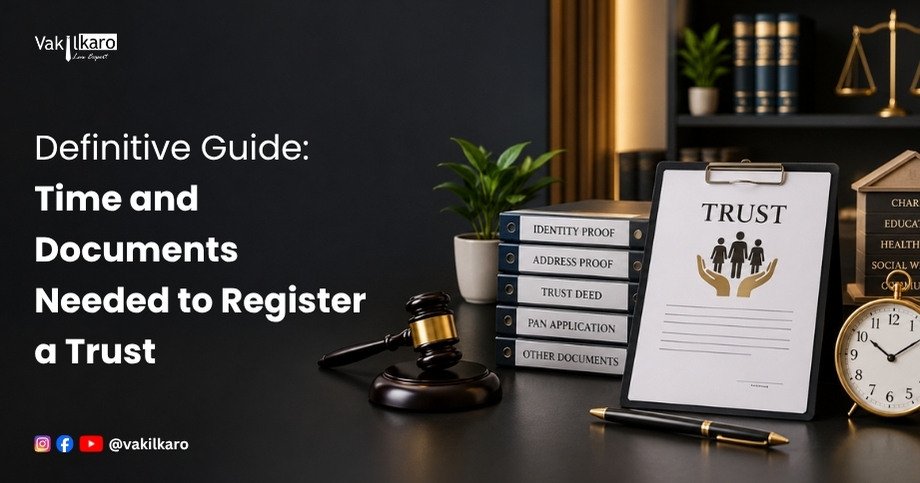
Registering a trust in India typically takes 10 to 30 working days, depending on state regulations, document preparation, and appointment availability. Essential documents include a detailed trust deed, ID and address proof of trustees, office proof, and stamp paper. Post-registration, trusts must apply for PAN, 12A and 80G registration, MSME registration, and NGO Darpan listing to gain tax benefits and government funding eligibility. While trust registration is faster than Section 8 company registration, it lacks centralized processing. Proper planning, documentation, and legal support are key to a smooth NGO registration process under applicable state laws and the Ministry of Corporate Affairs.
Key Takeaways
- Understanding the Time and Documentation Required to Register a Trust in India Establishing a public charitable trust is one of the most efficient ways to begin your nonprofit journey in India.
- The documentation required includes a comprehensive trust deed outlining the purpose and structure of the organization, identity and address proofs of trustees, photographs, office address documents, and in some states, a formal affidavit from trustees.
- For those planning to launch a trust, two of the most frequently asked questions are: How long does it take to register a trust in India? and What are the documents required for trust registration?
- Time Required to Register a Trust in India The process of trust registration can take anywhere from 10 to 30 working days, depending on several factors: State-specific regulations: Since trusts are registered through the local Sub-Registrar or Charity Commissioner, timeframes vary across states.
- By understanding the documents required for trust registration, following proper procedures, and seeking guidance from legal professionals, you can avoid common pitfalls and start your NGO on the right foot.
Understanding the Time and Documentation Required to Register a Trust in India
Establishing a public charitable trust is one of the most efficient ways to begin your nonprofit journey in India. However, prospective founders frequently ask: “How long does it take to register a trust, and what documents are required?” While trust registration is typically quicker than Section 8 company registration, it still requires careful planning and documentation to ensure smooth processing and future eligibility for schemes like 12A and 80G registration, MSME registration, and listings on platforms like NGO Darpan managed by NITI Aayog.
Generally, the timeline for registering a trust ranges between 10 and 30 working days. The duration depends on factors such as state-specific laws, availability of appointments at the Sub-Registrar’s office, and how well-prepared the documentation is. Drafting the trust deed takes around 2–5 days, followed by its execution on stamp paper and signing in front of witnesses. If all documents are in place, the registration process at the Sub-Registrar’s office is typically completed within 1–2 working days. However, obtaining PAN, completing 12A and 80G registrations, MSME enrollment, and NGO Darpan listing can extend the process by an additional 3 to 6 weeks.
The documentation required includes a comprehensive trust deed outlining the purpose and structure of the organization, identity and address proofs of trustees, photographs, office address documents, and in some states, a formal affidavit from trustees. The deed must be executed on non-judicial stamp paper and signed by at least two witnesses.
While trust registration is not governed by the centralized Ministry of Corporate Affairs—unlike Section 8 companies—it remains a legitimate and effective NGO registration method. Founders should ensure full compliance with local requirements and consider legal assistance to streamline the process and enhance the trust’s long-term credibility and operational success.
India’s nonprofit and social impact sector is experiencing significant growth, driven by a rising awareness of social issues, expanding corporate social responsibility (CSR) initiatives, and increased collaboration between the government and civil society. As a result, the demand for formal, transparent, and legally recognized nonprofit entities has never been greater. Among the various options for NGO registration, one of the most accessible and commonly chosen structures is a public charitable trust.
For those planning to launch a trust, two of the most frequently asked questions are: How long does it take to register a trust in India? and What are the documents required for trust registration? Understanding the answers to these questions is crucial. Proper planning ensures the process is smooth, minimizes delays, and facilitates future steps such as obtaining key certifications like 12A and 80G registration for tax exemptions, securing MSME registration for operational benefits, and getting listed on NGO Darpan, a portal managed by NITI Aayog, which is essential for accessing government grants and CSR funds.
This blog delves deep into the timeline and documentation involved in trust registration, shedding light on procedural details that can make or break your compliance journey. Whether you're an individual philanthropist, a group of social entrepreneurs, or an established entity looking to formalize charitable efforts, this guide will walk you through every stage of the process.
We’ll also compare trust registration with other forms of NGO registration—especially Section 8 company registration governed by the Ministry of Corporate Affairs (MCA)—to help you make an informed decision based on your organizational goals, scalability, and legal needs. From preparation to post-registration formalities, this article aims to provide a comprehensive roadmap for registering a trust the right way.
What Is a Trust?
A trust is a legal structure wherein one or more individuals, known as trustees, manage assets or property for the benefit of others, called beneficiaries. This fiduciary relationship is based on a formal agreement—usually a trust deed—that defines the objectives of the trust, the powers and responsibilities of the trustees, and the mechanisms for managing resources. In India, trusts are widely used for nonprofit purposes, especially in sectors like education, healthcare, welfare, and religion.
In the context of NGO registration, a public charitable trust is specifically established to serve public causes and contribute to the common good. These trusts operate on a not-for-profit basis and are created to address key social needs—such as promoting literacy, supporting orphanages, providing medical aid, or uplifting marginalized communities. The trust may also be eligible for 12A and 80G registration, allowing it to enjoy tax benefits and accept tax-deductible donations.
What sets trusts apart from other forms of NGO registration—such as societies or Section 8 companies—is their governance and legal oversight. Private trusts are governed by the Indian Trusts Act, 1882, whereas public charitable trusts are typically registered under relevant state-specific legislation. This means that the registration process, compliance requirements, and operational guidelines for a trust may vary slightly from one state to another, as opposed to the centralized regulation of Section 8 companies by the Ministry of Corporate Affairs (MCA).
Because of their relatively simple structure and fewer compliance hurdles, trusts are often the preferred choice for individuals or small groups who want to start charitable initiatives quickly. However, those seeking to scale nationally or engage in corporate partnerships may opt for a Section 8 company registration for its higher credibility and structured governance.
Time Required to Register a Trust in India
The process of trust registration can take anywhere from 10 to 30 working days, depending on several factors:
- State-specific regulations: Since trusts are registered through the local Sub-Registrar or Charity Commissioner, timeframes vary across states.
- Preparation of Trust Deed: Drafting, notarizing, and signing the trust deed typically takes 2–5 days.
- Appointment scheduling: Registration requires an appointment at the Sub-Registrar's office, which may be subject to availability.
- Document verification and execution: If all documents are in order, the registration itself takes 1–2 days.
- Post-registration processes: Applying for PAN, 12A and 80G registration, MSME registration, and listing on NGO Darpan adds additional time—often 3 to 6 weeks.
While trust registration is generally faster than Section 8 company registration, it lacks the centralized and digitized process offered by the Ministry of Corporate Affairs.
Documents Required for Trust Registration
To initiate NGO registration through a trust, the following documents are typically required:
Trust Deed
This is the foundational legal document outlining the objectives, rules, structure, and operations of the trust. It must include:
- Name and address of the trust
- Objectives and purposes
- Details of the settlor, trustees, and beneficiaries
- Roles and powers of trustees
- Operational framework
Photographs and Identity Proofs
- PAN and Aadhaar of the settlor and trustees
- Passport-size photographs
- Valid address proof (Voter ID, Passport, Driving License)
Registered Office Proof
- Utility bill (not older than 2 months)
- Rent agreement (if the property is rented)
- NOC from the property owner
Stamp Paper
The Trust Deed must be executed on a stamp paper of appropriate value, which varies by state.
Witnesses
Two witnesses are required to sign the Trust Deed during the registration process.
Affidavit or Declaration
Some states may require affidavits from trustees declaring their intention to serve the trust.
Step-by-Step Trust Registration Process
- Drafting the Trust Deed
Engage a legal expert to draft a clear, comprehensive trust deed. This ensures long-term legal protection and smooth regulatory approval.
- Purchase of Stamp Paper
The deed must be printed on non-judicial stamp paper with the value as per state laws.
- Execution and Signing
The settlor and trustees sign the deed in the presence of two witnesses.
- Visit to Sub-Registrar
All parties visit the local Sub-Registrar's office for execution. Biometric and photo identification is required.
- Trust Registration Certificate
Once the documents are verified, the Sub-Registrar provides a certified copy or registration certificate.
Post-Registration Steps
After registration, several steps are necessary to fully operationalize your trust:
- Apply for PAN: A Permanent Account Number is mandatory for financial transactions and applying for tax exemptions.
- 12A and 80G Registration: These are essential for availing income tax exemptions and accepting tax-deductible donations.
- MSME Registration: NGOs engaged in livelihood training, rural entrepreneurship, or product manufacturing can benefit from schemes under MSME.
- NGO Darpan/NITI Aayog Registration: Mandatory for applying for government grants and CSR funds.
Comparison: Trust vs Section 8 Company Registration
Best Practices for Faster Trust Registration
- Ensure complete documentation: Missing paperwork is the top reason for delays.
- Use experienced professionals: Legal experts familiar with NGO registration can expedite the process.
- Book appointments early: Sub-Registrar offices in metro areas may have long wait times.
- Check state-specific rules: Stamp duty, witness requirements, and formats vary across India.
- Digitize your records: Scan all signed documents for online applications like PAN, 12A, MSME, and NGO Darpan.
Final Thoughts
Registering a trust is a practical and relatively quick way to begin your nonprofit journey in India. With timelines ranging from 10 to 30 working days for registration—and a few more weeks for post-registration formalities like 12A and 80G registration, MSME registration, and NGO Darpan listing—it’s essential to prepare thoroughly.
By understanding the documents required for trust registration, following proper procedures, and seeking guidance from legal professionals, you can avoid common pitfalls and start your NGO on the right foot.
If your organization aims to expand nationally or attract CSR funding, you may also explore Section 8 company registration, which, although longer, offers enhanced credibility and regulatory clarity under the Ministry of Corporate Affairs.
Whatever form you choose—trust, society, or Section 8 company—early planning and legal compliance are key to building a strong, sustainable nonprofit organization in India.
Choosing the right legal partner is crucial when navigating the complexities of NGO registration and compliance in India. Vakilkaro offers a comprehensive suite of legal services tailored to meet the unique needs of nonprofit organizations.
Why Choose Vakilkaro for NGO and Legal Services
- Expertise in NGO Registration: Vakilkaro specializes in various forms of NGO registration, including Trusts, Societies, and Section 8 Companies. Their team is well-versed in the nuances of each structure, ensuring that your organization is set up correctly from the start.
- Comprehensive Compliance Support: Beyond initial registration, Vakilkaro assists with obtaining essential certifications such as 12A and 80G registrations, MSME registration, and listing on NGO Darpan managed by NITI Aayog. This holistic approach ensures your NGO meets all regulatory requirements.
- Efficient and Timely Service: Understanding the importance of time in launching social initiatives, Vakilkaro streamlines the registration process, aiming to complete Trust registrations within 10 to 30 working days, depending on state-specific regulations.
- Customized Legal Solutions: Vakilkaro offers tailored legal services that cater to the specific needs of your organization, whether it's drafting a comprehensive Trust Deed, handling documentation for Section 8 company registration, or providing legal advice on compliance matters.
- Transparent Pricing: With clear and upfront pricing, Vakilkaro ensures that you are aware of all costs involved in the registration and compliance processes, avoiding unexpected expenses.
- Dedicated Support: Vakilkaro provides continuous support throughout the registration process and beyond, assisting with annual compliance, tax filings, and any legal challenges that may arise.
By choosing Vakilkaro, you gain a partner committed to facilitating the legal aspects of your nonprofit journey, allowing you to focus on making a meaningful impact.
Official External Resources
Use these primary/official sources to verify rules, forms, fees, timelines and regulatory updates before publication.
Frequently asked questions
Definitive Guide: Time and Documents Needed to Register a Trust+
Understanding the Time and Documentation Required to Register a Trust in India Establishing a public charitable trust is one of the most efficient ways to begin your nonprofit journey in India. For those planning to launch a trust, two of the most frequently asked questions are: How long does it take to register a trust in India? and What are the documents required for trust registration?
