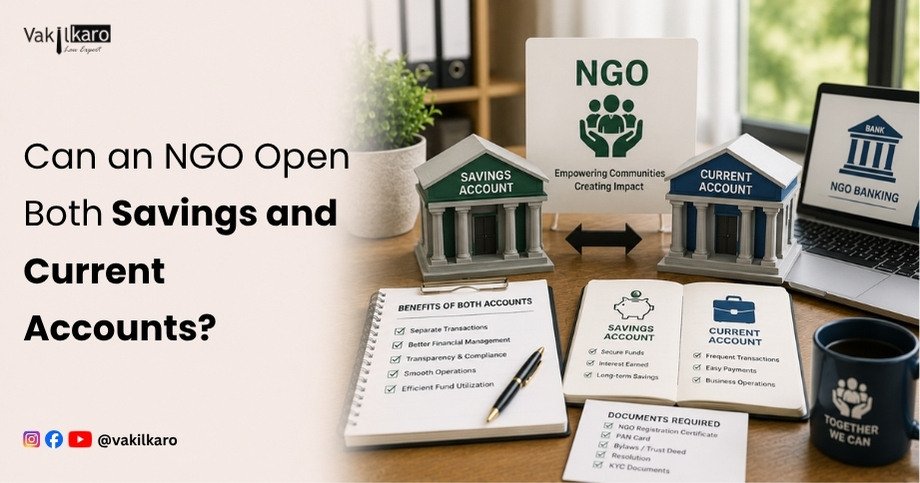
After completing NGO registration, Section 8 Company registration, or even MSME registration, NGOs face a key operational decision: what type of bank accounts should they maintain? Many wonder if having both a savings and a current account is allowed. This blog explores when and why NGOs can operate both, the regulatory expectations involving 12A and 80G registrations, and the importance of maintaining transparency for platforms like NGO Darpan managed by NITI Aayog. We also dive into compliance strategies, banking best practices, and risks NGOs must manage when handling multiple accounts for smooth operations and financial integrity.
Key Takeaways
- Can an NGO Open Both Savings and Current Accounts?
- This blog aims to explore this topic in detail — examining whether NGOs can or should open both savings and current accounts, the legal and practical implications of doing so, the regulatory expectations tied to different types of NGO registrations, and best practices to maintain transparency and financial discipline.
- A very common question among newly registered NGOs, whether through NGO registration, Section 8 Company registration, or even during the MSME registration process, is whether it is permissible to maintain both a savings account and a current account.
- Disclosure of Multiple Accounts: If the NGO operates both savings and current accounts, all must be declared to avoid discrepancies and potential audit flags.
- Conclusion: Strategic Banking for NGOs In summary, while NGOs can indeed open and operate both savings and current accounts, it must be done with clear intent, transparency, and strict regulatory compliance.
Can an NGO Open Both Savings and Current Accounts?
When an NGO completes its formation process through NGO registration, Section 8 Company registration, or secures MSME registration, effective financial management becomes a key operational requirement. A common question among NGO leaders is whether it is possible — or even advisable — for an NGO to maintain both a savings account and a current account simultaneously.
The simple answer is yes, NGOs can open and operate both types of accounts, but it must be approached carefully and with strict adherence to compliance rules. Generally, NGOs are expected to use a current account for day-to-day transactions such as receiving donations, paying vendors, disbursing project funds, and handling administrative expenses. A current account enables unlimited transactions, providing the flexibility required for operational efficiency, and is essential when applying for grants or government collaborations through platforms like NGO Darpan, administered by NITI Aayog.
On the other hand, a savings account can serve specific purposes — for example, holding corpus funds, managing earmarked donations, or retaining surplus funds to earn some interest. However, NGOs must maintain clear separation between operational and reserve funds, and ensure that all transactions are transparent and properly recorded, especially when preparing for 12A and 80G registrations or routine audits.
Regulatory bodies, including the Income Tax Department and the Ministry of Corporate Affairs, expect clear disclosures of all financial activities. Mismanaging multiple accounts or failing to report them correctly during audits can lead to penalties, disqualification from grants, or even the rejection of compliance certifications.
In conclusion, while maintaining both savings and current accounts is allowed for NGOs, doing so requires clear intent, board approval, meticulous accounting, and full compliance with all statutory obligations. Building a strategic banking framework strengthens financial transparency, regulatory trust, and long-term organizational credibility.
When establishing and managing an NGO in India, strong financial planning is essential for ensuring operational success and regulatory compliance. Whether an organization is undergoing NGO registration, forming under Section 8 Company registration, or aiming for further credibility through MSME registration, setting up and managing bank accounts becomes one of the first critical steps.
One common dilemma many NGO founders and management teams encounter is: Can an NGO operate both a savings account and a current account simultaneously? While it may seem like a simple administrative choice, this decision has significant implications for compliance, financial transparency, and long-term sustainability.
Bank account management for NGOs isn't merely about facilitating transactions; it is about establishing an auditable, compliant financial structure that supports grant applications, partnerships, and tax exemptions. Proper banking practices are particularly crucial when applying for important certifications such as 12A registration (for income tax exemption) and 80G registration (to allow donors to claim tax benefits). Additionally, maintaining the right account structure is vital when registering with government platforms like NGO Darpan, managed by NITI Aayog, which opens doors to government grants, partnerships, and public credibility.
This blog aims to explore this topic in detail — examining whether NGOs can or should open both savings and current accounts, the legal and practical implications of doing so, the regulatory expectations tied to different types of NGO registrations, and best practices to maintain transparency and financial discipline. Whether you are in the early stages of forming your NGO or planning to scale operations nationally or internationally, understanding the strategic use of banking accounts is fundamental to achieving operational excellence and donor trust.
Banking Essentials for NGOs
Financial transparency and regulatory compliance form the backbone of any successful NGO. From the moment an NGO completes its legal registration process—whether through NGO registration as a Trust or Society, or Section 8 Company registration under the Companies Act—setting up a proper banking system becomes a top operational priority. Banking is not just a tool for receiving funds and making payments; it is the foundation of trustworthy financial management, transparent reporting, and legal accountability.
After legal incorporation, the very next critical step for any NGO is to open an official bank account in the organization's name. The choice of account type—whether a current account or, in rare cases, a savings account—has direct implications for the NGO’s compliance with statutory requirements, including Income Tax Return (ITR) filings, financial audits, ROC (Registrar of Companies) submissions, and the successful application for tax exemptions like 12A and 80G registration.
For the majority of NGOs, opening a current account is highly recommended and often mandatory. Current accounts are specifically structured to accommodate the high volume of transactions typical of NGOs, including donations, grants, vendor payments, and operational expenses. They align with the professional standards expected by regulatory bodies, grant-giving agencies, and platforms like NGO Darpan, operated by NITI Aayog.
However, there are certain scenarios where maintaining a savings account alongside a current account may be justified. This could include managing corpus funds, handling specific restricted grants, or optimizing interest income on surplus funds not immediately needed for operations.
Understanding when and how to properly operate one or multiple bank accounts is crucial. It not only ensures seamless financial operations but also strengthens the NGO’s credibility, donor confidence, and eligibility for government collaborations and grants. In the sections ahead, we will explore these considerations in much greater depth.
Understanding Savings and Current Accounts
Before choosing the right banking structure for an NGO, it is essential to clearly understand the basic features, advantages, and limitations of savings accounts and current accounts. Both serve important purposes but are designed for different types of users and transaction patterns, which can have a direct impact on an NGO’s financial operations, compliance, and credibility.
Savings Account
A savings account is primarily intended for individuals or entities that wish to store money securely while earning modest interest on their deposits. The primary goal of a savings account is to encourage and facilitate the habit of saving. Key features include:
- Interest Earnings: Savings accounts offer a nominal interest rate, which helps individuals grow their idle funds modestly over time.
- Limited Transactions: Banks typically impose restrictions on the number of free transactions—withdrawals, deposits, or fund transfers—allowed per month. Beyond the limit, charges may apply.
- Lower Minimum Balance Requirements: Compared to current accounts, savings accounts generally require maintaining a lower average balance.
- Personal Financial Management: These accounts are best suited for personal, low-volume financial activity rather than the heavy, continuous operations of an organizational entity.
For NGOs, especially those that are scaling operations, managing frequent donations, grants, and project payments, a savings account’s transaction limitations make it impractical for everyday use.
Current Account
In contrast, a current account is specifically designed for businesses, companies, trusts, societies, and NGOs. It is built to support the high volume of daily financial transactions that operational entities require. Key characteristics include:
- Unlimited Transactions: NGOs can make unlimited withdrawals, deposits, and fund transfers without restrictions, ensuring operational efficiency.
- No or Minimal Interest: Typically, current accounts do not offer interest on balances as their primary purpose is to facilitate business or organizational operations, not savings.
- Higher Minimum Balance: Banks often require a higher minimum balance for current accounts, reflecting their business-focused nature.
- Professional Financial Management: Maintaining a current account demonstrates financial professionalism, which is critical when applying for 12A and 80G registration, NGO Darpan verification under NITI Aayog, or securing large grants and corporate CSR funds.
Opening a current account aligns an NGO’s financial practices with regulatory expectations, improves audit readiness, and strengthens credibility among donors, partners, and government bodies.
Are NGOs Allowed to Open Both Types of Accounts?
A very common question among newly registered NGOs, whether through NGO registration, Section 8 Company registration, or even during the MSME registration process, is whether it is permissible to maintain both a savings account and a current account. The answer is: Yes, NGOs are legally allowed to open and operate multiple bank accounts, but certain conditions, compliance norms, and best practices must be strictly followed.
Primary Account: Mandatory Current Account for Operations
Every NGO must have at least one primary current account that serves as the official channel for:
- Receiving donations and grants from individuals, CSR entities, and government bodies.
- Disbursing funds for project expenses, salaries, vendor payments, and administrative costs.
- Managing routine transactions that support the day-to-day operations of the NGO.
A current account provides the operational flexibility needed for frequent and high-volume financial activities and ensures that the NGO remains compliant with regulatory bodies, including those overseeing 12A and 80G registrations and NGO Darpan certifications under NITI Aayog.
Secondary Account: Savings Account for Specific Purposes
In addition to the current account, NGOs may open a savings account for specialized financial purposes, such as:
- Corpus Funds: These are permanent funds where the principal amount remains intact and only the interest is used for the organization’s objectives. Parking corpus funds in a savings account can help earn modest interest while safeguarding the capital.
- Earmarked Funds: Funds designated for specific projects (like scholarships, relief work, health camps) can be held separately in a savings account for easier tracking and reporting.
- Restricted Use Grants: Some grants come with strict usage conditions, and opening a separate savings account for such grants ensures clean audits and accountability.
However, while maintaining multiple accounts, NGOs must ensure:
- Clear Separation of Funds: Operational money and earmarked/corpus funds should never mix.
- Proper Accounting Practices: Each account must have its own ledger entries and be reconciled separately during audits.
- Transparent Disclosures: All accounts must be properly declared during statutory filings, including during ROC annual returns, 12A/80G compliance processes, and NGO Darpan profile updates.
Maintaining multiple accounts without proper internal control and transparency could invite regulatory scrutiny and may even affect the NGO's eligibility for government grants, CSR partnerships, and tax exemptions.
Regulatory Expectations and Compliance
Managing multiple bank accounts—whether a savings account, current account, or both—is not simply an internal choice for NGOs; it is closely tied to regulatory expectations under various frameworks. Proper financial management, transparency, and disclosure are mandatory under Indian laws, and failure to comply can result in penalties, disqualification from grants, or even cancellation of tax exemptions.
Let's break down the regulatory landscape across different registration types:
Section 8 Company Registration
NGOs registered as Section 8 Companies under the Companies Act, 2013 are considered corporate entities created for promoting charitable purposes. With this status comes strict financial responsibilities, including:
- Operating Primarily Through a Current Account: Section 8 Companies must manage all financial transactions—donations, grants, payments—through a professional current account to reflect commercial discipline.
- Audited Financial Statements: All financial activities must be recorded accurately and presented in audited financial reports filed annually with the Registrar of Companies (ROC).
- Full Disclosure of Banking Activities: All accounts held by the NGO must be disclosed during ROC filings and annual returns, ensuring complete transparency with regulatory authorities.
Maintaining a savings account for specific purposes is permitted but must be transparently disclosed and properly accounted for.
NGO Registration (Trusts and Societies)
For NGOs registered as Trusts or Societies, the financial expectations are slightly more flexible in the beginning:
- Savings Account for Initial Activities: In the early stages, a savings account may suffice for basic operations if transaction volumes are low.
- Transition to Current Account: As the NGO grows, receives larger grants, or seeks public partnerships, shifting to a current account becomes essential to maintain regulatory and donor credibility.
NGO Darpan and NITI Aayog
NGO Darpan, operated by NITI Aayog, serves as the government’s official portal for NGOs seeking grants, partnerships, and public listing. For NGOs registering on NGO Darpan:
- Current Account Details Are Mandatory: NGOs must submit verified details of their official current account.
- Transparent Fund Tracking: All financial activities must be recorded in a manner that can be easily tracked and verified during audits.
- Disclosure of Multiple Accounts: If the NGO operates both savings and current accounts, all must be declared to avoid discrepancies and potential audit flags.
Failure to disclose full banking details can result in rejection of the NGO Darpan registration or future grant applications.
12A and 80G Registration
12A registration provides NGOs with exemption from income tax, while 80G registration allows donors to claim tax deductions. When applying for these certifications:
- Financial Clarity Is Critical: The NGO must demonstrate that funds received (whether in a current or savings account) are being utilized exclusively for charitable purposes.
- Separate Ledgers for Each Account: If multiple bank accounts exist, clear ledgers and fund flow statements must be maintained separately.
- Documentation Standards: Savings accounts used for corpus funds must still follow strict documentation, including donation receipts, board approvals, and usage guidelines.
MSME Registration
NGOs operating as social enterprises may also register under MSME (Micro, Small and Medium Enterprises) to access government benefits. To comply with MSME standards:
- Current Account Is Preferable: Demonstrating business-like, transparent financial practices is essential, which aligns with operating through a current account.
- Clean Bank Statements: For audits, subsidy applications, and credit approvals, NGOs must produce clear, clean, and separated bank records for all operational and corpus activities.
When Should an NGO Operate Both a Savings and a Current Account?
While maintaining a current account is generally mandatory for NGOs to manage regular donations, project expenses, and day-to-day transactions, there are strategic scenarios where having a savings account alongside the current account becomes not just advisable but beneficial. However, this must be done with clear purpose, strict accounting practices, and full regulatory compliance.
Here are key situations where an NGO should consider operating both accounts:
Managing Corpus Funds
Corpus donations are funds donated with the specific intent that the principal amount remains untouched and only the interest earned is used to fund activities.
- A savings account can securely hold corpus donations, allowing the NGO to earn modest interest while safeguarding the principal amount.
- Meanwhile, operational expenses are handled through the current account, ensuring there is no mix-up between reserve and operational funds.
- This practice also strengthens financial audits, particularly during 12A and 80G registration scrutiny and NGO Darpan verifications.
Handling Specific Projects
Some donors or grant-making agencies may impose conditions requiring that funds be used strictly for specific projects (such as building a school, running a health camp, or operating a scholarship fund).
- Setting up a separate savings account to manage such earmarked donations makes it easier to track fund usage, simplify reporting, and maintain donor trust.
- This method also supports clean fund audits, a critical requirement for government partnerships under NITI Aayog initiatives.
Strategic Financial Planning
At times, NGOs may accumulate surplus funds that are not immediately needed for ongoing projects.
- Parking these reserve funds in a savings account provides a buffer for future operational stability, particularly useful during funding gaps or emergencies.
- It also demonstrates responsible financial stewardship to both donors and regulatory authorities.
Maximizing Financial Returns
Idle funds sitting in a current account do not earn interest.
- Temporarily moving surplus operational funds to a savings account ensures that the NGO maximizes returns on idle balances without exposing the principal amount to risk.
- However, care must be taken to document such transfers transparently in the NGO's books and during financial reporting.
Facilitating Donor Requirements
In specific cases, large corporate donors, CSR contributors, or international grant bodies may request that their grants be handled through a dedicated bank account.
- Opening a project-specific savings account enables NGOs to segregate funds, demonstrate exclusive usage, and streamline donor audits.
- This approach is particularly useful when applying for larger grants or partnerships post-MSME registration or while working with government agencies via NGO Darpan listings.
In all these cases, the guiding principle must be financial transparency, segregation of funds, and proper accounting.
Operating both accounts can strengthen the NGO’s financial credibility, improve compliance outcomes, and provide a flexible structure for responsible financial management — provided the organization adheres to strict internal controls and disclosure norms.
Key Rules to Follow When Maintaining Multiple Accounts
While NGOs are permitted to maintain both current and savings accounts for different operational and strategic needs, it is critical that this practice is approached with a strong foundation of financial discipline, transparency, and regulatory compliance. Poorly managed multiple accounts can result in audit red flags, penalties, or even loss of donor confidence. To ensure smooth operations, NGOs must follow these key rules:
No Commingling of Funds
Under no circumstances should personal funds or personal transactions of trustees, board members, or employees be mixed with the organization’s bank accounts.
- Organizational accounts must be kept entirely separate from personal banking activities.
- Mixing personal and organizational funds can raise serious compliance concerns during audits for 12A and 80G registration and may affect credibility with platforms like NGO Darpan under NITI Aayog.
Clear Purpose for Each Account
Each bank account opened by the NGO must have a specific, auditable purpose:
- A current account should be used exclusively for operational expenses, donations, and project payments.
- A savings account could be reserved for corpus funds, specific grant tracking, or designated project funds. Clearly defining the purpose ensures that funds are used as intended and simplifies financial reporting.
Proper Record Keeping
Maintaining separate ledgers and accurate books of accounts for each bank account is essential:
- All inflows (donations, grants) and outflows (payments, disbursements) must be properly recorded against the correct account.
- During audits, clear documentation must be available to demonstrate fund usage, especially for Section 8 Company ROC filings or Income Taxassessments.
Transparent Disclosures
All bank accounts operated by the NGO must be fully disclosed in:
- Annual audit reports
- Income tax returns
- NGO Darpan registrations and updates
- ROC (Registrar of Companies) filings for Section 8 Companies Failure to disclose multiple accounts can result in regulatory penalties or rejection of important certifications like 12A and 80G.
Strong Internal Controls
The opening, operating, and closure of any bank account must be authorized through formal Board Resolutions:
- Board meeting minutes must clearly record the decision to open an account, appoint authorized signatories, and define usage policies.
- Changes in account operation (adding/removing signatories, closing an account) should also be properly approved and documented. Strong internal governance strengthens the NGO’s financial reputation and supports compliance during MSME registration and government collaborations.
Practical Tips for NGOs Operating Multiple Accounts
- Board Resolutions: Approve account operations formally.
- Periodic Reconciliation: Monthly reconciling of bank statements with books.
- Financial Policies: Draft clear internal financial policies for banking operations.
- Compliance Audit: Conduct regular compliance audits to ensure all financial norms are met.
- Professional Accounting: Hire a professional accountant familiar with NGO financial regulations.
Risks of Mismanaging Multiple Accounts
- Audit Penalties: Failure to properly account for multiple accounts can attract audit penalties.
- Disqualification: Mistakes in bank account disclosure can lead to rejection of NGO Darpan, 12A, or 80G applications.
- Loss of Credibility: Poor financial management can erode donor and stakeholder trust.
- Tax Issues: Mismanagement can trigger scrutiny from the Income Tax Department.
Conclusion: Strategic Banking for NGOs
In summary, while NGOs can indeed open and operate both savings and current accounts, it must be done with clear intent, transparency, and strict regulatory compliance.
For daily operations, donations, project funding, and compliance with government and tax authorities, a current account is non-negotiable. A savings account can be an additional tool for managing special purpose funds, corpus donations, or strategic financial reserves.
Any NGO looking to scale, attract larger donations, participate in government initiatives via NGO Darpan under NITI Aayog, or achieve financial excellence under MSME registration, must build a banking strategy based on discipline and transparency.
By maintaining clear policies, obtaining board approvals, and disclosing all financial activities appropriately, NGOs can operate multiple accounts successfully while building a sustainable, compliant, and credible organization.
Official External Resources
Use these primary/official sources to verify rules, forms, fees, timelines and regulatory updates before publication.
Frequently asked questions
Can an NGO Open Both Savings and Current Accounts?+
Can an NGO Open Both Savings and Current Accounts? This blog aims to explore this topic in detail — examining whether NGOs can or should open both savings and current accounts, the legal and practical implications of doing so, the regulatory expectations tied to different types of NGO registrations, and best practices to maintain transparency and financial discipline.
