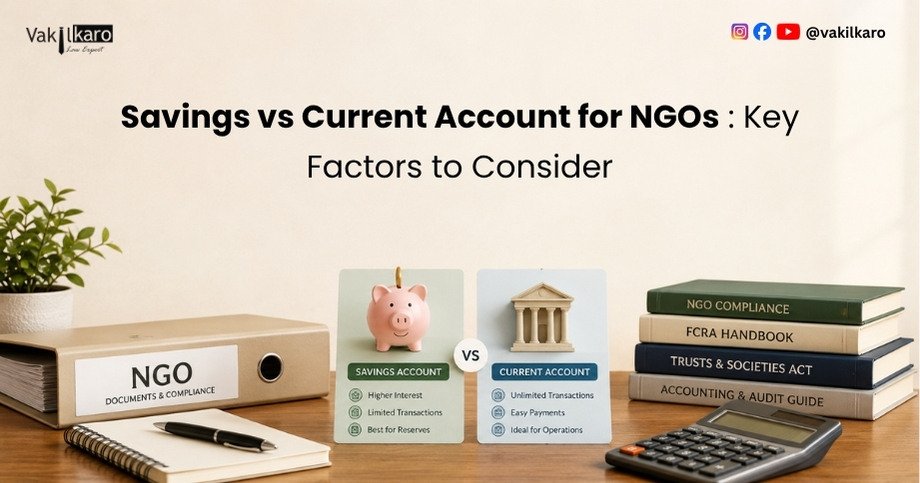
When starting and running an NGO in India, sound financial decisions are key to sustainable operations. After completing NGO registration, Section 8 Company registration, or MSME registration, NGOs must carefully choose between opening a savings account or a current account. This decision impacts transaction handling, regulatory compliance for 12A and 80G registration, and NGO Darpan requirements under NITI Aayog. In this blog, we’ll explore important factors NGOs must consider when selecting the right type of bank account to ensure smooth financial management, transparency, credibility, and long-term success in the nonprofit sector.
Key Takeaways
- After completing NGO registration, Section 8 Company registration, or MSME registration, NGOs must carefully choose between opening a savings account or a current account.
- Choosing the Right Bank Account for Your NGO: Key Factors to Consider When establishing and operating an NGO in India, one of the first crucial financial decisions involves selecting the appropriate type of bank account.
- In this detailed guide, we will explore the vital factors NGOs must evaluate when deciding between a savings account and a current account.
- Factors to Consider When Choosing Between a Savings and a Current Account 1.
- Key Insight: NGOs aiming for NGO Darpan registration or working with government schemes under NITI Aayog typically require a current account to handle increased transaction volumes professionally.
Choosing the Right Bank Account for Your NGO: Key Factors to Consider
When establishing and operating an NGO in India, one of the first crucial financial decisions involves selecting the appropriate type of bank account. After completing formalities such as NGO registration, Section 8 Company registration, or MSME registration, choosing between a savings account and a current account becomes critical for seamless operations and future growth.
Financial management is a foundation for NGO success, impacting not just daily transactions but also eligibility for tax exemptions like 12A registration, donor benefits under 80G registration, and transparent reporting on platforms like NGO Darpan governed by NITI Aayog. Thus, this decision must be made thoughtfully.
A savings account is traditionally meant for individuals and encourages saving by offering interest on deposits, but it limits the number of free transactions. This makes it suitable only for very small NGOs with minimal financial activity in their early stages. However, as an NGO scales up and begins managing larger grants, donations, and project funds, these limitations can become a hindrance.
On the other hand, a current account is specifically designed for businesses, NGOs, and organizations handling frequent and high-volume transactions. Current accounts provide unlimited transaction capabilities and enable smoother financial operations without restrictions, although they usually do not offer interest on deposits.
Key considerations when making the choice include the NGO’s size, the expected volume of transactions, future fundraising goals, and compliance requirements. NGOs aiming for 12A/80G registration or planning to work with government agencies through NGO Darpan should prioritize opening a current account from the outset.
Ultimately, selecting the right account structure supports better compliance, financial transparency, audit readiness, and credibility with donors and stakeholders. By aligning banking decisions with operational goals, NGOs can build a solid foundation for long-term impact and regulatory excellence.
Starting and operating an NGO in India involves much more than simply completing the basic legal formalities like NGO registration, Section 8 Company registration, or MSME registration for social enterprises. One of the most critical aspects that follows is setting up a sound financial management system. Among the very first financial decisions NGOs must make is choosing the correct type of bank account to support their operations.
The choice between opening a savings account or a current account is not merely a banking formality—it is a strategic decision that directly impacts the NGO’s day-to-day financial transactions, legal compliance, fundraising potential, and overall credibility. The nature of the bank account determines how easily the organization can manage donations, grants, project funding, and operational expenses. More importantly, it affects the NGO's ability to comply with essential statutory requirements, such as those under 12A and 80G registrations, which provide tax exemptions and benefits to the organization and its donors.
Additionally, transparency is key in the nonprofit sector. Registration and listing on platforms like NGO Darpan, governed by NITI Aayog, require NGOs to maintain clear, auditable financial records. Banks accounts, especially current accounts, play a central role in ensuring that the NGO's financial dealings remain transparent and in line with government and donor expectations.
In this detailed guide, we will explore the vital factors NGOs must evaluate when deciding between a savings account and a current account. We’ll cover operational needs, compliance demands, regulatory frameworks, and strategic growth considerations—equipping NGOs with the insights needed to make a decision that supports their mission, enhances credibility, and ensures regulatory excellence.
Understanding the Basics: Savings vs. Current Account
Before diving into decision factors, it’s important to understand the fundamental difference:
- Savings Account: Intended primarily for individuals, offering interest on deposits but limiting the number of free transactions per month.
- Current Account: Designed for businesses, NGOs, and other entities that require unlimited transactions. It typically offers no interest but provides seamless financial operations.
Factors to Consider When Choosing Between a Savings and a Current Account
Nature and Volume of Transactions
One of the first factors to assess is the expected number and size of transactions. NGOs engaged in large projects, frequent donations, grants, or multiple disbursements must operate through a current account to facilitate unlimited transactions without penalties.
On the other hand, smaller NGOs with limited transactions might initially manage with a savings account, but must transition to a current account as operations expand.
Key Insight: NGOs aiming for NGO Darpan registration or working with government schemes under NITI Aayog typically require a current account to handle increased transaction volumes professionally.
Type of NGO Registration
The type of NGO registration directly influences banking choices:
- Section 8 Company Registration: Mandates opening a current account as part of compliance with the Companies Act, 2013.
- Trusts and Societies: While savings accounts may be permitted initially, serious operations require a transition to current accounts for managing donations and grants.
Important Tip: Section 8 Companies must report banking information during annual ROC filings, and a current account streamlines this process.
Requirement for 12A and 80G Registration
NGOs seeking 12A registration for income tax exemption and 80G registration to offer tax benefits to donors must demonstrate financial transparency.
Maintaining a current account:
- Shows professional fund management
- Makes it easier for auditors to verify fund sources and uses
- Strengthens the case for 12A/80G approval
Savings accounts, due to their limited transparency and potential for personal-style use, are often discouraged.
Future Fundraising Plans
If an NGO plans to:
- Raise corporate donations (CSR funding)
- Receive government grants
- Partner with international agencies
...then having a current account is essential.
Large donors often scrutinize banking practices. A savings account could suggest amateur management, undermining credibility and potential funding opportunities.
Separate Fund Management Needs
Sometimes, NGOs receive:
- Corpus funds (permanent donations)
- Earmarked project-specific grants
- Scholarship or endowment funds
In such cases, maintaining a savings account in addition to a current account can be beneficial:
- Corpus and restricted funds can be stored in savings accounts to earn interest.
- Operational funds can be managed through the current account.
This separation supports clear fund tracking during audits and compliance inspections under 12A, 80G, and NGO Darpan standards.
Regulatory Compliance with NGO Darpan and NITI Aayog
NGO Darpan registration under NITI Aayog requires NGOs to submit detailed financial information, including bank account details.
- Current accounts are preferred because they reflect organizational professionalism.
- NGOs with only savings accounts often face additional scrutiny or registration delays.
Maintaining a current account ensures smooth registration and better eligibility for government schemes and grants.
Operational Professionalism and Audit Readiness
An NGO that wishes to maintain high standards of:
- Professionalism
- Audit-readiness
- Financial discipline
...must operate a current account.
Savings accounts can muddy audit trails due to restricted transactions and blended personal/organizational usage, which could result in adverse audit remarks or compliance failures.
Eligibility for MSME Registration Benefits
Today, many NGOs, especially social enterprises, are opting for MSME registration to access government incentives, subsidies, and grants.
MSME registered NGOs are expected to demonstrate:
- Clean, auditable banking practices
- Business-like fund management
- Clear operational segregation of funds
Having a current account strengthens their application and eligibility for MSME benefits.
Practical Scenarios: Which Account to Choose?
Scenario Recommended Account
Newly formed, grassroots NGO with few transactions Savings Account (initially)
NGO applying for 12A/80G registration Current Account
NGO registered as Section 8 Company Current Account (mandatory)
NGO managing corpus funds Both Savings and Current Accounts
NGO fundraising for multiple projects Current Account
NGO registering on NGO Darpan Current Account strongly recommended
NGO applying for MSME registration Current Account
Common Mistakes NGOs Should Avoid
- Mixing personal and organizational funds: Especially in savings accounts, causing audit risks.
- Delaying the shift from savings to current account: Missing out on compliance benefits.
- Lack of Board Resolutions: Every new account should be approved by the NGO’s governing board.
- Non-disclosure of multiple accounts: Particularly risky when applying for 12A/80G, NGO Darpan, or MSME registration.
Best Practices for NGOs While Managing Bank Accounts
- Define Clear Purposes: Each account must have a clearly documented role—operational, corpus, scholarship fund, etc.
- Maintain Separate Ledgers: Track transactions per account meticulously.
- Board Oversight: Regularly review account usage during board meetings.
- Timely Reconciliation: Match bank statements with internal books monthly.
- Transparent Disclosures: Declare all accounts during statutory filings and registrations.
- Policy Documentation: Have internal policies for fund usage, transfers, and interest allocation.
Conclusion
Choosing between a savings account and a current account for an NGO is not just a banking decision—it is a strategic financial and compliance decision that affects every aspect of the NGO’s growth, credibility, and funding potential.
In most cases, NGOs must prioritize opening a current account immediately after completing NGO registration or Section 8 Company registration. For specific situations like managing corpus funds or restricted project donations, maintaining an additional savings account may be appropriate.
Properly managed, these accounts help NGOs easily comply with 12A and 80G registration requirements, smoothly register on platforms like NGO Darpan under NITI Aayog, qualify for MSME benefits, and build long-term financial resilience.
Ultimately, by making informed banking choices, NGOs can strengthen their operational foundation, attract greater donor trust, and amplify their social impact sustainably and transparently.
Official External Resources
Use these primary/official sources to verify rules, forms, fees, timelines and regulatory updates before publication.
Frequently asked questions
Savings vs Current Account for NGOs: Key Factors to Consider+
After completing NGO registration, Section 8 Company registration, or MSME registration, NGOs must carefully choose between opening a savings account or a current account. In this detailed guide, we will explore the vital factors NGOs must evaluate when deciding between a savings account and a current account.
